Scientists Discover Gold Clusters Stabilize Platinum Electrocatalysts For Use in Fuel Cells
January 12, 2007
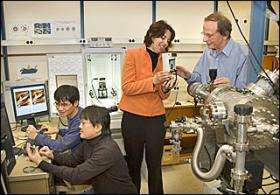
(Clockwise) Brookhaven Lab researchers Kotaro Sasaki, Junliang Zhang, Eli Sutter and Radoslav Adzic view gold clusters on a single-crystal platinum surface using a scanning tunneling microscope.
Platinum is the most efficient electrocatalyst for accelerating chemical reactions in fuel cells for electric vehicles. In reactions during the stop-and-go driving of an electric car, however, the platinum dissolves, which reduces its efficiency as a catalyst. This is a major impediment for vehicle-application of fuel cells.
Now, scientists at the U.S. Department of Energy's Brookhaven National Laboratory have overcome this problem. Under lab conditions that imitate the environment of a fuel cell, the researchers added gold clusters to the platinum electrocatalyst, which kept it intact during an accelerated stability test. This test is conducted under conditions similar to those encountered in stop-and-go driving in an electric car. The research is reported in the January 12, 2007, edition of the journal Science.
Brookhaven's Chemistry Department researchers Junliang Zhang, Kotaro Sasaki, and Radoslav Adzic, along with Eli Sutter from Brookhaven's Center for Functional Nanomaterials, authored the research paper. "Fuel cells are expected to become a major source of clean energy, with particularly important applications in transportation," said coauthor Radoslav Adzic. "Despite many advances, however, existing fuel-cell technology still has drawbacks, including loss of platinum cathode electrocatalysts, which can be as much as 45 percent over five days, as shown in our accelerated stability test under potential cycling conditions. Using a new technique that we developed to deposit gold atoms on platinum, our team was able to show promise in helping to resolve this problem. The next step is to duplicate results in real fuel cells."
A hydrogen-oxygen fuel cell converts hydrogen and oxygen into water and, as part of the process, produces electricity. Platinum electrocatalysts speed up oxidation and reduction reactions. Hydrogen is oxidized when electrons are released and hydrogen ions are formed; the released electrons supply current for an electric motor. Oxygen is reduced by gaining electrons, and in reaction with hydrogen ions, water, the only byproduct of a fuel cell reaction, is produced.
In the unique method developed at Brookhaven, the researchers displaced a single layer of copper with gold on carbon-supported platinum nanoparticles. After being subjected to several sweeps of 1.2 volts, the gold monolayer transformed into three-dimensional clusters. Using x-rays as probes at Brookhaven's National Synchrotron Light Source, a scanning transmission microscope at Brookhaven's Center for Functional Nanomaterials, and electrochemical techniques in the laboratory, the scientists were able to verify the reduced oxidation of platinum and to determine the structure of the resulting platinum electrocatalyst with gold clusters, which helped them to gain an understanding of the effects of the gold clusters.
In the Brookhaven experiment, the platinum electrocatalyst remained stable with potential cycling between 0.6 and 1.1 volts in over 30,000 oxidation-reduction cycles, imitating the conditions of stop-and-go driving. "The gold clusters protected the platinum from being oxidized," Adzic said. "Our team's research raises promising possibilities for synthesizing improved platinum-based catalysts and for stabilizing platinum and platinum-group metals under cycling oxidation/reduction conditions."
Source: Brookhaven National Laboratory
-
Tiny battery is also a nanomotor
Oct 19, 2011 |
4.4 / 5 (7) |
0
-
Quebec unveils $80 bln plan for undeveloped north
May 10, 2011 |
5 / 5 (2) |
3
-
Say hello to cheaper hydrogen fuel cells: Scientists document utility of non-precious-metal catalysts
Apr 21, 2011 |
4.7 / 5 (15) |
5
-
The fine art of producing chemicals and electricity: Researchers develop organometallic fuel cell
Dec 16, 2010 |
5 / 5 (6) |
0
-
Novel fuel cell catalyst lowers need for precious metal
Nov 23, 2010 |
4.7 / 5 (3) |
2
-
Engineers build first sub-10-nm carbon nanotube transistor
Feb 01, 2012 |
4.9 / 5 (31) |
30
-
Something old, something new: Evolution and the structural divergence of duplicate genes
Jan 31, 2012 |
4.6 / 5 (7) |
1
-
The hidden nanoworld of ice crystals: Revealing the dynamic behavior of quasi-liquid layers
Jan 30, 2012 |
5 / 5 (3) |
1
-
Stock market network reveals investor clustering
Jan 27, 2012 |
3.9 / 5 (23) |
8
-
Of microchemistry and molecules: Electronic microfluidic device synthesizes biocompatible probes
Jan 26, 2012 |
5 / 5 (1) |
0
-
Questions about Equivalence principle & Einstein Elevator?
2 hours ago
-
Kinetic energy of gas
4 hours ago
-
Understanding induced emfs
6 hours ago
-
What is the precise definition of a year?
7 hours ago
-
Universe as a cellular automaton
8 hours ago
-
Question about Newton's laws
9 hours ago
- More from Physics Forums - General Physics
More news stories
Explained: Sigma
It's a question that arises with virtually every major new finding in science or medicine: What makes a result reliable enough to be taken seriously? The answer has to do with statistical significance -- but ...
Feb 09, 2012 |
5 / 5 (19) |
66
Quantum physicist explains $100K offer for proof scaled-up quantum computing is impossible
(PhysOrg.com) -- MIT researcher Scott Aaronson has certainly riled the physics community with his offer this past Friday, of $100,000 to anyone who can prove that scaled-up quantum computing is impossible. ...
Diamond light, brighter than the sun
Its the size of five football pitches and generates light 10 billion times brighter than the sun. As the Diamond Light Source celebrates its tenth anniversary this year, Penny Bailey visits one of the ...
Feb 07, 2012 |
4.3 / 5 (7) |
17
|
Physicists 'record' magnetic breakthrough
An international team of scientists has demonstrated a revolutionary new way of magnetic recording which will allow information to be processed hundreds of times faster than by current hard drive technology.
Feb 07, 2012 |
4.5 / 5 (41) |
14
|
Hints of the Higgs - papers are submitted
Back in December 2011, the ATLAS and CMS experiments at CERN presented some exciting results that provided tantalising hints of the Higgs boson.
Feb 08, 2012 |
4.1 / 5 (7) |
10
Walney offshore wind farm is world's biggest (for now)
(PhysOrg.com) -- The Walney wind farm on the Irish Sea--characterized by high tides, waves and windy weather--officially opened this week. The farm is treated in the press as a very big deal as the Walney ...
GPS court ruling leaves US phone tracking unclear
A US Supreme Court decision requiring a warrant to place a GPS device on the car of a criminal suspect leaves unresolved the bigger issue of police tracking using mobile phones, legal experts say.
Europeans protest controversial Internet pact
Tens of thousands of people marched in protests in more than a dozen European cities Saturday against a controversial anti-online piracy pact that critics say could curtail Internet freedom.
Europe stakes billion-dollar bet on new rocket
A pencil-slim rocket is scheduled to lift into space from South America on Monday, carrying a billion-dollar bet that Europe can grab a juicy slice of the market to place satellites in low orbit.
Study finds that anti-diabetic medication can prevent the long-term effects of maternal obesity
In a study to be presented today at the Society for Maternal-Fetal Medicine's annual meeting, The Pregnancy Meeting, in Dallas, Texas, researchers will report findings that show that short therapy with the anti-diabetic medication ...
Netflix settlement trims 14 pct off 4Q earnings
(AP) -- Netflix pressed the rewind button on its fourth-quarter earnings after settling allegations that the video subscription service violated a consumer-privacy law.