Harnessing the heating - and cooling - powers of the sun
Imagine heat radiating from the walls of your home on a cold winter night, or the glass in your home's windows emitting cool temperatures on a scorching summer afternoon. Now imagine these systems operating on an endless supply of affordable energy – the sun. Three years ago a team of Rensselaer Polytechnic Institute researchers began developing an "intelligent" heating and cooling system that made these seemingly too-good-to-be-true scenarios a possibility.
Today the same team is exploring the likelihood of increasing the system's efficiency and adaptability by reducing it to the micrometer scale. A $300,000, three-year grant from the National Science Foundation will fund the research.
Developed by Steven Van Dessel, assistant professor of architecture at Rensselaer, the patented Active Building Envelope (ABE) system uses a photovoltaic (PV) system to collect and convert sunlight into electricity. That power is then delivered to a series of thermoelectric (TE) heat-pumps that are integrated into a building envelope (the walls, windows, and roof). Depending on the direction of the electric current supplied to the TE heat-pump system, the sun's energy can actively be used to make the inside space warmer or cooler. An energy storage mechanism is also integrated to collect extra energy for use when little or no sunlight is available.
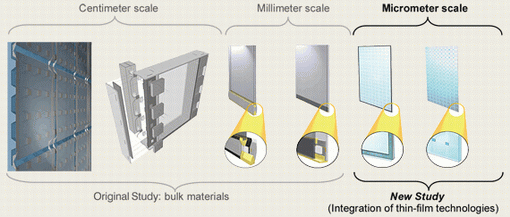
The original ABE system uses solar-panels placed on the outside walls or roof of a building. TE heat-pumps approximately one square inch in size are dispersed throughout the building's envelope. Since this system is made up of bulk materials, its implementation can be costly and impractical. Additionally, the ABE system can only be applied to new construction projects, as the TE devices need to be placed inside the building's walls, windows, and roof.
Downsizing the ABE System
Currently, Van Dessel is leading a team of Rensselaer researchers that includes Achille Messac, professor of mechanical, aerospace, and nuclear engineering (MANE), and students in Rensselaer's architecture and MANE programs, to investigate the potential of ABE systems operating on the micrometer scale. The miniaturized system would function in a similar fashion to the original, but would use thin-film photovoltaic and thin-film thermoelectric materials instead of bulk components. The use of thin-film technologies could potentially result in extremely thin (less than 500 µm) ABE-surfaces. The very fine, transparent material would function as a thermal coating system that could be applied on to various surfaces, much like a glaze. This ease of application would make it possible to seamlessly apply the system to both new and existing building surfaces, rendering conventional air conditioning and heating equipment obsolete, according to Van Dessel.
"Applying the glaze-like system to selected parts of a building's envelope creates the ability to control the temperature of internal surfaces, which in turn, regulates the indoor temperature. Essentially, internal surfaces could become warm in the winter and cool in the summer." says Van Dessel. "Additionally, because the thin-film ABE technologies are based on solid-state materials, they are completely silent and virtually maintenance free."
Van Dessel notes that the creation of an ABE system on the micrometer scale gives way to a new class of materials whose thermal conductivity would no longer be determined by thickness alone. Instead, these materials would interact with their environment to direct and control the flow of energy. He says that, in theory, future ABE systems operating at such a small scale will likely outperform the bulk systems both in cost and efficiency.
Solar-Powered Spaceships, Sunroofs, and Soda Bottles
According to Van Dessel the thin-film solar technology lends itself to applications spanning far beyond the construction industry.
"The ABE system could potentially be useful in the development of advanced thermal control systems for use in future space missions for the aerospace industry," says Van Dessel. "And the automotive industry could apply the thin-film ABE system onto windshields and sun roofs, giving them the ability to heat or cool the interior of an automobile depending on outside conditions." He also envisions creating packaging materials using the ABE system for thermal control – think a self-cooling soda bottle.
A self-heating and cooling prototype of the original ABE system resides on the roof of the Student Union at Rensselaer Polytechnic Institute. The new NSF grant will allow for the design and optimization of a prototype of the system on the micrometer scale. In conjunction with recent advances in the area of nanotechnology and biotechnology, this research may also open the theoretical path toward the development of future ABE materials that operate at the scale of molecules, according to Van Dessel.
"This is another example of the important energy security research under way at Rensselaer," says Omkaram "Om" Nalamasu, vice president for research at Rensselaer. "The availability of reliable, sustainable, and secure energy sources is paramount to solving the global energy security problems facing humanity today. Rensselaer's historical strengths in materials, devices, and systems combined with rapidly growing research efforts in energy conservation and renewable energy systems will help to address the world's demand for affordable and environmentally benign energy."
Source: Rensselaer Polytechnic Institute


