Extreme Weather Leaves Flamingos Hungry
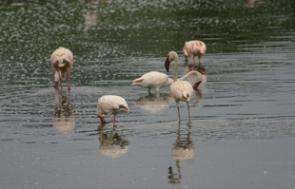
Lesser flamingos (Phoeniconaias minor) at Lake Bogoria, Kenya, are suffering from malnutrition, report Earthwatch-supported scientists working there. The scientists are investigating the causes of recent large-scale mortality events, resulting in the death of thousands of lesser flamingos in Kenya last year and at least half a million birds during the 1990s.
Post-mortem examinations on several flamingos found dead at Bogoria in late 2006 revealed that the birds weighed just 63 per cent of their normal body mass, approximately 1,050 grams. An analysis of the lake water confirmed that very low levels of spirulina (a blue-green bacteria that is the primary food source for lesser flamingos) were leaving the birds with only 10 per cent of their minimum daily food requirements.
“Based on these findings, it appears that starvation needs to be included in the possible causes of flamingo mortality,” said Dr. David Harper of University of Leicester, principal investigator of Earthwatch’s Flamingos of the Rift Valley project. Earthwatch-supported scientists believe that heavy rains led to swollen seasonal streams, bringing water and high sediment concentrations into the lake that diluted the food supply.
“It is unknown why the birds did not simply leave Bogoria,” continues Harper. “We speculate that these birds may had arrived at Bogoria already in poor condition and were unable to regain enough strength to move on.”
Coincidently, the flamingos observed at Bogoria also tended to be a paler shade of pink, indicating that they were not in good enough condition to breed. Flamingos get their bright breeding coloration from the alpha and beta-carotene in their normal diet. Out of about perhaps 15,000 flamingos, Harper observed less than 100 intensely pink birds.
Behavioral changes in the flamingos were also observed. The birds were not wading or feeding in groups along the shoreline as normal, but instead were dispersed and feeding primarily in the open water. Flamingos were routinely observed feeding from small rain puddles in fields and even in the road, making themselves vulnerable to other causes of mortality.
“In seven years of working at Lake Bogoria, I have never seen lesser flamingos feeding from streams and puddles,” said Harper.
“Clearly the birds are looking for an emergency food supply,” said veterinarian Dr. Lindsay Oakes, from Washington State University. “Unfortunately they are putting themselves at risk of predation by feeding in open spaces.” Several flamingos observed to be captured and killed by marabou storks were found to be in very poor body condition, suggesting that these victims were malnourished. “They may also suffer from poisoning as the blue–green bacteria found in hot streams are more likely to produce dangerous toxins.”
“The bottom line is that we do not really know whether anthropogenic or natural causes are the strongest mortality factor,” continues Harper. “We now fear that food stress might lead to large scale flamingo mortality either directly through starvation, or indirectly by increasing susceptibility to infectious diseases or access to toxins.”
Harper and Oaks were joined by Earthwatch-funded conservationists from the University of Nairobi, National Museums of Kenya, Kenya Wildlife Services and Tanzanian equivalent bodies.
In 20 years, more than 800 Earthwatch volunteers have assisted Harper and his colleagues in their efforts to understand the ecology of Kenya’s Rift Valley lakes and wildlife. Their findings have resulted in more than 50 articles in scientific journals and helped spur conservation efforts both locally and internationally. Their results have ranged from charting the cycle of destruction and regrowth caused by the introduced Louisiana crayfish in Lake Naivasha to satellite-tracking the movements of flamingos from lake to lake.
For more about Earthwatch’s Flamingos of the Rift Valley project, go to www.earthwatch.org/site/pp.asp … sJSK6PFJnH&b=2243869
Source: Earthwatch Institute


