Scientists create wrinkled 'skin' on polymers
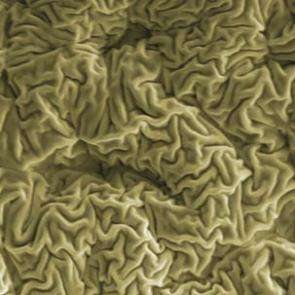
Applied scientists demonstrated a new method for developing wrinkled hard skins on the surface areas of polymers using a focused ion beam. By controlling the direction and intensity of the ion beam, the researchers literally sculpted patterns on flat areas of polydimethylsiloxane, a silicon-based organic polymer (more commonly known as the primary ingredient in Silly Putty). The technique has potential use for biological sensors and microfluidic devices and may offer new ways to build custom-made cell templates for tissue engineering.
The work is a collaboration among researchers at Harvard University and Seoul National University. The Harvard group consisted of John W. Hutchinson, Abbott and James Lawrence Professor of Engineering, Myoung-Woon Moon, Post-doctoral Fellow, and Ashkan Vaziri, Lecturer on Engineering and Research Associate in Applied Mechanics, all of Harvard Engineering and Applied Sciences. Their findings were published in the Proceedings of the National Academy of Sciences. The researchers have also filed for a U.S. patent covering the discovery.
"This technique is a one-step process for creating wrinkled skins," explains Vaziri. "The method is more robust compared with traditional techniques. The patterns can be generated along desired paths by simply controlling the relative movement of the ion beam and polymeric substrate. It's almost like using an airbrush on fabric. At a smaller scale the desired morphology of wrinkles can be achieved by controlling the ion beam intensity."
Because only the areas exposed to the beam are affected, the method enabled the scientists to create a variety of patterns--from simple one-dimensional wrinkles to peculiar and complex hierarchical nested wrinkles--along desired paths. Specific examples to date include "S" shapes, circular patterns, and long horizontal channels akin to the repeating tines of a closed zipper.
"Irradiation by the ion beam alters the chemical composition of the polymer close to its surface and forms a thin stiff skin which wants to expand," explains Vaziri. "The consequent mismatch between the mechanical strain of the generated stiff skin and the underlying polymeric substrate, almost like a tug-of-war, buckles the skin and forms the wrinkle patterns."
Such patterns can be used in the construction of microfluidic devices for particle separation and mixture and also have potential use in designing biosenors. The researchers have also started a close collaboration with scientists at the Harvard-MIT Division of Health Sciences and Technology aimed at exploring the behavior of living cells on these patterned substrates. Such research may lead to the development of an effective and robust method to build custom templates for engineering and growing tissues.
"We are approaching this field of research from various directions," says Vaziri. "At the moment we are looking at the effect of ion beam energy and have been able to reduce the wavelength of the wrinkles to 50 nanometers. Manipulation at such a small scale makes this method even more attractive. We are also building multifunctional microfluidic devices for the mixing of flow at very small scales and stretching of proteins and DNA. These new efforts, while at early stages of development, are very promising."
Source: Harvard University


