Dangerous wheat disease jumps Red Sea
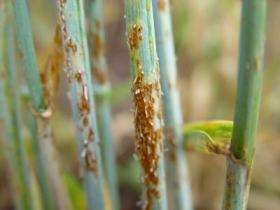
A new form of stem rust, a virulent wheat disease, has jumped from eastern Africa and is now infecting wheat in Yemen in the Arabian Peninsula.
Researchers with the Global Rust Initiative (GRI) and the Agricultural Research Service of the United States Department of Agriculture (USDA-ARS) have confirmed conclusively the existence of the disease in Yemen. There is also evidence that the disease has spread into Sudan but more tests are needed to confirm the finding. Until this discovery, this new strain of stem rust, known as Ug99, had only been seen in Uganda, Kenya and Ethiopia.
The last major epidemic of stem rust occurred in North America in the early 1950s, when a strain of stem rust destroyed as much as 40 percent of the continent's spring wheat crop. Out of this crisis came a new form of international cooperation among wheat scientists worldwide, spearheaded by Nobel laureate wheat scientist Norman Borlaug. This international alliance of scientists led to the development of wheat varieties which resisted the onslaught of stem rust for more than four decades. But in 1999, a new strain of stem rust was discovered in Uganda and Kenya capable of destroying most previously disease-resistant wheat varieties.
A year and a half ago geographic information systems specialists working at CIMMYT plotted the probable trajectory of the fungus, whose spores can travel large distances on the wind. The wind models predicted that if the fungus crossed from eastern Africa to the Arabian Peninsula it could easily spread to the vast wheat-growing areas of North Africa, the Middle East, Pakistan and India.
There is precedence for this, from a virulent strain of another wheat disease, called yellow rust, which emerged in eastern Africa in the late 1980s. Once it appeared in Yemen, it took just four years to reach wheat fields of South Asia. On its way, this new strain of yellow rust caused major wheat losses in Egypt, Syria, Turkey, Iran, Iraq, Afghanistan, and Pakistan, exceeding USD 1 billion in value. There is every reason to believe the new Ug99 strain of stem rust represents a much greater risk to world wheat production. Annual losses of as much as USD 3 billion in Africa, the Middle East and south Asia alone are possible.
According to the Food and Agriculture Organization of the United Nations (FAO), countries in the predicted, immediate pathway grow more than 65 million hectares of wheat, accounting for 25 percent of the global wheat harvest. "If we don't control this stem rust threat," says ME Tusneem, Chairman of Pakistan's Agriculture Research Council, "it will have a major impact on food security, especially since global wheat stocks are at a historic low."
Experiments conducted over the past two years by international researchers in the Global Rust Initiative in Kenya and Ethiopia demonstrate clearly that most of the world's wheat varieties are susceptible to the new Ug99 strain of stem rust. "This is a problem that goes far beyond wheat production in developing countries," warns Borlaug. "The rust pathogen needs no passport to cross national boundaries. Sooner or later Ug99 will be found throughout the world, including in North America, Europe, Australia and South America."
GRI scientists have already identified promising experimental wheat materials with resistance to Ug99. But from the first breeding trials to growing new, rust-resistant varieties in farmers' fields on millions of hectares takes time and a massive effort.
"If we fail to contain Ug99 it could bring calamity to tens of millions of farmers and hundreds of millions of consumers," says Nobel Laureate Borlaug. "We know what to do and how to do it. All we need are the financial resources, scientific cooperation and political will to contain this threat to world food security."
Source: International Maize and Wheat Improvement Center


