New details of first major urban battle emerge along with clues about civilization’s origins
New details in the tragic end of one of the world’s earliest cities as well as clues about how urban life may have begun there were revealed in a recent excavation in northeastern Syria that was conducted by the University of Chicago and the Syrian Department of Antiquities.
“The attack must have been swift and intense. Buildings collapsed, burning out of control, burying everything in them under vast pile of rubble,” said Clemens Reichel, the American co-director of the Syrian-American Archaeological Expedition to Hamoukar. Reichel, a Research Associate at the University’s Oriental Institute, added that the assault probably left the residents destitute as they buried their dead in the ruins of the city.
Reichel made that assessment of the battle that destroyed Hamoukar about 3500 B.C. after an excavation was conducted in September and October at the site near the Iraqi border. The team uncovered further evidence of the accomplishments of the inhabitants among the remains of the walled city dating to the fourth millennium B.C.
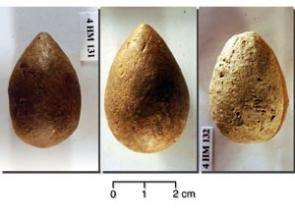
In addition to the wall, the team has uncovered quasi-industrial installations and two large administrative buildings that had been destroyed by an intense fire. It was at the site that, mixed in with the debris from the collapsed wall, that over 1,000 egg-shaped sling bullets were found in 2005, leading the excavators to conclude that an early act of warfare had caused the end of the settlement.
Work in this past season may explain how powerful the early weapons were. “We literally have them at all stages of use, from manufacture to impact,” Reichel said, pointing out that the team found a sling bullet that had pierced the plaster of a mud brick wall. The team also found 12 graves in the debris, very likely of people killed in the battle.
The team discovered several rooms with walls up to six feet high in which more than 1,100 sling bullets were found mixed in with collapsed walls and roofs. They also found a shallow pit into which a water jar had been buried to its rim in the floor of one of the rooms. This pit, ordinarily used to soak discarded clay sealings to recycle them into fresh sealing clay, was used to make sling bullets during the city’s final hours. This was indicated by two dozen sling bullets than were lined up neatly along its edge.
“It looks as if they were—quite literally—throwing everything they could find against the aggressors,” Reichel said.
Hamoukar was on a key trade route that led from Anatolia (modern-day Turkey) across Northern Syria and the river Tigris into Southern Mesopotamia. Some evidence of this long-lasting trade was found in an area to the south of Hamoukar’s main site— a large mound. The team found obsidian fragments in an area of over 700 acres (280 hectares), which they dated to 4,500 - 4,000 B.C. using pottery fragments found with the obsidian. In addition to tools and blades, the team found large amounts of production debris such as cores, a discovery that is even more significant than finding actual tools.
“Finding cores and other production debris tells us that they are not just using these tools here, they are making them here,” Salam al-Kuntar, the Syrian co-director of the expedition, explained. Obsidian does not occur around Hamoukar but had to be brought in from Turkey with the nearest sources being over 70 miles away.
The discovery of an obsidian processing center is significant, Reichel added, for it could explain the emergence of a city in this location at such an early time. A large-scale export of tools to Southern Mesopotamia would have resulted in significant revenue and accumulation of wealth. “This could have been the incentive that pulled people off their fields. People specialized instead of ploughing their own fields they bought their food supplies from surrounding villages. And once people accumulated a fortune they want a walled enclosure to protect it — your first city.” Unlike in southern Mesopotamia, therefore, the prime mover towards urbanism appears to have been economic incentive, not coercion.
The obsidian workshops were located off the main mound and predate the destroyed city by several hundred years, but numerous older levels have already been noted below the destroyed buildings in small test trenches. “We have no clear idea how far the first city at Hamoukar goes back in time,” Reichel said. “It could be much earlier than 3,500 B.C.”
By the time the city was destroyed, he added, copper had started to replace obsidian as key raw material for tools. The discovery of numerous copper tools in the ruins of Hamoukar might indicate that Hamoukar had followed developed from an obsidian into a copper processing center, possibly also exporting copper tools to the south.
The discovery could lead the way to providing an additional explanation for how civilization developed in the Fertile Crescent. In the south, urban society emerged in the Uruk culture in response to the needs of providing organization to an economy supported by an irrigation-based agriculture.
The latest findings from Hamoukar suggest that the specialized mass-production of goods for trade could have been a similar driving force in the North.
Source: University of Chicago


