THEMIS mission fields 5 probes to solve mystery of auroral substorms
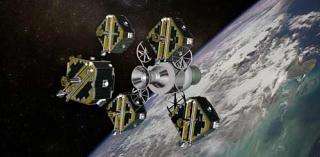
NASA is poised to launch on Feb. 15 five identical space probes – the largest number of spacecraft ever attempted by the agency on a single rocket – to solve a decades-long mystery about the origin of magnetic storms that turn the green, shimmering curtains of the Earth's Northern and Southern Lights into colorful, dancing light shows.
Just as weather storms are punctuated by lightning and thunder, so storms in the magnetic field surrounding the Earth are punctuated by sudden releases of energy, called substorms, which generate 10 minutes to hours of frenetic activity in the aurorae.
The five space probes comprising the Time History of Events and Macroscale Interactions during Substorms (THEMIS) mission, built by scientists at the University of California, Berkeley's Space Sciences Laboratory (SSL) and Swales Aerospace, aim to establish once and for all where in Earth's magnetosphere substorms originate.
"For over 30 years, the source location of these explosive energy releases has been sought after with great fervor. It is a question almost as old as space physics itself," said THEMIS principal investigator Vassilis Angelopoulos, a research physicist at SSL. "A substorm starts from a single point in space and progresses past the moon's orbit within minutes, so a single satellite cannot identify the substorm origin. The five-satellite constellation of THEMIS will finally identify the trigger location and the physics involved in substorms."
THEMIS will be launched on its two-year mission by NASA as part of its Medium-class Explorer (MIDEX) program. To date, all MIDEX missions have been single spacecraft, but THEMIS used the $180 million in NASA funding to "build five spacecraft for the price of one, and on the same schedule as everybody else takes to build one," said THEMIS project manager Peter Harvey of SSL.
After launch, the cloned probes will coast in Earth orbit for 10 months until they line up within Earth's shadow like a string of beads. By February 2008, they will begin collecting coordinated measurements every four days to pinpoint where and when substorms begin, a feat not possible with previous single-satellite missions. Angelopoulos expects that the probes will observe over 30 substorms during the mission's lifespan.
The ultimate cause of the aurorae and auroral substorms is the sun, which crackles with flares and violent explosions called coronal mass ejections that send charged particles hurtling into space. When these particles pass by our planet, the particles flow around the Earth along the planet's magnetic field lines and down the "magnetotail" in the shadow of the Earth.
Some of these particles leak into Earth's magnetosphere and arc through the atmosphere toward the poles, colliding with air molecules and making the atmosphere glow like a neon light. From space, the glow is like an oval halo encircling the north and south magnetic poles. Periodically, however, energy builds up until Earth's magnetic field breaks, releasing a sudden burst of electrical current that turns the green aurora purple, red and white and make it shimmy and shake.
"Substorms are what make the aurorae interesting," said John Bonnell, a plasma physicist and aurora specialist with THEMIS. "Without them, the greenish white sheets are static, like a cloud. Substorms make the sheets ripple and create different colors, such as red borders and colorful edge effects."
The chicken or the egg?
The big question for THEMIS is: What is the sequence of events that triggers these auroral eruptions? One theory proposes that the solar wind disrupts a sheet of moving charged particles about 10 Earth radii down the magnetotail, triggering the eruption and, a minute later, causing the Earth's magnetic field to cross-link or "reconnect" with the passing solar wind magnetic field. A second theory proposes that magnetic reconnection happens first, at about 25 Earth radii, which then disrupts the sheet of current to trigger the substorm a couple of minutes later.
THEMIS is named after the Greek goddess of justice, often called "blind justice," because it will impartially decide which comes first, current disruption or magnetic reconnection. Spread out along the magnetotail, THEMIS will time the sequence of electrical discharges and magnetic field changes, and coordinate with ground-based cameras spread over Alaska and Canada, to discover the time history of these events, perhaps resolving the mystery within months of going online.
"THEMIS is so important because the same fundamental physical process is seen around all planets, it happens on the sun in solar flares, and in astrophysical systems such as black holes," Angelopoulos said. "It's amazing that being so close to us, here at Earth, it is not understood yet."
Ground-based observations crucial
The 20 All-Sky cameras and the ground-based observatories housing their acquisition systems were built by the SSL team. Magnetometer sensors which measure currents in near-Earth space were built by UCLA scientists or contributed by the University of Alberta. Sixteen of these observatories were installed across Canada by University of Calgary scientists in places like Inuvik, Whitehorse, Prince George, Goose Bay and at the Ekati Diamond Mine, while another four were installed in Alaska by SSL.
In addition, UCLA scientists have buried $20,000 ground-based magnetometers near 10 schools across the northern United States so that grade-school students can participate in THEMIS experiments and learn, through specially designed curricula, about magnetism and the Earth's interactions with the sun.
The mission is the first for NASA to include a spare spacecraft. Only four probes, each the size of a dishwasher, are necessary to obtain the data needed to answer the main questions posed by researchers. The fifth probe, which will huddle with two other probes in a one-day equatorial orbit at 10 Earth radii, can be redeployed should one of the others fail. Another probe will settle into a two-day orbit at 20 Earth radii, while the last will be in a four-day orbit at 30 Earth radii. Every four days, they will line up in the magnetotail, ready to capture the signature of a substorm.
At the moment, the five space probes are at Astrotech Space Operations in Titusville, Fla., where they arrived Dec. 11 after a cross-country trip from the Jet Propulsion Laboratory in Pasadena, where they were environmentally tested. On Feb. 2, the probes will be trucked to Cape Canaveral to be mounted atop a Delta II rocket in preparation for a Feb. 15 launch within a 6:08-6:27 p.m. EST window.
Source: University of California - Berkeley


