VISTA Camera takes to the air
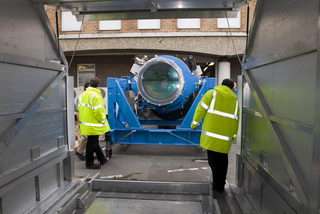
The world's biggest infrared camera for Europe's newest telescope left the UK today (17th January 2007) for its flight to Santiago in Chile. The infrared camera will sit at the focal point of VISTA - a UK provided survey telescope being constructed in Chile for ESO, the Organisation for Astronomical Research in the Southern Hemisphere.
VISTA will be able to map the infrared sky faster than any previous telescope, studying areas of the Universe that are hard to see in the optical region of the spectrum due to either (or all of) their cool temperature, surrounding dust or their high redshift.
The 2.9 tonne VISTA camera has been designed and built by a consortium including CCLRC Rutherford Appleton Laboratory in Oxfordshire, the UK Astronomy Technology Centre (UK ATC) in Edinburgh and the University of Durham. Mr Kim Ward, the Camera Manager, oversaw the technical challenges "The inside of the camera is under vacuum and it operates at a temperature of -200 degrees, so in many ways it has been like designing an instrument for use in space, but with the additional constraint of having to survive an earthquake environment. VISTA has a much larger number of infrared sensitive detectors than previous infrared instruments - totalling 67 million pixels, and its wide field of view requires it to have the largest ever window of any infrared camera."
Only one airline offers regular cargo flights to Chile, so the camera will be loaded into a container and taken by ferry to mainland Europe, so that it can catch its Boeing 747 flight from Luxemburg on the 22nd January. The container is so large that it will only just fit in this massive plane. Once it touches down in Santiago, the container will be driven 1300 km to the mountain top where VISTA is being assembled at ESO's Cerro Paranal Observatory.
VISTA is due to start scientific operations in the last quarter of 2007. Professor Jim Emerson of Queen Mary, University London is VISTA's Principal Investigator "VISTA will be able to take good quality images of areas of sky each about 3 times as great as the full moon. This means it can survey quickly which is its niche. The camera is crucial to carrying out VISTA's surveys which will provide statistical samples of objects and at the same time locate and characterise rare and variable objects, and perhaps most tantalisingly make discoveries of the as-yet unknown."
VISTA will survey large areas of the southern sky at near infrared wavelengths (2 to 4 times the wavelength of visible light) to study objects that are not seen easily in optical light either because they are too cool to (such as brown dwarfs), or are surrounded by interstellar dust which infrared light penetrates much better than optical, or whose optical light is redshifted into the near infrared by the expansion of the Universe. Amongst other things VISTA's surveys will help our understanding of the nature and distribution and origin of known types of stars and galaxies, map the 3-D structure of our galaxy, and help determine the relation between the 3-D structure of the universe and the mysterious 'dark energy' and dark matter'. Samples of objects will be followed up in detail with further observations by other telescopes and instruments such as the nearby Very Large Telescope (VLT).
Professor Richard Wade, Particle Physics and Astronomy Research Council Director and President of ESO Council said "The unique Paranal site, the large 4-m telescope aperture, the wide field, and the high efficiency of the detectors will make VISTA the world's outstanding ground based near-IR survey instrument."
Catherine Cesarsky, ESO's Director General commented "VISTA is an eagerly awaited addition to ESO's suite of telescopes. Wide area surveys such as those which VISTA will undertake can drive discoveries across the field of astronomy."
VISTA is a £36 million project, funded by grants from the DTI's Joint Infrastructure Fund and the Particle Physics and Astronomy Research Council (PPARC) to Queen Mary, University of London, the lead institute of the VISTA Consortium. VISTA forms part of the UK's subscription to ESO and will be an ESO telescope. VISTA is project managed by PPARC's UK Astronomy Technology Centre.
Source: PPARC


