Assisting NASA in biology mission, Stanford helps E. coli visit the final frontier
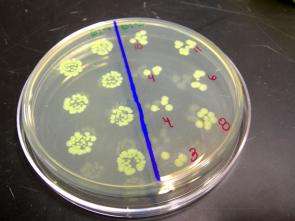
Banished from kitchen counters, E. coli, albeit a harmless variety, are taking to space. On Saturday, Dec. 16, 2006, bacteria hitchhiked into low-Earth orbit aboard an Air Force Minotaur 1 rocket that took off from the NASA Wallops Flight Facility in Virginia in an experiment to test the effects of space on living organisms.
The GeneSat-1 mission, a partnership of about 45 scientists from NASA Ames Research Center, Stanford, Santa Clara University, San Jose State University and the California Polytechnic State University-San Luis Obispo, could help scientists better understand the genetic damage and grave health problems to which humans might be exposed on long space flights.
"This is a toehold into the science of what space does to humans," said Stanford electrical engineering Professor Gregory Kovacs, who is principal investigator on the university's contract for the project.
When people spend a long time in microgravity, they can lose bone density, muscle tone and immune-system rigor. The radiation in space can be so damaging that by the time astronauts made the almost three-year trip to Mars, they would stand a high chance of getting cancer, according to a NASA statement.
By studying what happens to a model organism, E. coli, scientists aim to understand how space affects living things on a genetic level and hope to contribute to the development of treatments. The flight also will allow scientists to test the hardware for use in future experiments.
The two bacterial strains that will be launched in GeneSat-1 were derived from a strain called K-12 that has been used in research labs for more than 40 years, according to GeneSat-1 Lead Scientist Macarena Parra of Lockheed Martin, a contractor at NASA Ames. The K-12 strain and all its derivative strains lack the ability to make certain proteins required for its survival inside the large intestine. So even if humans were to ingest billions of cells, the bacteria could do no harm, she said. One of the strains in GeneSat is considered so safe that it is part of a science activity kit sold to middle and high schools.
To understand which genes are activated when E. coli endure microgravity and radiation, the scientists make genes that can glow in the dark when triggered. "You find a gene you'd like to study and fuse onto it this gene for green fluorescence," said Stanford electrical engineer Antonio Ricco, chief technologist for NASA's Astrobionics Program and an architect of the mission.
For example, if radiation damage occurs, the repair gene is triggered and glows, acting like a beacon to signal the scientists. "If you do this, you can make the organism be a living radiation meter," Kovacs said. Once the scientists know which genes are involved with radiation damage, they can work to design treatments.
E. coli is an ideal species for this type of experiment, Kovacs said. "The big thing is that we know [its] genome really well," he said. "And [the bacteria] can have many, many generations over a very short time." That way the scientists can watch space's effects play out in the genetic information passed from parent to offspring within days instead of decades.
Another plus to the mission is that it's small and inexpensive. The whole experiment is the size of a shoebox, and only 10 pounds. GeneSat-1 uses miniature technology called CubeSats—tiny cube-shaped satellites designed by Robert Twiggs, a consulting professor at Stanford.
The idea for GeneSat-1 arose when John Hines, the mission program manager and a Stanford alumnus, came across Twiggs' CubeSat webpage while at a meeting. Kovacs recalls, "John waved me over to his seat and whispered, 'Couldn't we put biological experiments on these?' I immediately said 'Yes!'"
The team constructed GeneSat-1 from three CubeSats. Because the little boxes are lightweight and compact, they don't cost much to put into space. "The total price tag on the project was about $8 million, which is relatively inexpensive for a space mission like this, where we've had to invent and build much of the technology from scratch," Ricco said.
But designing the project to fit snuggly in the satellite wasn't easy. The team crafted the mini lab to make sure the E. coli could live and reproduce in orbit, far from human tending.
"It's difficult enough to keep a closed container of E. coli alive on Earth," Kovacs said. "It's even harder in space. You have to keep them at the right temperature, and take out the trash," he said, referring to wastes the bacteria produce.
Inside the satellite, optical devices will measure the amount of green fluorescence to find out if the targeted genes are activated. As the satellite circles the earth, it will transmit data back to the GeneSat communications center over the SRI antenna located on the hills above the Stanford campus. Since Saturday, Ricco said, ham radio operators around the world have been receiving GeneSat-1's radio beacon, and GeneSat-1's primary transceiver is successfully sending data and receiving commands.
In biology, a critical aspect of understanding new phenomena is repeating the experiment several times, separated by weeks or months, to prove that the effect is real and to understand the statistical variations typical of living systems. "Getting human-tended science experiments into space is costly and too rare," Ricco said. "But with low-cost, frequent space access using unmanned hitchhiking satellite experiments, many more experiments can be done, and repetition of the most important experiments can become routine."
The biology experiment will begin within 15 days of the rocket launch, and will run for about four days. At that point, the bacteria will run out of food, but the satellite will stay in space and continue to make measurements for about a year, until its orbit begins to decay and it burns up in Earth's atmosphere.
If everything goes well, the project could give scientists insight into what goes wrong when living things travel in space. "It's a pretty long path from these initial studies to human treatments, but you've got to start somewhere," Ricco said.


