Integral sees the Galactic centre playing hide and seek
January 18, 2007
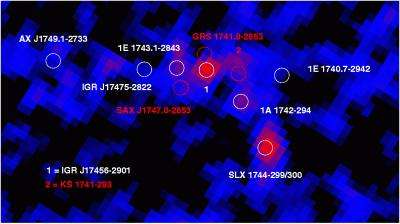
This mosaic image, built with exposures obtained by the IBIS/ISGRI instrument on board ESA’s Integral gamma-ray observatory in April 2006, shows the Galactic centre region, an area of the sky supposed to host a gigantic black hole and characterized by the presence of a variety of hard X-ray and gamma-ray point sources. Due to the variability these sources possess on all time scales, the region never looks exactly the same. Surprisingly, the sources were "off" around the time of the observation (including the normally bright well-known black-hole candidate and micro-quasar 1E 1740.7-2942), displaying an unusually "quiet" galactic centre. This is a very different view from those obtained on the long-term average. The sources and the positions marked in white are almost permanently visible, while those marked in red are known "transient" sources, that is sources more often "off" than "on." The source called 1E 1740.7-2942 is normally the brightest source in the Galactic Centre region. It is a well-known black-hole candidate, as well as a micro-quasar source. The massive black hole at the very centre of our Galaxy, Sagittarius A* (or Sgr A*), is very close to source marked as "1," corresponding to IGR J17456-2901. The image covers a sky area of 4.3x2 degrees, and it is centred on (0, -0.5) degrees in Galactic coordinates. Credit: ESA/ISDC
ESA's gamma ray observatory Integral has caught the centre of our galaxy in a moment of rare quiet. A handful of the most energetic high-energy sources surrounding the black hole at the centre of the Galaxy had all faded into a temporary silence when Integral looked.
This unusual event is allowing astronomers to probe for even fainter objects and may give them a glimpse of matter disappearing into the massive black hole at the centre of our galaxy.
The Galactic centre is one of the most dynamic places in our Galaxy. It is thought to be home to a gigantic black hole, called Sagittarius A* (pronounced 'A star'). Since the beginning of the Integral mission, ESA's gamma ray observatory has allowed astronomers to keep watch on this ever-changing environment.
Integral has discovered many new sources of high-energy radiation near the galactic centre. From February 2005, Integral began to regularly monitor the centre of the Galaxy, and its immediate environment, known as the Galactic bulge.
Erik Kuulkers of ESA's Integral Science Operations Centre, ESAC, Spain, leads the Galactic bulge monitoring programme. Integral now keeps its high-tech eyes on about 80 high-energy sources in the galactic bulge. "Most of these are X-ray binaries," says Kuulkers.
X-ray binaries are made up of two stars in orbit around one another. One star is a relatively normal star; the other is a collapsed star, such as a white dwarf, neutron star or even a black hole. If the stars are close enough together, the strong gravity of the collapsed star can pull off gaseous material from the normal star. As this gas spirals down around the collapsed star, it is heated to over a million degrees centigrade and this causes it to emit high energy X-rays and gamma rays. The amount of gas falling from one star to the other determines the brightness of the X-ray and gamma-ray emission.
According to the Integral observations in April 2006, the high-energy rays from about ten sources closest to the galactic centre all faded temporarily. Kuulkers excludes the possibility that a mysterious external force is acting on all the objects to drive them into quiescence. "All the sources are variable and it was just by accident or sheer luck that they had turned off during that observation," he says with a smile.
The fortuitous dimming allows astronomers to set new limits on how faint these X-ray binaries can become. It also allows a number of new investigations to be undertaken with the data.
"When these normally bright sources are faint, we can look for even fainter sources," says Kuulkers. These could be other X-ray binaries or the high-energy radiation from giant molecular clouds interacting with past supernovae. There is also the possibility of detecting the faint high-energy radiation from the massive black hole in our Galaxy's centre.
Integral's Galactic bulge monitoring programme will continue throughout this year. The data is made available, within a day or two of being collected, to the scientific community via the Internet from a dedicated webpage at the Integral Science Data Centre (IDSC), Geneva, Switzerland. This way, anyone interested in specific sources can watch for interesting changes and trigger follow up observations with other telescopes in good time.
Source: European Space Agency
-
Ten years of Very Large Telescope adaptive optics
Nov 25, 2011 |
4.4 / 5 (9) |
3
-
INTEGRAL observations suggest unified model for Active Galactic Nuclei requires a rethink
Aug 03, 2011 |
4.6 / 5 (5) |
16
-
Integral satellite disproves dark matter origin for mystery radiation
Jul 22, 2009 |
4.5 / 5 (11) |
15
-
Galactic X-ray emissions originate from stars
May 05, 2009 |
4.6 / 5 (8) |
2
-
Integral discovers the galaxy’s antimatter cloud is lopsided
Jan 09, 2008 |
4.5 / 5 (52) |
1
-
Engineers build first sub-10-nm carbon nanotube transistor
Feb 01, 2012 |
4.9 / 5 (31) |
30
-
Something old, something new: Evolution and the structural divergence of duplicate genes
Jan 31, 2012 |
4.6 / 5 (7) |
1
-
The hidden nanoworld of ice crystals: Revealing the dynamic behavior of quasi-liquid layers
Jan 30, 2012 |
5 / 5 (3) |
1
-
Stock market network reveals investor clustering
Jan 27, 2012 |
3.9 / 5 (23) |
8
-
Of microchemistry and molecules: Electronic microfluidic device synthesizes biocompatible probes
Jan 26, 2012 |
5 / 5 (1) |
0
-
Never ending outer space.....
7 hours ago
-
Neutron Star fragments?
9 hours ago
-
stationary or not?
13 hours ago
-
Scale of the Universe
Feb 10, 2012
-
Titan's lack of impact craters
Feb 09, 2012
-
Real pictures of black hole eating a star?
Feb 08, 2012
- More from Physics Forums - General Astronomy
More news stories
Latin America mining boom clashes with conservation
Latin America is experiencing a mining boom as prices rise fuelled by a hike in global demand, but the region is also being hit by a wave of violent protests, strikes and rallies by environmentalists.
5 minutes ago |
not rated yet |
0
Europe stakes billion-dollar bet on new rocket
A pencil-slim rocket is scheduled to lift into space from South America on Monday, carrying a billion-dollar bet that Europe can grab a juicy slice of the market to place satellites in low orbit.
Space & Earth / Space Exploration
19 hours ago |
3.5 / 5 (2) |
0
Political leaders play key role in how worried Americans are by climate change: study
More than extreme weather events and the work of scientists, it is national political leaders who influence how much Americans worry about the threat of climate change, new research finds.
Feb 06, 2012 |
5 / 5 (6) |
72
NASA budget will axe Mars deal with Europe: scientists
US President Barack Obama's budget proposal to be submitted next week for 2013 will cut NASA's budget by 20 percent and eliminate a major partnership with Europe on Mars exploration, scientists said Thursday.
Space & Earth / Space Exploration
Feb 10, 2012 |
5 / 5 (3) |
48
Humans may have helped the decline of African rainforests 3000 years ago
(PhysOrg.com) -- Large areas of rainforests in Central Africa mysteriously disappeared over three thousand years ago, to be replaced by savannas. The prevailing theory has been that the cause was a change ...
Love a click away in Indonesia's Twitter Republic
He was a geeky kid from Yogyakarta, she a glamorous city girl in Jakarta. In a country with one of the world's most vibrant social networking scenes they fell in love on Twitter.
Walney offshore wind farm is world's biggest (for now)
(PhysOrg.com) -- The Walney wind farm on the Irish Sea--characterized by high tides, waves and windy weather--officially opened this week. The farm is treated in the press as a very big deal as the Walney ...
GPS court ruling leaves US phone tracking unclear
A US Supreme Court decision requiring a warrant to place a GPS device on the car of a criminal suspect leaves unresolved the bigger issue of police tracking using mobile phones, legal experts say.
Europeans protest controversial Internet pact
Tens of thousands of people marched in protests in more than a dozen European cities Saturday against a controversial anti-online piracy pact that critics say could curtail Internet freedom.
Study finds that anti-diabetic medication can prevent the long-term effects of maternal obesity
In a study to be presented today at the Society for Maternal-Fetal Medicine's annual meeting, The Pregnancy Meeting, in Dallas, Texas, researchers will report findings that show that short therapy with the anti-diabetic medication ...
Netflix settlement trims 14 pct off 4Q earnings
(AP) -- Netflix pressed the rewind button on its fourth-quarter earnings after settling allegations that the video subscription service violated a consumer-privacy law.