Conceptualizing a cyborg
January 18, 2007 Conceptualizing a cyborg

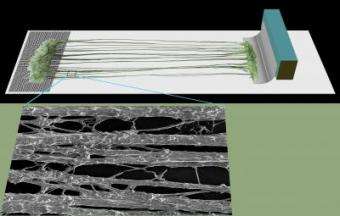
Schematic of stretch-grown axons, showing axons growing on electrodes on right and computer-controlled motor pulling axons to left. Blow-up is close-up of stretch-grown axons. Credit: Douglas H. Smith, MD, University of Pennsylvania School of Medicine

Investigators at the University of Pennsylvania School of Medicine describe the basis for developing a biological interface that could link a patient's nervous system to a thought-driven artificial limb. Their conceptual framework - which brings together years of spinal-cord injury research - is published in the January issue of Neurosurgery.

"We're at a junction now of developing a new approach for a brain-machine interface," says senior author Douglas H. Smith, MD, Professor of Neurosurgery and Director of the Center for Brain Injury and Repair at Penn. "The nervous system will certainly rebel if you place hard or sharp electrodes into it to record signals. However, the nervous system can be tricked to accept an interface letting it do what it likes - assimilating new nerve cells into its own network".

To develop the next generation of prosthetics the idea is to use regions of undamaged nervous tissue to provide command signals to drive a device, such as an artificial limb. The challenge is for a prosthesis to perform naturally, relaying two-way communication with the patient's brain. For example, the patient's thoughts could convert nerve signals into movements of a prosthetic, while sensory stimuli, such as temperature or pressure provides feedback to adapt the movements.

The central feature of the proposed interface is the ability to create transplantable living nervous tissue already coupled to electrodes. Like an extension cord, of sorts, the non-electrode end of the lab-grown nervous tissue could integrate with a patient's nerve, relaying the signals to and from the electrode side, in turn connected to an electronic device.

This system may one day be able to return function to people who have been paralyzed by a spinal-cord injury, lost a limb, or in other ways. "Whether it is a prosthetic device or a disabled body function, the mind could regain control," says Smith.

To create the interface, the team used a newly developed process of stretch growth of nerve fibers called axons, previously pioneered in Smith's lab. Two adjacent plates of neurons are grown in a bioreactor. Axons sprout out to connect the neuron populations on each plate. The plates are then slowly pulled apart over a series of days, aided by a precise computer-controlled motor system, until they reached a desired length.

For the interface, one of the plates is an electrical microchip. Because Smith and his team have shown that stretch-grown axons can transmit active electrical signals, they propose that the nervous-tissue interface - through the microchip - could detect and record real-time signals conducted down the nerve and stimulate the sensory signals back through the axons.

In another study, Smith and colleagues showed that these stretch-grown axons could grow when transplanted into a rat model of spinal-cord damage. The team is now is the midst of studies measuring neuronal electrical activity across newly engineered nerve bridges and the restoration of motor activity in experimental animals.

Source: University of Pennsylvania


print this article email this article download pdf blog this article bookmark this article     Stumble it Digg this share on Facebook retweet share on Reddit add to delicious
Rate this story - 4.3 /5 (18 votes)


January 18, 2007 all stories

Comments: 0

4.3 /5 (18 votes)
  • Stumble this up

  • Digg this

  • share this

  • hide
  • Related Stories

  • Brain-computer interface, developed at Brown, begins new clinical trial
    created Jun 10, 2009 | popularity not rated yet | comments 0
  • New 'smart' materials for the brain
    created Dec 21, 2008 | popularity not rated yet | comments 0
  • Researchers engineer new polymers to change their stiffness, strength when exposed to liquids
    created Mar 06, 2008 | popularity not rated yet | comments 0
  • Nanomedicine opens the way for nerve cell regeneration
    created Jun 06, 2007 | popularity not rated yet | comments 0
  • Nanomedicine opens the way for nerve cell regeneration
    created May 21, 2007 | popularity not rated yet | comments 0


  • hide
  • Relevant PhysicsForums posts

  • How to prevent another stroke?
    created Nov 11, 2009
  • Swine flu vaccination
    created Nov 10, 2009
  • Improving the brain through chemistry
    created Nov 07, 2009
  • Sleep / REM Sleep and homeostasis
    created Nov 07, 2009
  • More from Physics Forums - Medical Sciences

Other News

Largest gene study of childhood IBD identifies 5 new genes

Medicine & Health / Genetics

created 7 hours ago | popularity 4.5 / 5 (2) | comments 0

In the largest, most comprehensive genetic analysis of childhood-onset inflammatory bowel disease (IBD), an international research team has identified five new gene regions, including one involved in a biological pathway ...


Researchers find potential treatment for Huntington's disease (w/ Video)

Medicine & Health / Research

created 7 hours ago | popularity not rated yet | comments 0

Investigators at Burnham Institute for Medical Research, the University of British Columbia's Centre for Molecular Medicine and Therapeutics and the University of California, San Diego have found that normal synaptic activity ...


Heart and bone damage from low vitamin D tied to declines in sex hormones

Medicine & Health / Research

created 7 hours ago | popularity not rated yet | comments 0

Researchers at Johns Hopkins are reporting what is believed to be the first conclusive evidence in men that the long-term ill effects of vitamin D deficiency are amplified by lower levels of the key sex hormone estrogen, ...


Young athletes need dual screening tests for heart defects, study suggests

Medicine & Health / Health

created 7 hours ago | popularity not rated yet | comments 0

To best detect early signs of life-threatening heart defects in young athletes, screening programs should include both popular diagnostic tests, not just one of them, according to new research from heart experts at Johns ...


Postmortem genetic tests after sudden death may provide less expensive way to identify risk

Medicine & Health / Research

created 7 hours ago | popularity not rated yet | comments 0

Targeted postmortem testing to identify genetic mutations associated with sudden unexplained death (SUD) is an effective and less expensive way to determine risk to relatives than comprehensive cardiac testing of first degree ...