Neural bottleneck found that thwarts multi-tasking
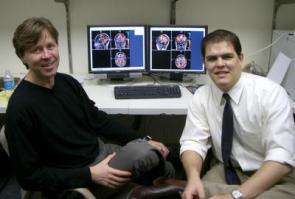
Many people think they can safely drive while talking on their cell phones. Vanderbilt neuroscientists Paul E. Dux and René Marois have found that when it comes to handling two things at once, your brain, while fast, isn't that fast.
"Why is it that with our incredibly complex and sophisticated brain, with 100 billion neurons processing information at rates of up to a thousand times a second, we still have such a crippling inability to do two tasks at once?" Marois, associate professor of Psychology, asked. "For example, what is it about our brain that gives us such a hard time at being able to drive and talk on a cell phone simultaneously?"
Researchers have long thought that a central "bottleneck" exists in the brain that prevents us from doing two things at once. Dux and Marois are the first to identify the regions of the brain responsible for this bottleneck, by examining patterns of neural activity over time. Their results were published in the Dec. 21 issue of Neuron.
"In our everyday lives, we seem to complete so many cognitive tasks effortlessly. However, we experience severe limitations when we try to do even two simple tasks at once, such as pressing a button when a visual stimulus appears and saying a word when a sound is presented. This is known as dual-task interference," Dux, a postdoctoral research associate in the Department of Psychology, said. "We were interested in trying to understand these limitations and in finding where in the brain this bottleneck might be taking place."
The research is particularly timely, as additional states consider banning the use of cell phones while driving.
"While we are driving, we are bombarded with visual information. We might also be talking to passengers or talking on the phone," Marois said. "Our new research offers neurological evidence that the brain cannot effectively do two things at once. People think if they are using a headset with their cell phone while driving they are safe, but they're not because they are still doing two cognitively demanding tasks at once."
Identifying the information bottleneck responsible for this dual-task limitation required the use of functional magnetic resonance imaging, or fMRI, an imaging technology that reveals the brain areas active in a given mental task by registering changes in oxygenated blood concentration in these regions. While fMRI is an excellent tool for identifying a particular area in the brain involved in a given task, it generally provides limited information about how that area responds over time.
To overcome this limitation, Dux and Marois rapidly sampled brain activity using fMRI while subjects were performing two demanding tasks. Evaluation of the data produced by this rapid sampling method allowed them to characterize the temporal pattern of activity in specific brain areas.
The two tasks consisted of pressing the appropriate computer key in response to hearing one of eight possible sounds and uttering an appropriate syllable in response to seeing one of eight possible images. Different senses and motor responses were enlisted in order to ensure that any interference between the two tasks was not specific to a particular sensory or motor modality, but instead originated at a central information-processing bottleneck.
The results revealed that the central bottleneck was caused by the inability of the lateral frontal and prefrontal cortex, and also the superior frontal cortex, to process the two tasks at once. Both areas have been shown in previous experiments to play a critical role in cognitive control.
"We determined these brain regions responded to tasks irrespective of the senses involved, they were engaged in selecting the appropriate response, and, most importantly, they showed 'queing' of neural activity--the neural response to the second task was postponed until the response to the first was completed," Dux said.
"Neural activity seemed to be delayed for the second task when the two tasks were presented nearly simultaneously – within 300 milliseconds of each other," Marois said. "If individuals have a second or more between tasks, we did not see this delay.
"This temporal delay is the essence of dual-task interference for tasks that require actions. By using time-resolved fMRI, we can see its signature in the brain," he continued. "These findings allow us to really now focus on this set of brain areas and to understand why these areas cannot process two tasks at once."
The researchers are interested in further exploring what is happening in the bottleneck to slow performance and believe the work may have future implications for people performing complex tasks.
"It may be possible to look to the sort of tasks people are going to have to do in a very complex environment, such as flying a plane, and find out under what circumstances these tasks may be less vulnerable to dual-task interference," Dux added.
For the record, neither Marois nor Dux use their cell phones while driving.
"I'm Australian, and it's illegal there, so I'm trained not to," Dux said. "Even so, I would never do it. Dual-task costs can be up to a second, and that's a long time when you're traveling at 60 miles per hour."
Source: Vanderbilt University


