Spacecraft to Pluto Prepares for Jupiter Encounter
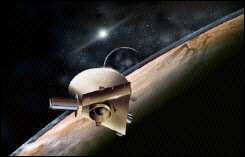
January 18, 2007 NASA artist\'s concept painting shows the proposed New Horizons Spacecraft

NASA's New Horizons spacecraft is on the doorstep of the solar system's largest planet. The spacecraft will study and swing past Jupiter, increasing speed on its voyage toward Pluto, the Kuiper Belt and beyond.

The fastest spacecraft ever launched, New Horizons will make its closest pass to Jupiter on Feb. 28, 2007. Jupiter's gravity will accelerate New Horizons away from the sun by an additional 9,000 miles per hour, pushing it past 52,000 mph and hurling it toward a pass through the Pluto system in July 2015.

"Our highest priority is to get the spacecraft safely through the gravity assist and on its way to Pluto," says New Horizons Principal Investigator Alan Stern, of the Southwest Research Institute, Boulder, Colo. "We also have an incredible opportunity to conduct a real-world encounter stress test to wring out our procedures and techniques, and to collect some valuable science data."

The New Horizons mission team will use the flyby to put the probe's systems and seven science instruments through the paces of more than 700 observations of Jupiter and its four largest moons. The planned observations from January through June include scans of Jupiter's turbulent, stormy atmosphere; a detailed survey of its ring system; and a detailed study of Jupiter's moons.

The spacecraft also will take the first-ever trip down the long "tail" of Jupiter's magnetosphere, a wide stream of charged particles that extends tens of millions of miles beyond the planet, and the first close-up look at the "Little Red Spot," a nascent storm south of Jupiter's famous Great Red Spot.

Much of the data from the Jupiter flyby will not be sent back to Earth until after the spacecraft's closest approach to the planet. New Horizons' main priority during the Jupiter close approach phase is to observe the planet and store data on its recorders before orienting its main antenna to transmit information home beginning in early March.

"Since launch, New Horizons will reach Jupiter faster than any of NASA's previous spacecraft and begin a year of extraordinary planetary science to complement future exploration activities," says Jim Green acting director, Planetary Science Division, NASA headquarters, Washington.

New Horizons has undergone a full range of system and instrument checkouts, instrument calibrations, flight software enhancements, and three propulsive maneuvers to adjust its trajectory.

After an eight-year cruise from Jupiter across the expanse of the outer solar system, New Horizons will conduct a five-month-long study of Pluto and its three moons in 2015. Scientific research will include studying the global geology, mapping surface compositions and temperatures, and examining Pluto's atmospheric composition and structure. A potential extended mission would conduct similar studies of one or more smaller worlds in the Kuiper Belt, the region of ancient, rocky, icy planetary building blocks far beyond Neptune's orbit.

Source: NASA


print this article email this article download pdf blog this article bookmark this article     Stumble it Digg this share on Facebook retweet share on Reddit add to delicious
Rate this story - 4.4 /5 (7 votes)


January 18, 2007 all stories

Comments: 0

4.4 /5 (7 votes)
  • Stumble this up

  • Digg this

  • share this

  • hide
  • Related Stories

  • Fuel for deep space exploration running on empty
    created May 07, 2009 | popularity not rated yet | comments 0
  • NASA Prepares for New Juno Mission to Jupiter
    created Nov 24, 2008 | popularity not rated yet | comments 0
  • Storn winds blow in Jupiter's Little Red Spot
    created May 21, 2008 | popularity not rated yet | comments 0
  • Wandering poles left scars on Europa
    created May 14, 2008 | popularity not rated yet | comments 0
  • New Horizons Spacecraft Sees Changes in Jupiter System
    created Oct 09, 2007 | popularity not rated yet | comments 0


  • hide
  • Relevant PhysicsForums posts

  • The shape of our solar system's orbits.
    created Nov 07, 2009
  • Above or Below the Line of Nodes
    created Nov 07, 2009
  • Supernova vs. Nova?
    created Nov 07, 2009
  • Supernova's Gamma Rays and Comets
    created Nov 06, 2009
  • More from Physics Forums - General Astronomy

Other News

Making Climate Forecasts More Useful to Farmers

Making Climate Forecasts More Useful to Farmers

Space & Earth / Environment

created 1hour ago | popularity not rated yet | comments 0

(PhysOrg.com) -- Climate forecasts are becoming more useful to farmers and ranchers, thanks to research by Agricultural Research Service (ARS) scientists and their cooperators.


L-R: Chiwetel Ejiofor, Amanda Peet and John Cusack at the premiere of "2012"

NASA on crusade to debunk 2012 apocalypse myths

Space & Earth / Space Exploration

created 3 hours ago | popularity not rated yet | comments 0

The world is not coming to an end on December 21, 2012, the US space agency insisted Monday in a rare campaign to dispel widespread rumors fueled by the Internet and a new Hollywood movie.


NASA satellites make a movie and get rainfall, wind info on Ida

NASA satellites make a movie and get rainfall, wind info on Ida (w/ Video)

Space & Earth / Earth Sciences

created 3 hours ago | popularity not rated yet | comments 0

NASA satellites are amazing examples of technology. The TRMM satellite peers into tropical cyclones and can tell how much rain is falling per hour and where. QuikScat uses microwave technology to measure Ida's ...


Antarctica glacier retreat creates new carbon dioxide store

Antarctica glacier retreat creates new carbon dioxide store

Space & Earth / Earth Sciences

created 8 hours ago | popularity 4.3 / 5 (3) | comments 0

Large blooms of tiny marine plants called phytoplankton are flourishing in areas of open water left exposed by the recent and rapid melting of ice shelves and glaciers around the Antarctic Peninsula. This ...


NASA's TRMM Satellite sees most of Ida's heaviest rain stayed off coasts

NASA's TRMM Satellite sees most of Ida's heaviest rain stayed off coasts

Space & Earth / Earth Sciences

created 4 hours ago | popularity not rated yet | comments 0

NASA and the Japanese Space Agency's Tropical Rainfall Measuring Mission (TRMM) satellite flew over Ida and captured her rainfall when she passed by Nicaragua, Honduras and Belize this weekend. TRMM data revealed ...