Bats in flight reveal unexpected aerodynamics
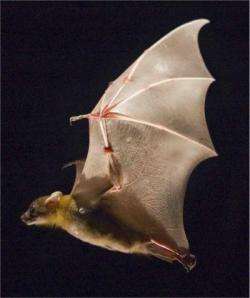
The maneuverability of a bat in flight makes even Harry Potter's quidditch performance look downright clumsy. While many people may be content to simply watch these aerial acrobats in wonder, Kenneth Breuer and Sharon Swartz are determined to understand the detailed aerodynamics of bat flight – and ultimately the evolutionary path that created it.
They have taken a major step toward that goal by combining high-resolution, three-dimensional video recordings with precise measurements of the wake field generated by the bats' wing movements. Their study, published in the journal Bioinspiration and Biomimetics, marks the first such measurements made in bats and highlights ways in which bat flight appears to differ from bird and insect flight. The results suggest the possibility that a novel lift-generating mechanism may be at work in bats and point to the highly maneuverable mammals as a model for tiny flying machines.
Breuer, a professor of engineering at Brown University, who studied mechanical aerodynamics earlier in his career, is particularly intrigued by bats because "they can generate different wing shapes and motions that other creatures can't."
"Bats have unique capabilities," says Breuer, "but the goal is not to build something that looks like a bat. We want to understand bat flight and be able to incorporate some of the features of bat flight into an engineered vehicle."
Swartz, an associate professor in ecology and evolutionary biology at Brown University, and longtime collaborator with Breuer, is particularly interested in how bats evolved their capabilities. "The assumption has always been that bats evolved from some sort of flying squirrel-type animals," says Swartz. "Gliding has evolved in mammals seven times. That tells us that it's really easy for an animal with skin to evolve into a glider, but going from a square gliding wing to a long, skinny flapping wing has not happened seven times. It might have happened once. And now it doesn't look like bats have any relationship to these gliding things."
Bat wings are highly articulated, with more than two dozen independent joints and a thin flexible membrane covering them. The videos, shot from four angles simultaneously and then synchronized, show how the complex movements of each wing stroke relate to overall flight speed, body position and angle of attack. Reflective markers placed on joints, along bones and at key points on the wing membrane allowed the researchers to accurately track the position and shape of bones throughout the wing stroke.
Birds and insects can fold and rotate their wings during flight, but bats have many more options. Their flexible skin can catch the air and generate lift or reduce drag in many different ways. During straightforward flight, the wing is mostly extended for the down stroke, but the wing surface curves much more than a bird's does – giving bats greater lift for less energy. During the up stroke, the bats fold the wings much closer to their bodies than other flying animals, potentially reducing the drag they experience. The wing's extraordinary flexibility also allows the animals to make 180-degree turns in a distance of less than half a wingspan.
The video images are impressive, but to truly understand how bats fly, the researchers needed to make the invisible visible. The research team filled the test corridor with a fine mist of non-toxic aerosol particles to trace the airflow. As each bat flies down the corridor, she (all the test subjects were female) triggers a laser imaging device, which captures the position, speed and direction of the particles in her wake.
By combining the information from dozens of flights, the research team was able to build a picture of the location and strength of the wake structure at each point in the bat's wing stroke. The detail of this first reconstruction is limited by the rate at which the laser setup can collect data, but it is clear that the aerodynamics of the bat's up stroke are quite different than what is seen in birds and insects. During the down stroke, the vortex – which generates much of the lift in flapping-wing flight – closely tracks the animal's wingtip. In the up stroke, the vortex seems to be shed from another location entirely – perhaps the animal's wrist joint.
This unusual pattern most likely results from the tremendous flexibility and articulation of the bat's wing, but it also seems to contribute to a substantial savings in the energy the animal expends. With the receipt of a new laser imaging system that will allow them to capture data at 40 times the rate they can now, the researchers look forward to a much more detailed understanding of this mechanism in the near future. They will also use the new system to examine aerobatic maneuvers such as take off, turning and landing, as well as straight flight.
Swartz and Breuer's collaboration demonstrates the great promise as well as the great challenge of cross-disciplinary cooperation. "Engineers like to control things and make many, many measurements," says Swartz, the biologist. "With a living bat, we might spend days getting them to fly through our test area a few times." Both investigators remark that it took them months to find a common language and set of expectations, but both also cite the other's insight as being among the most rewarding elements of the project.
Source: Brown University


