'Speechless' and 'Mute' help break the silence of the leaves
January 18, 2007
Stomata Development

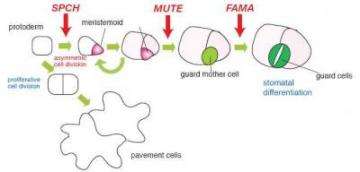
The gene Speechless drives the division that initiates stomatal development. (Without Speechless, cells become the wax-coated, interlocking pavement cells on the surface of the plant, none of which open or close.) Two or three divisions after Speechless, Mute causes the formation of a guard mother cell. Then Fama causes the guard mother cell to divide into two equal guard cells that, as their name implies, guard the opening of the stomatal pore. Credit: University of Washington

Researchers have discovered two genes that guide land plants to develop microscopic pores that they can open and close as if each pore was a tiny mouth.

Plants wouldn't have been able to move from water to land 400 million years ago if they hadn't evolved this ability, which protects them from losing too much moisture.

The leaves and stems of land plants are dotted with the "tiny mouths," called stomata. When open, stomata allow the plant to take in carbon dioxide gas needed for photosynthesis and allow moisture to evaporate, pulling water from the roots into the plant. But when too much moisture is being lost, the two cells around the stomatal pore close it completely.

Without the genes guiding stomatal development, plants won't develop any mouthlike pores, hence the names Speechless and Mute for the newly discovered genes, according to Keiko Torii, a University of Washington associate professor of biology.

Two separate papers on the genes, one by Torii's UW group and the other by Stanford University researchers, have been published online by Nature, and are scheduled to appear in the print publication Feb. 1. Each group describes independently finding the gene that came to be called Speechless and its role in initiating the process that leads to stomata.

In addition, Torii's UW group published findings in its Nature article about another gene, one they named Mute, that triggers the key middle step that decides when a cell will fully become a stomata. Earlier this year the Stanford group published findings about the gene that controls the final step in stomata development, called Fama.

"In the last few months, we've gone from knowing surprisingly little about the genes involved to knowing all three major factors – Speechless, Mute and Fama," says Lynn Pillitteri, a research associate in biology and lead author of the Nature paper.

That the three are so closely related will be of interest to biologists studying both plants and animals, she says. Each is a basic protein with a helix-loop-helix domain, a sequence that is quite ancient and controls a vast range of physiological and developmental processes. Speechless, Mute and Fama also have very similar DNA sequences and could have arisen from a single gene that replicated and evolved, giving plants additional genes with slightly different characteristics.

Having two or three genes with similar characteristics would give plants what Torii terms "the freedom to play, to make functions that are the more elaborate stomata in modern plants."

Other biologists have seen something similar in animals. The ability to differentiate cells that become muscles also is controlled by consecutive action of basic helix-loop-helix proteins with DNA closely related to each other.

Molecular conservation of such key regulatory genes between plants and animals – genes that switch on and off cell-type differentiation programs from precursor stem cells – is intriguing and exciting, Torii says.

Source: University of Washington

3.5 /5 (2 votes)  

Rank 3.5 /5 (2 votes)
Tags

Related Stories
Relevant PhysicsForums posts

More news stories

Entire genome of extinct human decoded from fossil

(PhysOrg.com) -- In 2010, Svante Pääbo and his colleagues presented a draft version of the genome from a small fragment of a human finger bone discovered in Denisova Cave in southern Siberia. The ...

Biology / Biotechnology

created Feb 07, 2012 | popularity 4.7 / 5 (58) | comments 44 | with audio podcast

Why are there so few fish in the Earth's oceans?

(PhysOrg.com) -- A Stony Brook University researcher has found that, contrary to popular belief, there are not plenty of fish in the sea.

Biology / Plants & Animals

created Feb 08, 2012 | popularity 4.3 / 5 (17) | comments 26 | with audio podcast

Miami battling invasion of giant African snails

No one knows how they got there. But an invasion of African giant snails has southern Florida in a panic over potential crop damage, disease and general yuckiness surrounding the slimy gastropods.

Biology / Ecology

created Feb 10, 2012 | popularity 4.5 / 5 (2) | comments 5

Deciding to go left or right: Researchers use device to determine that lower animals can navigate too

For decades, scientists have associated binary decision making — opting to go left or right — with higher-ranking animals, including humans. A team of Harvard researchers, however, is rewriting that ...

Biology / Plants & Animals

created Feb 09, 2012 | popularity 4 / 5 (1) | comments 4 | with audio podcast

Study shows chimps able to understand needs of others

(PhysOrg.com) -- By setting up a unique experiment, a small team of researchers has found that chimpanzees are able to understand need in other chimps, despite their general disinclination to offer aid when ...

Biology / Plants & Animals

created Feb 07, 2012 | popularity 5 / 5 (2) | comments 4 | with audio podcast report


Latin America mining boom clashes with conservation

Latin America is experiencing a mining boom as prices rise fuelled by a hike in global demand, but the region is also being hit by a wave of violent protests, strikes and rallies by environmentalists.

Love a click away in Indonesia's Twitter Republic

He was a geeky kid from Yogyakarta, she a glamorous city girl in Jakarta. In a country with one of the world's most vibrant social networking scenes they fell in love on Twitter.

Walney offshore wind farm is world's biggest (for now)

(PhysOrg.com) -- The Walney wind farm on the Irish Sea--characterized by high tides, waves and windy weather--officially opened this week. The farm is treated in the press as a very big deal as the Walney ...

GPS court ruling leaves US phone tracking unclear

A US Supreme Court decision requiring a warrant to place a GPS device on the car of a criminal suspect leaves unresolved the bigger issue of police tracking using mobile phones, legal experts say.

Europeans protest controversial Internet pact

Tens of thousands of people marched in protests in more than a dozen European cities Saturday against a controversial anti-online piracy pact that critics say could curtail Internet freedom.

Europe stakes billion-dollar bet on new rocket

A pencil-slim rocket is scheduled to lift into space from South America on Monday, carrying a billion-dollar bet that Europe can grab a juicy slice of the market to place satellites in low orbit.