Deep in arctic mud, geologists find strong evidence of climate change
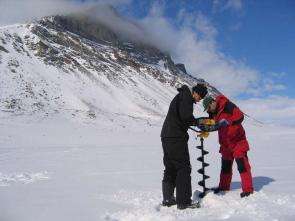
How severe will global warming get? Jason P. Briner is looking for an answer buried deep in mud dozens of feet below the surface of lakes in the frigid Canadian Arctic.
His group is gathering the first quantitative temperature data over the last millennium from areas in extreme northeastern sections of the Canadian Arctic, such as Baffin Island. Every spring, Briner, Ph.D., assistant professor of geology in the College of Arts and Sciences at the University at Buffalo, travels to the region to sample Arctic lake sediments and glaciers and analyzes them to reconstruct past climates.
"As paleoclimatologists, we want to study Earth under conditions similar to those we have today, what we call 'climate analogues,' which might tell us what to expect in the future," he said.
The Arctic as a region is an excellent harbinger of future change, Briner said, because the signals or clues that signify climate change are so much stronger in the Arctic than elsewhere on the planet.
"Yet, even when we take that phenomenon into account," he noted, "the signals we're finding on Baffin Island are huge," he said. "The temperature records, that is, the 'signal' of warmth that we're reconstructing for this part of the Canadian Arctic over the past 10,000 years seems to be higher than the global average for that period and even higher than the Arctic average."
For example, during the 'Holocene thermal maximum,' the warmest period of the past 10,000 years, the Arctic average temperature was two to three degrees warmer than it is today, while the global average was only a degree or so warmer.
"But based on lake sediments from Baffin Island, our data show that this area of the Arctic experienced temperatures five degrees warmer than today," said Briner.
Briner and his co-authors published these results last May in Quaternary Research (Vol. 65, pp. 431-442). The co-authors were N. Michelutti, formerly of the University of Alberta; D.R. Francis of the University of Massachusetts; G.H. Miller of the University of Colorado; Yarrow Axford, Briner's post- doctoral research associate at UB; M.J. Wooller of the University of Alaska, Fairbanks; and A.P. Wolfe of the University of Alberta.
Because Arctic regions show such strong seasonality, Briner explained, it's relatively easy to correlate climate changes with very fine layers in the sediments. In some lakes, each layer represents one year, with thicker sediment layers generally signaling warmer summers.
Like other paleoclimatologists, he also is finding that the warming trend that began in the 20th century is more pronounced in the Arctic than it is in the rest of the globe.
"The magnitude of warmth over the past 100 years seems pretty exceptional in the context of the past 1,000 years," he said.
"Whereas maybe an average of all of the instrument data from the globe shows just a half a degree increase in this century, in the Arctic, temperatures went up by two to three degrees in the same period."
The rapidity of the change also is exceptional, he added.
"If we look at the temperature graphs that we've generated for the past 1,000 years for this region, the temperatures wiggle back and forth, so there is a little variability in there," he said. "However, in the past 100 years, both the magnitude and the rate of temperature increase exceed all the variations of the past 1,000 years."
To do the research, Briner and his graduate students and post-doctoral associates travel to Baffin Island and other areas in extreme northeast Canada each May, while it is still winter there.
They fly to remote Eskimo villages, and then drive snowmobiles, dragging their gear behind them on sleds, for hours across the tundra and sea ice. Once they reach a good sampling site, they set up camp nearby and get to work, drilling through the ice and the water below until their equipment reaches sediments.
"The beauty of lake sediments is that they're being deposited continuously right up until yesterday," Briner said, "so by looking at them, we get clues into past climates, which we can then overlap with records from weather stations, which only cover the past 50 to 75 years."
They then send their samples -- long tubes full of mud -- back to UB, where Briner and his team analyze them. Among the clues in the cores are isotopes, fossils and increases in organic material from the accumulation of dead organisms and algae.
"Generally, the more organic matter in sediments, the warmer the climate," said Briner.
A primary goal of the research is to account for spatial variability when reconstructing past climate records.
"Everyone knows the climate is extremely variable, spatially," said Briner. "For example, earlier this year, Colorado got slammed with snow and Buffalo didn't get a flake. It's the same when we reconstruct past climates: maybe the climate cooled by 30 degrees in Greenland but only 10 degrees in the area that's now Buffalo."
Reconstructing this spatial variability will help develop a more precise view of how past changes in climate have affected the planet, Briner says, providing a guide for how the current global warming trend may unfold.
"We can use these patterns to test climate models," said Briner. "Once models can adequately predict past climates and their spatial patterns, then we have confidence that they work and so can be used to predict the future."
Briner and members of his team will present some of their data May 2-5 at the 37th Annual International Arctic Workshop in Iceland.
Source: University at Buffalo


