Nanocomposite research yields strong and stretchy fibers

January 19th, 2007

MIT engineers have produced a new strong, stretchy nanocomposite material. This micrograph shows the results of tensile stretching: The un-stretched region (above grip line) exhibits bright domains, indicating order and alignment of the polyurethane and nano-clay. Upon stretching, the dark, disorganized polymer chains become aligned and brighten in color due to polymer alignment, while the bright ordered domains become disordered or darken (below grip line). Image width=0.48 mm. Image courtesy / Gareth McKinley Lab

Creating artificial substances that are both stretchy and strong has long been an elusive engineering goal. Inspired by spider silk, a naturally occurring strong and stretchy substance, MIT researchers have now devised a way to produce a material that begins to mimic this combination of desirable properties.
Nanocomposities yield strong, stretchy fibers

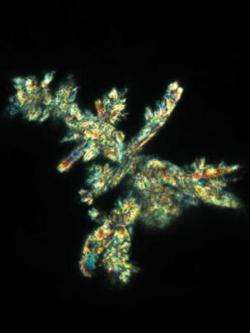
A zoomed view of a bright, ordered domain in the nanocomposite. Upon heating to temperatures above 120 degrees Celsius, the bright domains disappear. But upon annealing the material at 60 degrees C for 68 hours, the bright domains re-appear. Image width=0.18 mm. Image courtesy / Gareth McKinley Lab

Such materials, known as polymeric nanocomposites, could be used to strengthen and toughen packaging materials and develop tear-resistant fabrics or biomedical devices. Professor Gareth McKinley, graduate student Shawna Liff and postdoctoral researcher Nitin Kumar worked at MIT's Institute for Soldier Nanotechnologies (ISN) to develop a new method for effectively preparing these materials. The research appears in the January issue of Nature Materials.

Engineers are already able to create materials that are either very strong or very stretchy, but it has been difficult to achieve both qualities in the same material. In the last few years scientists have determined that the secret behind the combined strength and flexibility of spider silk lies in the arrangement of the nano-crystalline reinforcement of the silk while it is being produced.

"If you look closely at the structure of spider silk, it is filled with a lot of very small crystals," says McKinley, a professor of mechanical engineering. "It's highly reinforced."

The silk's strength and flexibility come from this nanoscale crystalline reinforcement and from the way these tiny crystals are oriented towards and strongly adhere to the stretchy protein that forms their surrounding polymeric matrix.

Liff, a Ph.D. student in mechanical engineering, and Kumar, a former MIT postdoctoral associate, teamed up to figure out how to begin to emulate this nano-reinforced structure in a synthetic polymer (A polymer or plastic consists of long chains composed of small repeating molecular units). Numerous earlier unsuccessful attempts, tackling the same issue, relied on heating and mixing molten plastics with reinforcing agents, but Liff and Kumar took a different approach: They focused on reinforcing solutions of a commercial polyurethane elastomer (a rubbery substance) with nanosized clay platelets.

They started with tiny clay discs, the smallest they could find (about 1 nanometer, or a billionth of a meter thick and 25 nanometers in diameter). The discs are naturally arranged in stacks like poker chips, but "when you put them in the right solvent, these 'nanosized poker chips' all come apart," said McKinley.

The researchers developed a process to embed these clay chips in the rubbery polymer-first dissolving them in water, then slowly exchanging water for a solvent that also dissolves polyurethane. They then dissolved the polymer in the new mixture, and finally removed the solvent. The end result is a "nanocomposite" of stiff clay particles dispersed throughout a stretchy matrix that is now stronger and tougher.

Importantly, the clay platelets are distributed randomly in the material, forming a structure much like the jumble that results when you try to stuff matches back into a matchbox after they have all spilled out.

Instead of a neatly packed arrangement, the process results in a very disorderly "jammed" structure, according to McKinley. Consequently the nanocomposite material is reinforced in every direction and the material exhibits very little distortion even when heated to temperatures above 150 degrees Celsius.

In a Nature Materials commentary that accompanied the research paper, Evangelos Manias, professor of materials science and engineering at the University of Pennsylvania, suggests that "molecular composites" such as those developed by the MIT group are especially suitable for new lightweight membranes and gas barriers, because the hard clay structure provides extra mechanical support and prevents degradation of the material even at high temperatures. One possible use for such barriers is in fuel cells.

The U.S. military is interested in such materials for use in possible applications such as tear-resistant films or other body-armor components. The military is also interested in thinner, stronger packaging films for soldiers' MREs (meals ready to eat) to replace the thick and bulky packaging now used.

Fabric companies have also expressed interest in the new materials, which can be used to make fibers similar to stretchy compounds such as nylon or Lycra. The new approach to making nanocomposites can also be applied to biocompatible polymers and could be used to make stents and other biomedical devices, McKinley said.

The research was funded by the U.S. Army through MIT's Institute for Soldier Nanotechnologies and by the National Science Foundation. McKinley's team was assisted by technical staff at the ISN, including research engineer Steven Kooi, who helped prepare special samples for transmission electron microscopy.

Source: MIT


print this article email this article download pdf blog this article bookmark this article     Digg this Stumble it share on Facebook share on Reddit add to delicious save to Yahoo! bookmarks
4.1/5 after 21 votes


January 19th, 2007 all stories
Nanotechnology / Nanomaterials

Comments: 0
Rank: 4.1/5 after 21 votes

  • Stumble this up

  • Digg this

  • Share it:
  • share on Facebook
  • share on MySpace
  • share on Slashdot
  • rss-newsfeed
  • share on Google
  • share on Reddit
  • add to delicious
  • save to Yahoo! bookmarks
  • share on Windows Live
  • Add to Mixx!
Rating: 4.1/5 after 21 votes

  • Related Stories

  • Long, Stretchy Carbon Nanotubes Could Make Space Elevators Possible
    created Jan 23, 2009 | popularity not rated yet | comments 0
  • Stretchy spider silks can be springs or rubber
    created May 31, 2008 | popularity not rated yet | comments 0
  • NIST imaging system maps nanomechanical properties
    created Dec 12, 2007 | popularity not rated yet | comments 0
  • New plastic is strong as steel, transparent
    created Oct 04, 2007 | popularity not rated yet | comments 0
  • Polymer opal films shed new kind of light on nature
    created Jul 23, 2007 | popularity not rated yet | comments 0

Tags


  • Transform a ball into a rock -- or make it invisible -- using transformation optics
    Transform a ball into a rock -- or make it invisible -- using transformation optics
    Physics / General Physics
    created 10 hours ago | popularity 3.7 / 5 (3) | comments 0
  • Could a quantum motor do work?
    Physics / General Physics
    created Jul 07, 2009 | popularity 4 / 5 (12) | comments 0
  • Physicists Demonstrate Quantum Memory with Matter Qubits
    Physicists Demonstrate Quantum Memory with Matter Qubits
    Physics / General Physics
    created Jul 03, 2009 | popularity 4.5 / 5 (20) | comments 1
  • 'Holey' Nanosheets for Wastewater Dye Removal
    Nanotechnology / Nanomaterials
    created Jul 01, 2009 | popularity 5 / 5 (5) | comments 1
  • Jellyfish Robot Swims Like its Biological Counterpart
    Jellyfish Robot Swims Like its Biological Counterpart
    Electronics / Robotics
    created Jun 26, 2009 | popularity 4.4 / 5 (9) | comments 1
  • Other News

    Nanopillars promise cheap, efficient, flexible solar cells

    Nanopillars Promise Cheap, Efficient, Flexible Solar Cells

    Nanotechnology / Nanomaterials

    created 3 hours ago | popularity 4 / 5 (4) | comments 1

    (PhysOrg.com) -- Researchers at the U.S. Department of Energy's Lawrence Berkeley National Laboratory and the University of California at Berkeley have demonstrated a way to fabricate efficient solar cells ...


    Material world: Graphene's versatility promises new applications

    Graphene's versatility promises new applications

    Nanotechnology / Nanomaterials

    created 8 hours ago | popularity 5 / 5 (2) | comments 1

    Since its discovery just a few years ago, graphene has climbed to the top of the heap of new super-materials poised to transform the electronics and nanotechnology landscape. As N.J. Tao, a researcher at the ...


    Light-absorbing nanowires may make better solar panels

    Light-absorbing nanowires may make better solar panels

    Nanotechnology / Nanomaterials

    created Jul 07, 2009 | popularity 4.1 / 5 (9) | comments 5

    (PhysOrg.com) -- A century after German physicist Gustav Mie derived the math to explain why the colors in some stained glass windows look especially resplendent in the sunlight, a team of Stanford engineers ...


    Researchers enlist DNA to bring carbon nanotubes' promise closer to reality

    Nanotechnology / Bio & Medicine

    created Jul 08, 2009 | popularity 5 / 5 (1) | comments 1

    A team of researchers from DuPont and Lehigh University has reported a breakthrough in the quest to produce carbon nanotubes (CNTs) that are suitable for use in electronics, medicine and other applications.


    'Flexible camera' replaces lens with fiber web

    'Flexible camera' replaces lens with fiber web

    Nanotechnology / Nanomaterials

    created Jul 07, 2009 | popularity 4.6 / 5 (10) | comments 0

    (PhysOrg.com) -- Imagine a soldier's uniform made of a special fabric that allows him to look in all directions and identify threats that are to his side or even behind him. In work that could turn such science ...