Ultra-Dense Optical Storage -- on One Photon
January 19, 2007
Ultra-Dense Optical Storage -- on One Photon

Enlarge

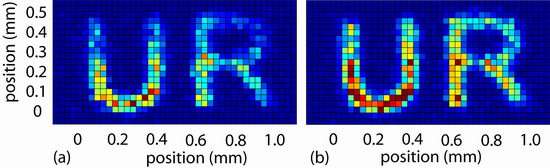
First image stored and retrieved from a single photon (Credit University of Rochester)

Researchers at the University of Rochester have made an optics breakthrough that allows them to encode an entire image's worth of data into a photon, slow the image down for storage, and then retrieve the image intact.

While the initial test image consists of only a few hundred pixels, a tremendous amount of information can be stored with the new technique.

The image, a "UR" for the University of Rochester, was made using a single pulse of light and the team can fit as many as a hundred of these pulses at once into a tiny, four-inch cell. Squeezing that much information into so small a space and retrieving it intact opens the door to optical buffering—storing information as light.

"It sort of sounds impossible, but instead of storing just ones and zeros, we're storing an entire image," says John Howell, associate professor of physics and leader of the team that created the device, which is revealed in today's online issue of the journal Physical Review Letters. "It's analogous to the difference between snapping a picture with a single pixel and doing it with a camera—this is like a 6-megapixel camera."
Ultra-Dense Optical Storage -- on One Photon
Enlarge

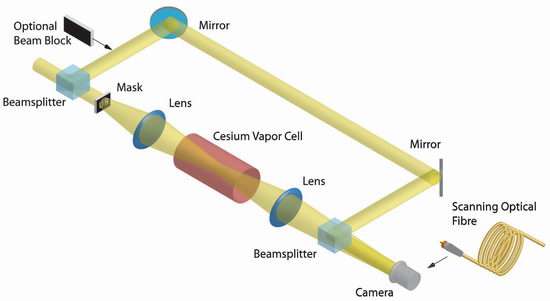
Diagram of the encoding device. Credit: University of Rochester

"You can have a tremendous amount of information in a pulse of light, but normally if you try to buffer it, you can lose much of that information," says Ryan Camacho, Howell's graduate student and lead author on the article. "We're showing it's possible to pull out an enormous amount of information with an extremely high signal-to-noise ratio even with very low light levels."

Optical buffering is a particularly hot field right now because engineers are trying to speed up computer processing and network speeds using light, but their systems bog down when they have to convert light signals to electronic signals to store information, even for a short while.

Howell's group used a completely new approach that preserves all the properties of the pulse. The buffered pulse is essentially a perfect original; there is almost no distortion, no additional diffraction, and the phase and amplitude of the original signal are all preserved. Howell is even working to demonstrate that quantum entanglement remains unscathed.

To produce the UR image, Howell simply shone a beam of light through a stencil with the U and R etched out. Anyone who has made shadow puppets knows how this works, but Howell turned down the light so much that a single photon was all that passed through the stencil.

Quantum mechanics dictates some strange things at that scale, so that bit of light could be thought of as both a particle and a wave. As a wave, it passed through all parts of the stencil at once, carrying the "shadow" of the UR with it. The pulse of light then entered a four-inch cell of cesium gas at a warm 100 degrees Celsius, where it was slowed and compressed, allowing many pulses to fit inside the small tube at the same time.

"The parallel amount of information John has sent all at once in an image is enormous in comparison to what anyone else has done before," says Alan Willner, professor of electrical engineering at the University of Southern California and president of the IEEE Lasers and Optical Society. "To do that and be able to maintain the integrity of the signal—it's a wonderful achievement."

Howell has so far been able to delay light pulses 100 nanoseconds and compress them to 1 percent of their original length. He is now working toward delaying dozens of pulses for as long as several milliseconds, and as many as 10,000 pulses for up to a nanosecond.

"Now I want to see if we can delay something almost permanently, even at the single photon level," says Howell. "If we can do that, we're looking at storing incredible amounts of information in just a few photons."

Source: University of Rochester

4.6 /5 (187 votes)  

Rank 4.6 /5 (187 votes)
Tags

Related Stories
Relevant PhysicsForums posts
  • E=mc2
    created1 hour ago
  • Are space and time things?
    created5 hours ago
  • Lock Magnet
    created9 hours ago
  • Neutrino interaction/detection?
    created12 hours ago
  • If an atom was scaled up to the size of a sports oval with a diameter of 150m...?
    created14 hours ago
  • Why no noise is added when we hear someone's voice from the other side of a wall?
    created16 hours ago
  • More from Physics Forums - General Physics

More news stories

Renowned physicist invents microscope that can peer at living brain cells

(PhysOrg.com) -- Ever since scientists began studying the brain, they’ve wanted to get a better look at what was going on. Researchers have poked and prodded and looked at dead cells under electron microscopes, ...

Physics / General Physics

created 12 hours ago | popularity 5 / 5 (12) | comments 5 | with audio podcast report

New kind of high-temperature photonic crystal could someday power everything from smartphones to spacecraft

A team of MIT researchers has developed a way of making a high-temperature version of a kind of materials called photonic crystals, using metals such as tungsten or tantalum. The new materials — which ...

Physics / Optics & Photonics

created 16 hours ago | popularity 4.9 / 5 (12) | comments 4 | with audio podcast

Searching for a solid that flows like a liquid

(PhysOrg.com) -- A series of neutron scattering experiments at Oak Ridge National Laboratory and other research centers is exploring the key question about a long-sought quantum state of matter called supersolidity: ...

Physics / Quantum Physics

created 13 hours ago | popularity 3 / 5 (1) | comments 7 | with audio podcast

Optics get magnetic powers

For decades, scientists have studied a class of materials called ‘multiferroics’ in which static electric and magnetic structures are coupled to each other. This allows capabilities such as controlling ...

Physics / General Physics

created 13 hours ago | popularity 5 / 5 (1) | comments 0

Manipulating the texture of magnetism

Knowing how to control the combined magnetic properties of interacting electrons will provide the basis to develop an important tool for advancing spintronics: a technology that aims to harness these properties ...

Physics / General Physics

created 14 hours ago | popularity 5 / 5 (2) | comments 0


Amazon fungi found that eat polyurethane, even without oxygen

(PhysOrg.com) -- Until now polyurethane has been considered non-biodegradable, but a group of students from Yale University in the US has found fungi that will not only eat and digest it, they will do so even in the absence ...

Scientists chart high-precision map of Milky Way's magnetic fields

(PhysOrg.com) -- Scientists at the Naval Research Laboratory (NRL) are part of an international team that has pooled their radio observations into a database, producing the highest precision map to date of ...

Whole exome sequencing identifies cause of metabolic disease

Sequencing a patient's entire genome to discover the source of his or her disease is not routine – yet. But geneticists are getting close.

Hearing metaphors activates brain regions involved in sensory experience

When a friend tells you she had a rough day, do you feel sandpaper under your fingers? The brain may be replaying sensory experiences to help understand common metaphors, new research suggests.

Discovery of extremely long-lived proteins may provide insight into cell aging

One of the big mysteries in biology is why cells age. Now scientists at the Salk Institute for Biological Studies report that they have discovered a weakness in a component of brain cells that may explain ...

Hackers intercept FBI, Scotland Yard call (Update)

(AP) -- Trading jokes and swapping leads, investigators from the FBI and Scotland Yard spent the conference call strategizing about how to bring down the hacking collective known as Anonymous, responsible ...