Improved Nanodots Could Be Key to Future Data Storage
January 19th, 2007 Improved nanodots could be key to future data storage

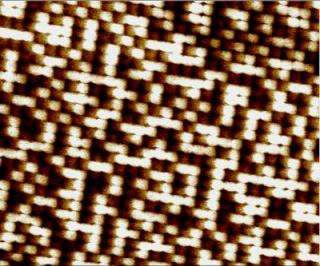
False-color image of 50-nanometer cobalt-palladium nanodots made with a magnetic force microscope provides both topographic and magnetic profiles. The darker dots are magnetized in the up direction (representing 1 in binary code) and the lighter dots are pointing down (representing 0). Credit: NIST

The massive global challenge of storing digital data--storage needs reportedly double every year--may be met with a tiny yet powerful solution: magnetic particles just a few billionths of a meter across. This idea is looking better than ever now that researchers at the National Institute of Standards and Technology (NIST) and collaborators have made nanodot arrays that respond to magnetic fields with record levels of uniformity.

The work enhances prospects for commercially viable nanodot drives with at least 100 times the capacity of today's hard disk drives.

A nanodot has north and south poles like a tiny bar magnet and switches back and forth (or between 0 and 1) in response to a strong magnetic field. Generally, the smaller the dot, the stronger the field required to induce the switch. Until now researchers have been unable to understand and control a wide variation in nanodot switching response. As described in a new paper,* the NIST team significantly reduced the variation to less than 5 percent of the average switching field and also identified what is believed to be the key cause of variability--the design of the multilayer films that serve as the starting material for the nanodots.

Nanodots, as small as 50 nanometers (nm) wide, were fabricated using electron beam lithography to pattern multilayer thin films. The key was to first lay down a tantalum "seed layer" just a few nanometers thick when making a multilayer film of alternating layers of cobalt and palladium on a silicon wafer. The seed layer can alter the strain, orientation or texture of the film. By making and comparing different types of multilayer stacks, the researchers were able to isolate the effects of different seed layers on switching behavior. They also were able to eliminate factors previously suspected to be critical, such as lithographic variations, nanodot shape or crystal grain boundaries.

Nanodots are one of two major approaches being pursued around the world as possible means of boosting the density of magnetic data storage. The other involves using a laser to heat and switch individual bits. The ultimate solution may be a combination of the two approaches, because heat reduces the strength of the magnetic field needed to switch nanodots, according to Justin Shaw, lead author of the new paper. Considerable work still needs to be done to make this type of patterned media commercially viable: Dot dimensions need to be reduced to below 10 nm; techniques to affordably fabricate quadrillions of dots per disk need to be developed; and new methods to track, read, and write these nanoscale bits need to be devised. The NIST authors collaborated with scientists at the University of Arizona, where some of the nanodot samples were made.

Citation: J.M. Shaw, W.H. Rippard, S.E. Russek, T. Reith and C.M. Falco. 2007. Origins of switching field distributions in perpendicular magnetic nanodot arrays. Journal of Applied Physics. 101, 023909 (2007), Jan. 15.

Source: National Institute of Standards and Technology


print this article email this article download pdf blog this article bookmark this article     Digg this Stumble it share on Facebook share on Reddit add to delicious save to Yahoo! bookmarks
4.5/5 after 24 votes


January 19th, 2007 all stories
Nanotechnology / General Physics

Comments: 0
Rank: 4.5/5 after 24 votes

  • Stumble this up

  • Digg this

  • Share it:
  • share on Facebook
  • share on MySpace
  • share on Slashdot
  • rss-newsfeed
  • share on Google
  • share on Reddit
  • add to delicious
  • save to Yahoo! bookmarks
  • share on Windows Live
  • Add to Mixx!
Rating: 4.5/5 after 24 votes

  • Related Stories

  • Novel Nanostructure Response Opens Possibilities for Electrical Devices
    created Nov 07, 2007 | popularity not rated yet | comments 0
  • Solar energy conversion offers a solution to help mitigate global warming
    created Mar 06, 2007 | popularity not rated yet | comments 0
  • Controlling the Vortex: a Novel Way to Create Switches
    created Jul 03, 2006 | popularity not rated yet | comments 0
  • Not-So-Spotty Material Breakthrough
    created Aug 31, 2004 | popularity not rated yet | comments 0
  • Simulations may explain nanoparticles 'pinned' to graphene
    created Apr 24, 2008 | popularity not rated yet | comments 0

Tags


  • Physicists Demonstrate Quantum Memory with Matter Qubits
    Physicists Demonstrate Quantum Memory with Matter Qubits
    Physics / General Physics
    created Jul 03, 2009 | popularity 4.4 / 5 (17) | comments 1
  • 'Holey' Nanosheets for Wastewater Dye Removal
    Nanotechnology / Nanomaterials
    created Jul 01, 2009 | popularity 5 / 5 (5) | comments 1
  • Jellyfish Robot Swims Like its Biological Counterpart
    Jellyfish Robot Swims Like its Biological Counterpart
    Electronics / Robotics
    created Jun 26, 2009 | popularity 4.4 / 5 (8) | comments 1
  • Could Maxwell's Demon Exist in Nanoscale Systems?
    Could Maxwell's Demon Exist in Nanoscale Systems?
    Physics / General Physics
    created Jun 24, 2009 | popularity 4.4 / 5 (18) | comments 29
  • Living Safely with Robots, Beyond Asimov's Laws
    Living Safely with Robots, Beyond Asimov's Laws
    Electronics / Robotics
    created Jun 22, 2009 | popularity 4.6 / 5 (52) | comments 40
  • Other News

    A 'quantum of sol' -- how nanotechnology could hold the key to a solar-powered future

    A 'quantum of sol' -- how nanotechnology could hold the key to a solar-powered future

    Nanotechnology / Nanomaterials

    created Jun 30, 2009 | popularity 3.9 / 5 (15) | comments 17

    (PhysOrg.com) -- A new generation of 'nano-structured' millimetre-sized solar cells that could convert the sun's energy to electricity more than twice as efficiently as current technology, is the subject of ...


    Australian researchers are set to begin human trials of a tiny nano-cell that acts as a "Trojan horse" against cancer

    Hi-tech 'Trojan horse' can kill cancer cells: researchers

    Nanotechnology / Bio & Medicine

    created Jun 29, 2009 | popularity 4.7 / 5 (12) | comments 7

    Australian researchers are set to begin human trials of a tiny nano-cell that acts as a "Trojan horse" against cancer cells, a breakthrough they say may curb the need for debilitating chemotherapy.


    'Holey' Nanosheets for Wastewater Dye Removal

    Nanotechnology / Nanomaterials

    created Jul 01, 2009 | popularity 5 / 5 (5) | comments 1

    (PhysOrg.com) -- Researchers have discovered that extremely thin sheets of nickel oxide with hexagonally shaped holes can absorb hazardous dyes from wastewater nearly as well as the best traditional methods, but are recyclable. ...


    Harnessing Nanoparticles To Track Cancer Cell Changes

    Nanotechnology / Bio & Medicine

    created Jul 03, 2009 | popularity not rated yet | comments 1

    The more dots there are, the more accurate a picture you get when you connect them. Cancer researchers adopting that philosophy have developed a new imaging technology that could give scientists the ability to simultaneously ...


    Computer-Guided Nanoparticle Therapy Destroys Tumors

    Nanotechnology / Bio & Medicine

    created Jun 29, 2009 | popularity 4.9 / 5 (12) | comments 0

    Gold nanoshells are among the most promising new nanoscale therapeutics being developed to kill tumors, acting as antennas that turn light energy into heat that cooks cancer to death. Now, a multi-institutional research team ...