New Miniaturized Device for Lab-on-a-Chip Separations
January 19th, 2007 New Miniaturized Device for Lab-on-a-Chip Separations

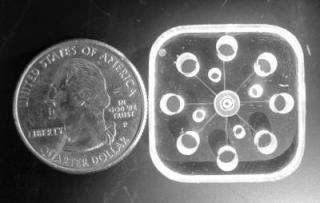
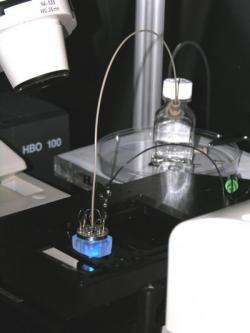
Core of the new NIST miniature GEMBE chemical separation device (above left) is a machined acrylic block, shown with a quarter for scale. Eight sample resevoirs for multiplexed separations form a ring around the central buffer solution port. (Smaller holes are for assembly screws.) At right: prototype in use. Credit: NIST

Researchers at the National Institute of Standards and Technology have developed an elegantly simple, miniaturized technique for rapidly separating minute samples of proteins, amino acids and other chemical mixtures. A low-cost prototype device described in a recent paper can run up to eight separations simultaneously in a space about the size of a quarter, highlighting the technique's potential for use in microfluidic "lab-on-a-chip" systems.
New Miniaturized Device for Lab-on-a-Chip Separations
Conventional electrophoresis instruments separate mixtures of electrically charged species--DNA fragments, for example--by injecting a discrete sample of the mixture at one end of a chemical race track, such as a capillary tube filled with a buffer solution, and applying a high voltage between the sample and the other end of the track.

Depending on their size, charge and chemical "mobility," the individual components of the mixture move down the track at different rates, gradually separating into individual bands. If two of the components move at very similar rates, it will require a relatively long channel--up to 50 centimeters or longer--to separate them effectively.

The new NIST technique, "gradient elution moving boundary electrophoresis" (GEMBE), works instead by opposing the movement of the mixture's components with a stream of buffering solution flowing at a variable rate. Like salmon swimming upstream, only the most mobile components can move up the channel against the highest buffer flow rates, but as that flow is reduced gradually, lesser mobility components begin to move. A sensor placed over the channel detects each new component as it arrives,

GEMBE is ideally suited for use in microfluidic "lab-on-a-chip" devices. Components are selected by buffer flow-rate rather than distance, so the channel can be very short--less than a centimeter in NIST prototypes. It doesn't require injection of a discrete sample, which greatly simplifies chip plumbing. By precisely controlling the flow rate, a particular component can be "parked" under the detector as long as desired to get a good signal, and the device can be adjusted easily to accommodate different separations. The device is easy to build with simple machining or molding techniques and low-cost polymers, enabling inexpensive mass production.

The technique has been validated at NIST with separations ranging from small dye molecules and amino acids to larger biomolecules, such as DNA. A prototype eight-channel GEMBE device built at NIST can produce a complete immunoassay calibration curve for insulin in a single run. NIST is applying for a patent on the method.

Citation: J.G. Shackman, M.S. Munson and D. Ross. "Gradient elution moving boundary electrophoresis for high-throughput multiplexed microfluidic devices." Anal. Chem., 79 (2), 565 -571, 2007. 10.1021/ac061759h S0003-2700(06)01759-8 on line at http://pubs.acs.org/cgi-bin/abstract.cgi/ancham/2007/79/i02/abs/ac061759h.html

Source: National Institute of Standards and Technology


print this article email this article download pdf blog this article bookmark this article     Digg this Stumble it share on Facebook share on Reddit add to delicious save to Yahoo! bookmarks
5/5 after 4 votes


January 19th, 2007 all stories
Chemistry /

Comments: 0
Rank: 5/5 after 4 votes

  • Stumble this up

  • Digg this

  • Share it:
  • share on Facebook
  • share on MySpace
  • share on Slashdot
  • rss-newsfeed
  • share on Google
  • share on Reddit
  • add to delicious
  • save to Yahoo! bookmarks
  • share on Windows Live
  • Add to Mixx!
Rating: 5/5 after 4 votes

  • Related Stories

  • Scientists develop novel ion trap for sensing force and light
    created Jul 01, 2009 | popularity not rated yet | comments 0
  • Flexible memristor: Memory with a twist (w/Video)
    created Jun 02, 2009 | popularity not rated yet | comments 0
  • Cracking a Tough Nut for the Semiconductor Industry
    created Dec 23, 2008 | popularity not rated yet | comments 0
  • Bottoms up: Better organic semiconductors for printable electronics
    created Sep 04, 2008 | popularity not rated yet | comments 0
  • 'Nanoglassblowing' Seen as Boon to Study of Individual Molecules
    created Jun 11, 2008 | popularity not rated yet | comments 0

Tags


  • Physicists Demonstrate Quantum Memory with Matter Qubits
    Physicists Demonstrate Quantum Memory with Matter Qubits
    Physics / General Physics
    created Jul 03, 2009 | popularity 4.4 / 5 (17) | comments 1
  • 'Holey' Nanosheets for Wastewater Dye Removal
    Nanotechnology / Nanomaterials
    created Jul 01, 2009 | popularity 5 / 5 (5) | comments 1
  • Jellyfish Robot Swims Like its Biological Counterpart
    Jellyfish Robot Swims Like its Biological Counterpart
    Electronics / Robotics
    created Jun 26, 2009 | popularity 4.4 / 5 (8) | comments 1
  • Could Maxwell's Demon Exist in Nanoscale Systems?
    Could Maxwell's Demon Exist in Nanoscale Systems?
    Physics / General Physics
    created Jun 24, 2009 | popularity 4.4 / 5 (18) | comments 29
  • Living Safely with Robots, Beyond Asimov's Laws
    Living Safely with Robots, Beyond Asimov's Laws
    Electronics / Robotics
    created Jun 22, 2009 | popularity 4.6 / 5 (54) | comments 40
  • Other News

    Researchers demonstrate reversible generation of a high capacity hydrogen storage material

    Chemistry / Materials Science

    created 3 hours ago | popularity 4.5 / 5 (2) | comments 0

    Researchers at the U.S. Department of Energy's Savannah River National Laboratory have created a reversible route to generate aluminum hydride, a high capacity hydrogen storage material. This achievement is not only expected ...


    New method for detecting nitroxyl will boost cardiac drug research

    New method for detecting nitroxyl will boost cardiac drug research

    Chemistry / Biochemistry

    created 8 hours ago | popularity not rated yet | comments 0

    Wake Forest University scientists have developed a new research tool in the pursuit of heart medications based on the compound nitroxyl by identifying unique chemical markers for its presence in biological ...


    Scientists find a biological 'fountain of youth' in new world bat caves

    Chemistry / Biochemistry

    created Jun 30, 2009 | popularity 3.9 / 5 (29) | comments 32

    Scientists from Texas are batty over a new discovery which could lead to the single most important medical breakthrough in human history -- significantly longer lifespans. The discovery, featured on the cover of the July ...


    urine

    Producing hydrogen from urine

    Chemistry / Analytical Chemistry

    created Jul 03, 2009 | popularity 4.6 / 5 (39) | comments 18

    (PhysOrg.com) -- You do two things at motorway services: fill up one tank and empty another. US chemists have combined refuelling your car and relieving yourself by creating a new catalyst that can extract ...


    Stanford researchers find a quicker, cheaper way to sort isotopes

    Researchers find quicker, cheaper way to sort isotopes

    Chemistry / Analytical Chemistry

    created Jun 29, 2009 | popularity 5 / 5 (2) | comments 3

    (PhysOrg.com) -- Whether it's the summer grass that tickles your feet or the red Bordeaux smacking on your palette, nearly every part of the world around you carries special chemical markers. These markers, ...