NIST 'Standard Bullet' fights gang violence
January 19, 2007 NIST 'Standard Bullet' fights gang violence

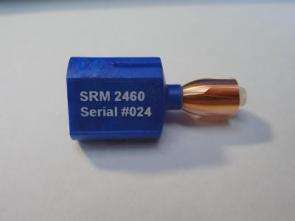
A NIST Standard Reference Material 2460 "standard bullet" mounted on a blue stub. Each one has six signature markings typically found in a fired bullet. SRM 2460 is intended primarily for use as a check for crime laboratories to help verify that the computerized optical equipment for bullet imaging and profiling is operating properly. Credit: NIST

Researchers at the National Institute of Standards and Technology (NIST) have developed a copper bullet designed to help end criminal sprees without once being fired. Crime laboratories can use NIST's "Standard Bullet" to optimize the settings of computerized optical imaging instruments used to match markings on fired bullets from a suspected weapon.

Analyzing bullet markings in order to trace guns used in multiple crimes, such as gang activities, is possible because a gun's firing pin, rifling, breech face and ejection mechanism can impart unique markings, called "signatures" on fired bullets or ejected casings. Comparison (dual) optical microscopes allow forensic experts to compare signature features as small as a micrometer or one fortieth the width of a human hair.

Digital imaging systems are used to gather and store bullet signatures in forensic databases, and it's important for these systems to record the best possible images. Crime labs can test the quality of their imaging systems by taking pictures of NIST's Standard Bullet and evaluating how well their system's analysis of the bullet's signature matches up with a certified signature provided by the Institute.

To make the Standard Bullet, NIST traced surface topography profiles on six master bullets fired by the Bureau of Alcohol, Tobacco, Firearms and Explosives (ATF) and the Federal Bureau of Investigation (FBI). Researchers fed the data to a computer-controlled diamond turning machine to engrave six typical bullet signatures on the standard. After machining, a specially designed chemical etching process was used to roughen the surface of the bullet to make it appear like a real bullet when observed under an optical microscope.

Earlier efforts at standard bullets produced by real guns could show minute changes in signatures due to gun wear and environmental conditions. However, since the signatures and dimensions of the NIST Standard Bullet are recorded for manufacture, subsequent copies are essentially identical. The etched and corrosion-protected NIST Standard Bullet is certified for use until June 30, 2016. In 2007, NIST hopes to produce a complementary standard for ejected casings by a different fabrication procedure. The bullet and casing reference standards will support the National Integrated Ballistics Information Network (NIBIN) goal of establishing nationwide ballistics traceability, measurement unification and quality control. NIBIN is a joint project of the FBI and the ATF.

Source: National Institute of Standards and Technology


print this article email this article download pdf blog this article bookmark this article     Stumble it Digg this share on Facebook retweet share on Reddit add to delicious
Rate this story - 4.1 /5 (9 votes)


January 19, 2007 all stories

Comments: 0

4.1 /5 (9 votes)
  • Stumble this up

  • Digg this

  • share this

  • hide
  • Related Stories

  • Improving speed measurements for cars, bullets
    created May 21, 2009 | popularity not rated yet | comments 0
  • NIST Bullet Tests Make Frangibles More Tangible
    created Jun 08, 2006 | popularity not rated yet | comments 0
  • Google hopes readers will 'flip' over new format
    created Sep 14, 2009 | popularity not rated yet | comments 0
  • Electronic health records are valuable but won't be a panacea
    created Apr 29, 2009 | popularity not rated yet | comments 0
  • Possible Fifth Force Would Make Direct Detection of Dark Matter Unlikely
    created Mar 26, 2009 | popularity not rated yet | comments 0


  • hide
  • Relevant PhysicsForums posts

  • Bread Board
    created 7 hours ago
  • Student team - building a satellite - want to join - problem:i'm a biotech student.
    created Nov 13, 2009
  • Motor Driver
    created Nov 13, 2009
  • Thermocouple Probe Selection
    created Nov 12, 2009
  • More from Physics Forums - General Engineering

Other News

Google digital book ambitions hinge on settlement (AP)

Google makes concessions on digital book deal (Update)

Technology / Internet

created 14 hours ago | popularity 5 / 5 (1) | comments 2

(AP) -- Google Inc. will loosen its control over millions of copyright-protected books that will be added to its digital library if a federal judge approves a revised legal settlement addressing the earlier ...


Aircraft that can see for themselves

Aircraft that can see for themselves (w/ Video)

Technology / Engineering

created 14 hours ago | popularity 5 / 5 (7) | comments 0

(PhysOrg.com) -- Australian researchers have made two important advances in the development of unmanned aircraft capable of seeing for themselves as they fly fast and low over dangerous terrain.


Road trains may be coming soon to Europe

Road trains may be coming soon to Europe (w/ Video)

Technology / Engineering

created Nov 13, 2009 | popularity 4.8 / 5 (11) | comments 17

(PhysOrg.com) -- Road trains linking vehicles together in a traveling convoy are planned for Europe. With only the lead vehicle being actively driven, the road trains would allow commuters to sleep, read a ...


A system of space solar power system (SSPS)

Japan eyes solar station in space as new energy source

Technology / Energy

created Nov 08, 2009 | popularity 4.8 / 5 (21) | comments 28

It may sound like a sci-fi vision, but Japan's space agency is dead serious: by 2030 it wants to collect solar power in space and zap it down to Earth, using laser beams or microwaves.


Cars sit in traffic on a highway

Netherlands to levy 'green' road tax by the kilometre

Technology / Hi Tech

created Nov 13, 2009 | popularity 3 / 5 (4) | comments 7

The Dutch government said Friday it wants to introduce a "green" road tax by the kilometre from 2012 aimed at cutting carbon dioxide emissions by 10 percent and halving congestion.