Motor protein plays key role in connecting neurons
January 22nd, 2007 Myosin X

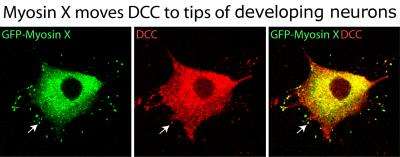
Myosin X is fused with green fluorescent protein so scientists can track its movement. Credit: Phil Jones

A motor protein called myosin X runs the main road of a developing neuron, delivering to its tip a receptor that enables it to communicate with other neurons, scientists say.

In another piece of the puzzle of how neurons form connections, researchers have found myosin X travels a portion of a neuron's backbone called the actin filament, a sort of two-way highway in the cell's highest traffic area, says Dr. Wen-Cheng Xiong, developmental neurobiologist at the Medical College of Georgia.

Part of its cargo is DCC receptor which needs to move from the central nucleus where it's synthesized to the cell's periphery, Dr. Xiong and her colleagues report in the February issue of Nature Cell Biology and available online Jan. 21.

At the periphery, DCC interacts with netrin-1, a guidance cue for helping the arm-like extension of the cell, called the axon, grow in the right direction. Cells eventually communicate through synapses at the end of these cellular projections.

"During early development, axons need to grow, they need to find a target, they need to decide how long to grow, which direction to grow. Eventually they will form a synapse," says Dr. Xiong, who is dissecting how neurons first connect with the goal of helping restore communication lost in spinal cord injuries and other disorders.

"Growth is precisely controlled during development," she says and errant growth can impair brain wiring or connectivity. "Myosin X gets the DCC receptor where it needs to be so it can interact with netrin-1."

Her previous studies, published in 2004 in Nature Neuroscience, showed that DCC binding to netrin-1, activates an enzyme, focal adhesion kinase, enabling developing cells to reorganize and intuitively know how to move. The process enables brain cells to reach out to each other and across the midline of the developing brain and spinal cord. When the kinase is deleted, the axon doesn't make the proper connections.

When researchers cut off myosin X's motor – which they believe happens in spinal cord injuries – axon outgrowth also was hindered.

"Myosin X plays a critical role in neurons during development," says Dr. Xiong. Different versions of the myosin family proteins are critical to essentially every cell including muscle cells and those that turnover and divide rapidly, such as skin and intestinal cells, and eggs or oocytes.

The rapidly moving protein is easily degraded and needs tight regulation. "If you don't want to have dramatic changes in your neuron structure, you don't want this molecule," she says.

In fact, she suspects the function of myosin X changes as the neuron develops. She has documented that in late stages of development, when the axon needs to stop growing, a shorter molecule, minus the motor, is expressed. "Probably after the neuron is developed, the major work of myosin is done. There are many cleavage sites in the middle and this typically large molecule can be cut down to a small molecule that actually inhibits axon growth function," Dr. Xiong says.

She suspects that negative function surfaces when the spinal cord is cut and plans to examine whether the protein is degraded in spinal cord injuries. "We already have evidence that if this protein degrades, most frequently without its motor domain, it becomes negative, inhibits DCC getting to the proper place and so axonal growth," Dr. Xiong says.

Source: Medical College of Georgia


print this article email this article download pdf blog this article bookmark this article     Digg this Stumble it share on Facebook share on Reddit add to delicious save to Yahoo! bookmarks
not rated yet


January 22nd, 2007 all stories
Medicine & Health / Research

Comments: 0
Rank: not rated yet

  • Stumble this up

  • Digg this

  • Share it:
  • share on Facebook
  • share on MySpace
  • share on Slashdot
  • rss-newsfeed
  • share on Google
  • share on Reddit
  • add to delicious
  • save to Yahoo! bookmarks
  • share on Windows Live
  • Add to Mixx!
Rating: not rated yet

  • Related Stories

  • Scientists discover molecular defect involved in hearing loss
    created May 13, 2009 | popularity not rated yet | comments 0
  • Intestinal cells surprisingly active in pursuit of nutrition and defense
    created Jun 29, 2009 | popularity not rated yet | comments 0
  • Muscle atrophy through thick but not thin
    created Jun 08, 2009 | popularity not rated yet | comments 0
  • Autopilot guides proteins in brain
    created Apr 21, 2009 | popularity not rated yet | comments 0
  • Why 'lazy Susan' has a weak heart
    created Mar 05, 2009 | popularity not rated yet | comments 0

Tags


  • Transform a ball into a rock -- or make it invisible -- using transformation optics
    Transform a ball into a rock -- or make it invisible -- using transformation optics
    Physics / General Physics
    created 10 hours ago | popularity 3.7 / 5 (3) | comments 0
  • Could a quantum motor do work?
    Physics / General Physics
    created Jul 07, 2009 | popularity 4 / 5 (12) | comments 0
  • Physicists Demonstrate Quantum Memory with Matter Qubits
    Physicists Demonstrate Quantum Memory with Matter Qubits
    Physics / General Physics
    created Jul 03, 2009 | popularity 4.3 / 5 (21) | comments 1
  • 'Holey' Nanosheets for Wastewater Dye Removal
    Nanotechnology / Nanomaterials
    created Jul 01, 2009 | popularity 5 / 5 (5) | comments 1
  • Jellyfish Robot Swims Like its Biological Counterpart
    Jellyfish Robot Swims Like its Biological Counterpart
    Electronics / Robotics
    created Jun 26, 2009 | popularity 4.4 / 5 (9) | comments 1
  • Other News

    Humans may give swine flu to pigs in new twist to pandemic

    Medicine & Health / Research

    created 2 hours ago | popularity not rated yet | comments 2

    The strain of influenza, A/H1N1, that is currently pandemic in humans has been shown to be infectious to pigs and to spread rapidly in a trial pig population.


    Diets bad for teeth are also bad for the body

    Medicine & Health / Other

    created 4 hours ago | popularity 4 / 5 (1) | comments 0

    (PhysOrg.com) -- Dental disease may be a wake-up call that your diet is harming your body.


    Reduced diet thwarts aging, disease in monkeys

    Reduced diet thwarts aging, disease in monkeys

    Medicine & Health / Research

    created 9 hours ago | popularity 5 / 5 (3) | comments 1

    (PhysOrg.com) -- The bottom-line message from a decades-long study of monkeys on a restricted diet is simple: Consuming fewer calories leads to a longer, healthier life.


    Newborn brain cells show the way

    Newborn brain cells show the way

    Medicine & Health / Research

    created 6 hours ago | popularity 5 / 5 (2) | comments 0

    Although the fact that we generate new brain cells throughout life is no longer disputed, their purpose has been the topic of much debate. Now, an international collaboration of researchers made a big leap ...


    Scientists link elevated insulin to increased breast cancer risk

    Medicine & Health / Cancer

    created 3 hours ago | popularity not rated yet | comments 0

    Elevated insulin levels in the blood appear to raise the risk of breast cancer in postmenopausal women, according to researchers at Albert Einstein College of Medicine of Yeshiva University. Their findings are published in ...