Sandia develops next generation of screening devices
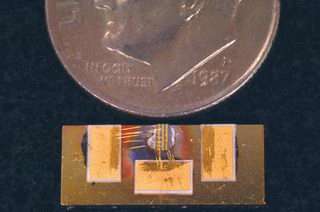
It might not be science fiction much longer. Researchers at Sandia National Laboratories are developing the next generation of screening devices that will identify hazardous and toxic materials even if concealed by clothing and packaging materials.
Working in the underutilized terahertz (THz) portion of the electromagnetic spectrum that lies between microwaves and infrared, a team of Labs scientists is harnessing Sandia's strengths in a variety of technical areas with the goal of building a highly integrated miniaturized terahertz transmitter-receiver (transceiver) that could make a number of applications possible.
The project, the Terahertz Microelectronics Transceiver Grand Challenge, is in its second of three years of funding through Sandia's internal Laboratory Directed Research and Development program.
"The technology being developed in the Grand Challenge can be used to scan for items such as concealed weapons or materials, explosives, and weapons of mass destruction," says Mike Wanke, principal investigator. "In addition, we believe it will find applications in advanced communication systems and high-resolution radars. However, the infrastructure needed to move the terahertz technology from the laboratory to the field is unavailable right now. We want to develop that infrastructure and invent the necessary technologies."
Wanke says over the past three years, "the terahertz situation has begun to change dramatically, primarily due to the revolutionary development of terahertz quantum cascade lasers."
These tiny lasers are semiconductor sources of terahertz radiation capable of output powers in excess of 100 mW. Previously, such powers could only be obtained by molecular gas lasers occupying cubic meters and weighing more than 100 kg, or free electron lasers weighing tons and occupying entire buildings.
Quantum cascade laser-based systems can be less than the size of a baseball and powered from a nine-volt battery. Sandia has been a leader in developing this new technology and in collaboration with MIT is responsible for several world performance records for the lasers. Also, the Labs and its partners are the only US institutions that have demonstrated the ability to grow the unique semiconductor crystals such that they can be turned into operating terahertz quantum cascade lasers. The crystals are grown by Sandia research scientist John Reno, an expert in molecular beam epitaxy, a method of laying down layers of materials with atomic thicknesses onto substrates.
Sandia researchers spent the first year of the Grand Challenge using Sandia's unique strengths in integrated microelectronics and device physics to develop components that are now being combined to create an integrated THz microelectronic transceiver, a core enabling element.
The team is currently developing the receiver, doing systems tests and exploring packaging requirements. At the end of three years, the researchers expect to have an actual working prototype capable of detecting the materials and chemicals by reading distinctive molecular spectral "signatures."
"Most materials and chemicals have their own unique terahertz spectral signatures," Wanke says. "A terahertz transceiver system would be able to measure, for example, the signature of a gas and determine what it is."
"Atmospheric scientists and radio astronomers have spent years developing terahertz spectral signature databases to identify chemicals in nebula and planetary atmospheres," says Greg Hebner, program manager. "Even though the current devices are washing machine-sized, they are located in a few observatories, and one is even flying on a satellite. To address specific national security problems, we are working on reducing the size, weight, and power requirement as well as expanding the existing spectral databases."
In addition to monitoring for concealed hazardous materials, Mike believes a terahertz system can be used to monitor the air for toxic materials. Using air sampling technology developed at Sandia and other locations, hazardous vapors can be preconcentrated. Shining light from the quantum cascade laser through the concentrated sample provides a direct identification of the vapor. This technology can be used in conjunction with existing mass spectrometer-based systems to reduce false identifications.
"We are very optimistic about working in the terahertz electromagnetic spectrum," Wanke says. "This is an unexplored area and a lot of science can come out of it. We are just beginning to scratch the surface of what THz can do to improve national security."
Source: Sandia National Laboratories


