North America's wind patterns shifted significantly in the past 30,000 years
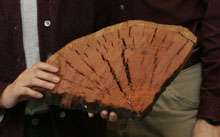
Dartmouth researchers have learned that the prevailing winds in the mid latitudes of North America, which now blow from the west, once blew from the east. They reached this conclusion by analyzing 14,000- to 30,000-year-old wood samples from areas in the mid-latitudes of North America (40-50°N), which represents the region north of Denver and Philadelphia and south of Winnipeg and Vancouver.
The researchers report their findings online on Jan. 23 in the journal Geology, published by the Geological Society of America.
"Today in the mid-latitude zone of North America, marine moisture is transported either from the west coast by westerly winds, or from both the west and east coasts by storms," says Xiahong Feng, the paper's lead author and a professor of earth sciences. "In this study, we found evidence that during the last glacial period, about 14-36 thousand years ago, the prevailing wind in this zone was easterly, and marine moisture came predominantly from the East Coast."
Feng explains that global climate change is often manifested by changes in general atmospheric circulation, i.e. winds, and this results in changing temperature and precipitation patterns. Clues of past climates usually hint at temperature and precipitation changes, but this is the first time that changing continental wind patterns have been reconstructed.
The researchers gathered their evidence using oxygen and hydrogen isotopic compositions of cellulose extracted from ancient wood. Feng and her team interpret the historic prevailing easterlies to be a result of a growing and intensifying northern circumpolar vortex, which was influenced by the powerful Laurentide Ice Sheet, an enormous mass of ice that covered a great deal of northern North America. Under this circulation regime, the jet stream shifted southward, and as a result, the Pacific Northwest received much less marine moisture from the Pacific. This is consistent with earlier studies of vegetation in the Pacific Northwest, indicating that the region was significantly drier during the last glaciation.
"This study is likely to open up new avenues of research based on oxygen and hydrogen isotopes in old wood," says Feng. "Climate change involves interactions among temperature, precipitation, and wind, but until now research has rarely been able to observe or confirm prehistoric winds and their continental-scale patterns. In the future, studies using this methodology will be able to look into ancient climates through a new window, and test hypotheses about climate change mechanisms. Such studies can potentially lead to more realistic formulations of future climate scenarios and better evaluations of their plausibility."
"This study began as Allison Reddington's undergraduate honors thesis," says Feng. "This exemplifies the extraordinary opportunities that undergraduates at Dartmouth have to become integral parts of research groups."
Source: Dartmouth College


