What Will GLAST Tell Us?
January 23rd, 2007 What Will GLAST Tell Us?

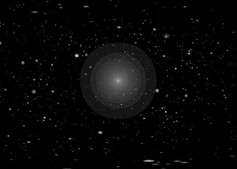
A simulated image of gamma-ray sources from dark matter annihilations in a model galaxy. Image courtesy of James E. Taylor and Arif Babul

The identity of dark matter—the mysterious stuff that makes up a quarter of the universe—continues to elude scientists, even decades after they first inferred its existence. The leading candidate that might explain the fundamental make-up of dark matter is a hypothetical particle called the weakly interacting massive particle (WIMP). Soon, with the Gamma-Ray Large Area Telescope (GLAST) built in part at SLAC and scheduled for launch in August of 2007, scientists may finally find clear evidence that dark matter is indeed made of WIMPs.

Gamma-rays—the most energetic form of light—originate from a multitude of mysterious sources, like black holes or exploding stars. But current theory suggests they can also come from WIMPs. Scientists believe WIMPs can interact with themselves, annihilating each other and releasing a flurry of secondary particles as well as gamma-rays. Using GLAST, scientists hope to find these high-energy signatures of dark matter in our galaxy. If they succeed, this discovery would help solve one of astronomy's grandest puzzles.

"With GLAST, we hope to actually see individual dark matter annihilations," said Michael Peskin, professor of theoretical physics at SLAC. Ted Baltz, a Kavli Institute for Particle Astrophysics and Cosmology (KIPAC) researcher who also works on the GLAST project, added, "GLAST has the real possibility of making a fundamental contribution to understanding what galaxies are made of."

Even though it is much more weakly interacting than ordinary matter, dark matter is not spread out evenly through space and should form clumps in galaxies. If dark matter is in fact composed of WIMPS, this clumping would improve the chances of these particles meeting and annihilating, producing steady streams of gamma rays detectable by GLAST.

The trick will be distinguishing gamma rays generated by dark matter events from those generated by numerous other sources in the universe. To differentiate between the two, researchers have established a set of four guidelines. Theory predicts that WIMP annihilations will create gamma rays of particular wavelengths, distinct from those generated by other sources like black holes or exploding stars.

Dark matter annihilations should produce gamma rays exclusively, ruling out interactions that involve other kinds of radiation. These signals should appear to GLAST not as point sources, but as large patches in the sky—some nearly twice as big as the full moon. Finally, these streams of gamma rays would be continuous, a marked difference from the fleeting explosions of gamma-ray bursts that last only a few milliseconds to several minutes. If scientists find a signal with all these characteristics, chances are good that they have found a source of WIMP annihilation.

Along with numerous other dark-matter experiments, such as searches for WIMP collisions in underground detectors and attempts to manufacture WIMPs at the Large Hadron Collider (LHC) at CERN, many scientists believe the existence of WIMPS could be confirmed within the next few years.

"I think there's a lot of hope in this business," Baltz said. "If GLAST doesn't see anything, and the LHC doesn't see anything, a lot of people will be surprised. But, we've been wrong before."

Source: Stanford Linear Accelerator Center, by Marcus Woo


print this article email this article download pdf blog this article bookmark this article     Digg this Stumble it share on Facebook share on Reddit add to delicious save to Yahoo! bookmarks
4.1/5 after 21 votes


January 23rd, 2007 all stories
Physics / General Physics

Comments: 0
Rank: 4.1/5 after 21 votes

  • Stumble this up

  • Digg this

  • Share it:
  • share on Facebook
  • share on MySpace
  • share on Slashdot
  • rss-newsfeed
  • share on Google
  • share on Reddit
  • add to delicious
  • save to Yahoo! bookmarks
  • share on Windows Live
  • Add to Mixx!
Rating: 4.1/5 after 21 votes

  • Related Stories

  • Possible Fifth Force Would Make Direct Detection of Dark Matter Unlikely
    created Mar 26, 2009 | popularity not rated yet | comments 0
  • GLAST Observatory reveals entire gamma-ray sky
    created Aug 26, 2008 | popularity not rated yet | comments 0
  • Study shows clumps and streams of dark matter in inner regions of the Milky Way
    created Aug 06, 2008 | popularity not rated yet | comments 0
  • Seeing the universe through gamma-ray eyes
    created Jul 09, 2008 | popularity not rated yet | comments 0
  • Looking for New Light
    created Jun 19, 2008 | popularity not rated yet | comments 0

Tags


  • Physicists Demonstrate Quantum Memory with Matter Qubits
    Physicists Demonstrate Quantum Memory with Matter Qubits
    Physics / General Physics
    created Jul 03, 2009 | popularity 4.4 / 5 (17) | comments 1
  • 'Holey' Nanosheets for Wastewater Dye Removal
    Nanotechnology / Nanomaterials
    created Jul 01, 2009 | popularity 5 / 5 (5) | comments 1
  • Jellyfish Robot Swims Like its Biological Counterpart
    Jellyfish Robot Swims Like its Biological Counterpart
    Electronics / Robotics
    created Jun 26, 2009 | popularity 4.4 / 5 (8) | comments 1
  • Could Maxwell's Demon Exist in Nanoscale Systems?
    Could Maxwell's Demon Exist in Nanoscale Systems?
    Physics / General Physics
    created Jun 24, 2009 | popularity 4.4 / 5 (18) | comments 29
  • Living Safely with Robots, Beyond Asimov's Laws
    Living Safely with Robots, Beyond Asimov's Laws
    Electronics / Robotics
    created Jun 22, 2009 | popularity 4.6 / 5 (52) | comments 40
  • Other News

    UQ researchers break the law -- of physics

    Physics / General Physics

    created 2 hours ago | popularity 4.6 / 5 (7) | comments 0

    (PhysOrg.com) -- Two UQ Science researchers have proved two famous physical laws that have been widely used for the past 25 years do not always work.


    Scientists create first electronic quantum processor

    Scientists create first electronic quantum processor

    Physics / General Physics

    created Jun 28, 2009 | popularity 4.8 / 5 (54) | comments 41

    A team led by Yale University researchers has created the first rudimentary solid-state quantum processor, taking another step toward the ultimate dream of building a quantum computer.


    Science journals

    How to Spot an Influential Paper Based on its Citations

    Physics / General Physics

    created Jul 04, 2009 | popularity 3.9 / 5 (10) | comments 6

    (PhysOrg.com) -- At first it may seem that the number of citations received by a published scientific paper is directly related to that paper's quality of content. The higher the quality, the more people read ...


    Fermilab's CDF observes Omega-sub-b baryon

    Fermilab's CDF observes Omega-sub-b baryon

    Physics / General Physics

    created Jun 29, 2009 | popularity 4.7 / 5 (17) | comments 7

    (PhysOrg.com) -- At a recent physics seminar at the Department of Energy’s Fermi National Accelerator Laboratory, Fermilab physicist Pat Lukens of the CDF experiment announced the observation of a new particle, ...


    New insights, and a new angle, on high-temperature superconductivity

    New insights, and a new angle, on high-temperature superconductivity

    Physics / Superconductivity

    created Jun 29, 2009 | popularity 4.8 / 5 (13) | comments 6

    (PhysOrg.com) -- A Princeton-led research team has revealed surprising information about how electron behavior influences the conduction of electricity in a class of high-temperature superconductors. An increased ...