Wanderlust -- deep-sea fauna under Antarctic ice shelf
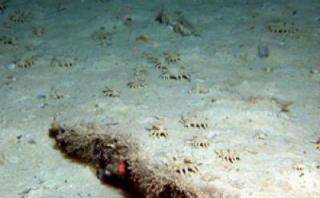
Under the former Larsen ice shelf east of the Antarctic Peninsula, deep-sea sea cucumbers and stalked feather stars were ubiquitously found in shallow waters. These animals usually inhabit far greater water depths.
The main aim of the current Polarstern expedition to Antarctica is the investigation of marine ecosystems under the former Larsen ice shelf. This "white spot" with regard to biodiversity research gave rise to the following questions: What kind of life actually existed under the former floating ice shelf which was up to several hundreds of meters thick? What are the prospects for the future after the collapse of the ice shelf?
Obviously, prosperous life did not exist in the area where the Larsen B ice shelf broke off three years ago. This is surprising since Antarctica's seafloor communities are known for their rich assemblages of sessile sponges, cnidarians and moss animals. Instead, underwater video footage and catches of towed sampling gear revealed the dominance of typical deep-sea animals and corresponding life forms.
Here, sea cucumbers and stalked feather stars are the main representatives. These deep-sea inhabitants belong to a group called echinoderms. Until now, stalked feather stars have only been found sporadically and then only below 800m water depths in this sector of Antarctica. But locally in the Larsen B region, they occurred rather frequently at depths of merely 200m. "During my nine expeditions to Antarctica, the only time I have seen the two most abundant species of sea cucumbers was below the far bigger Filchner-Ronne ice shelf further south."
This second encounter brought back chief scientist Julian Gutt's memories of his first trip to Antarctica and his PhD thesis 21 years ago. Preliminary results show that a unique macrofauna exists in conjunction with the ice shelf. The sea cucumber Elpidia is probably the most prominent deep-sea animal but is also known to occur in shallow Arctic waters. Maybe this is the reason why this animal is aptly named glacialis (icy) especially with regard to our confirmatory findings on the opposite pole – Antarctica.
This species, its bigger "sister" Scotoplanes globosa and other relatives according to their feeding mode are referred to as grazers. Myriads of single-celled algae that sink down to the seafloor are literally grazed by herds of sea cucumbers. The oceanographer Enrique Isla is excited about further processing the collected data back in the Marine Sciences Institute (ICM) in Barcelona. "Our measurements of environmental parameters of the sediment and the water column will contribute to answer the question, why there are such similarities between habitat use of the deep-sea and below the former ice shelf."
Scientists on this expedition will meet again in autumn in Barcelona to work on a synthesis of various results combining the different aspects of ecosystem components. This workshop will be hosted by the ICM and is supported by the Census of Antarctic Marine Life (CAML). Marine ecologist Julian Gutt is looking to the future: "The minute we have a better understanding of how ecosystems under the ice shelf work we might dare to put forward prognoses how biodiversity on the seafloor changes with respect to ongoing atmospheric warming".
Source: Alfred Wegener Institute for Polar and Marine Research


