Huygens finds a hostile world on Titan
Conditions on Saturn's moon Titan, with its dense atmosphere, are similar to those on Earth early in our solar system. Pictures and spectral analysis of Titan's surface, recorded by an international scientific team including researchers from the Max Planck Institute for Solar System Research (MPS), show a dried-out "river" landscape. Evaluating the data has now shown that methane on Titan exists in solid, liquid, and gas states, and plays a similar role in Titan's atmosphere and on its surface that water plays on Earth. Water ice on Titan congeals to be similar to stone on Earth: it makes up a major component of the Titan's surface. "Stones" made presumably largely of water ice show signs of erosion and transport through a liquid.
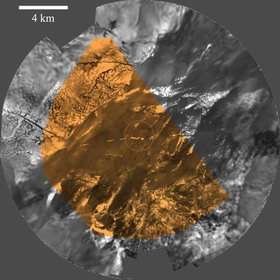
Image: Panorama of Titan from a height of eight kilometres. The circle shows the region where the space probe "Huygens" landed. The coloured area shows what Titan would look like to an observer standing on its surface. The orange colour comes from the absorption of the short-wave blue and green sunlight in Titan's atmosphere. Image: MPS/ University of Arizona/ESA/NASA
With a diameter of about 5,150 kilometres, Titan is the largest moon of Saturn. It has a dense atmosphere which we mostly cannot see through. Until recently, Titan was one of the few objects in the solar system whose surface was not researched. In 1997, the Cassini/Huygens mission to Saturn was launched. The NASA spaceship Cassini reached Saturn's orbit in 2004 and since then has been investigating the ringed planet and its moons. The Huygens probe of the European Space Agency ESA separated from Cassini at the end of 2004 and landed on Titan on January 14, 2005, after a two-and-a-half hour descent through the atmosphere.
Among the scientific instruments aboard Huygens were the Descent Imager/Spectral Radiometer (DISR), plus a combination of 14 cameras, spectrometers for visible and infrared light, and photometers. The Max Planck Institute for Solar System Research developed the CCD detector, which received the signal from all the cameras and spectrometers in the visible wavelengths.
During descent, as well as after Huygens landed, the DISR investigated the atmosphere and surface of Titan. At first sight, it is similar to a landscape on Earth. We can see the courses of rivers, which lead from a higher-lying area to a lower, flat terrain, bordered by a kind of coastline (see image 1). Spectral analysis showed indeed that materials from the higher areas were transported down to a "sea".
Huygens landed in the low-lying, flat area. The pictures taken after landing (see image 2) show that there is currently no liquid in the "sea". There are, however, "stones", whose rounded shape, and size distribution, suggest they were transported in a liquid. Given the extremely low temperatures on Titan -- about 180 degrees below Celsius -- the liquid could not be water. The scientists guess rather that it is methane and/or another hydrocarbon, and that the "stones" are made of water ice.
Investigations of the atmosphere on Titan concentrated on its dust layer. Before landing, it was assumed that the dust is only located above 50 kilometres up in the atmosphere, and the area lying underneath it is clear. The DISR measurements have now shown that the dust layer reaches down to the surface. Spectral analysis shows that the dust particles are aggregates of some hundreds of very small particles, about 50 nanometers across.
Source: Max-Planck-Gesellschaft


