Reactivated gene shrinks tumors
January 24, 2007
Reactivated gene shrinks tumors

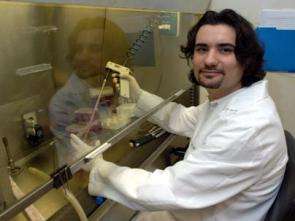
Andrea Ventura, an MIT postdoctoral associate, works in the lab at the Center for Cancer Research. He and his colleagues have shown that by reactivating a certain gene, cancerous tumors in mice can be drastically reduced in size. Photo: Donna Coveney

Many cancers arise due to defects in genes that normally suppress tumor growth. Now, for the first time, MIT researchers have shown that re-activating one of those genes in mice can cause tumors to shrink or disappear.

The study offers evidence that the tumor suppressor gene p53 is a promising target for human cancer drugs.

"If we can find drugs that restore p53 function in human tumors in which this pathway is blocked, they may be effective cancer treatments," said David Kirsch of MIT's Center for Cancer Research and Harvard Medical School, one of the lead co-authors of the paper.

The study will be published in the Jan. 24 online edition of Nature. It was conducted in the laboratory of Tyler Jacks, director of the Center for Cancer Research, the David H. Koch Professor of Biology and a Howard Hughes Medical Institute investigator.

P53 has long been known to play a critical role in the development of many tumors-it is mutated in more than 50 percent of human cancers. Researchers have identified a few compounds that restore p53 function, but until now, it has not been known whether such activity would actually reverse tumor growth in primary tumors.

The new MIT study shows that re-activating p53 in mouse tumors dramatically reduces the size of the tumors, in some cases by 100 percent.

"This study provides critical genetic evidence that continuous repression of a tumor suppressor gene is required for a tumor to survive," said Andrea Ventura, an Italian postdoctoral associate in the Center for Cancer Research and first author of the paper.

In normal cells, p53 controls the cell cycle. In other words, when functioning properly, it activates DNA repair mechanisms and prevents cells with damaged DNA from dividing. If DNA damage is irreparable, p53 induces the cell to destroy itself by undergoing apoptosis, or programmed cell death.

When p53 is turned off by mutation or deletion, cells are much more likely to become cancerous, because they will divide uncontrollably even when DNA is damaged.

In this study, the researchers used engineered mice that had the gene for p53 turned off. But, they also included a genetic "switch" that allowed the researchers to turn p53 back on after tumors developed.

Once the switch was activated, p53 appeared in the tumor cells and the majority of the tumors shrank between 40 and 100 percent.

The researchers looked at two different types of cancer-lymphomas and sarcomas. In lymphomas, or cancers of the white blood cells, the cancer cells underwent apoptosis within 1 or 2 days of the p53 reactivation.

In contrast, sarcomas (which affect connective tissues) did not undergo apoptosis but went into a state of senescence, or no growth. Those tumors took longer to shrink but the senescent tumor cells were eventually cleared away.

The researchers are not sure why these two cancers are affected in different ways, but they have started trying to figure it out by identifying the other genes that are activated in each type of tumor when p53 turns back on.

The study also revealed that turning on p53 has no damaging effects in normal cells. The researchers had worried that p53 would kill normal cells because it had never been expressed in those cells.

"This means you can design drugs that restore p53 and you don't have to worry too much about toxic side effects," said Ventura.

Possible therapeutic approaches to turn on p53 in human cancer cells include small molecules that restore mutated p53 proteins to a functional state, as well as gene therapy techniques that introduce a new copy of the p53 gene into tumor cells. One class of potential drugs now under investigation, known as nutlins, acts by interfering with MDM2, an enzyme that keeps p53 levels low.

In follow-up studies, the MIT researchers are looking at other types of cancer, such as epithelial (skin) cancer, in their mouse model, and they plan to see if the same approach will also work for tumor suppressors other than p53.

Source: Massachusetts Institute of Technology

4.9 /5 (19 votes)  

Rank 4.9 /5 (19 votes)
Tags

Relevant PhysicsForums posts
  • Is Everyday Technology Killing Us?
    createdFeb 08, 2012
  • Exercise and weight loss
    createdFeb 08, 2012
  • Why do we have head aches? Our brains can't feel anything.
    createdFeb 07, 2012
  • "The end of diseases" by David Agus, interview from Daily Show with Jon Stewart
    createdFeb 04, 2012
  • Oncolytic adenovirus
    createdFeb 04, 2012
  • Nutrition label stuffs and diets
    createdFeb 02, 2012
  • More from Physics Forums - Medical Sciences

More news stories

Study finds that anti-diabetic medication can prevent the long-term effects of maternal obesity

In a study to be presented today at the Society for Maternal-Fetal Medicine's annual meeting, The Pregnancy Meeting, in Dallas, Texas, researchers will report findings that show that short therapy with the anti-diabetic medication ...

Medicine & Health / Health

created 11 hours ago | popularity 5 / 5 (1) | comments 1

Steroid injections prove effective in treatment of lumbar disc herniations

The use of epidural steroid injections may be a more efficient treatment option for lumbar disc herniations, according to research presented today at the American Orthopaedic Society for Sports Medicine's Specialty Day in ...

Medicine & Health / Health

created 11 hours ago | popularity not rated yet | comments 0

Amateur football players not always keen on returning to play after ACL injuries

Despite the known success rates of reconstructive Anterior Cruciate Ligament (ACL) surgery, the number of high school and collegiate football players returning to play may not be as high as anticipated, say researchers presenting ...

Medicine & Health / Health

created 11 hours ago | popularity not rated yet | comments 0

Study finds elevated levels of cell-free DNA in first trimester do not predict preeclampsia

In a study to be presented today at the Society for Maternal-Fetal Medicine's annual meeting, The Pregnancy Meeting, in Dallas, Texas, researchers will report findings that indicate that elevated levels of cell-free DNA in ...

Medicine & Health / Other

created 11 hours ago | popularity not rated yet | comments 0

PRP treatment aids healing of elbow injuries say researchers

As elbow injuries continue to rise, especially in pitchers, procedures to help treat and get players back in the game quickly have been difficult to come by. However, a newer treatment called platelet rich plasma (PRP) may ...

Medicine & Health / Other

created 11 hours ago | popularity 5 / 5 (1) | comments 0


Walney offshore wind farm is world's biggest (for now)

(PhysOrg.com) -- The Walney wind farm on the Irish Sea--characterized by high tides, waves and windy weather--officially opened this week. The farm is treated in the press as a very big deal as the Walney ...

GPS court ruling leaves US phone tracking unclear

A US Supreme Court decision requiring a warrant to place a GPS device on the car of a criminal suspect leaves unresolved the bigger issue of police tracking using mobile phones, legal experts say.

Europeans protest controversial Internet pact

Tens of thousands of people marched in protests in more than a dozen European cities Saturday against a controversial anti-online piracy pact that critics say could curtail Internet freedom.

Europe stakes billion-dollar bet on new rocket

A pencil-slim rocket is scheduled to lift into space from South America on Monday, carrying a billion-dollar bet that Europe can grab a juicy slice of the market to place satellites in low orbit.

Netflix settlement trims 14 pct off 4Q earnings

(AP) -- Netflix pressed the rewind button on its fourth-quarter earnings after settling allegations that the video subscription service violated a consumer-privacy law.

Elbow position not a predictor of injury

Elbow position alone appeared to not affect injury rates and performance in college-level, male pitchers say researchers presenting at the American Orthopaedic Society for Sports Medicine's Specialty Day in San Francisco, ...