PULSE: The Impact of European Pulsar Science on Modern Physics
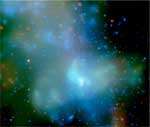
Pulsars are neutron stars that rotate quickly, up to 600 times per second. They are compact -- only 20 kilometres in diameter -- leftovers of supernova explosions. Nonetheless they have a mass 1.4 times that of our sun, and a very strong magnetic field. They emit beams of radiation from two regions above their magnetic poles, using a mechanism that is not completely understood.
When a pulsar rotates, we on Earth can receive these regular radio pulses. Because neutron stars have a high inertia, their pulse periods are quite stable -- they are like very precise clocks in outer space. Observing fluctuations in the pulse rates allows us to follow pulsar movements very closely. We can also learn about the properties of super-dense materials, the behaviour of plasma in strong magnetic fields, and a number of other extreme conditions in the universe.
Because it is very expensive to produce and use equipment to examine these stars, researchers across the continent created the European Pulsar Network (EPN, also known as PULSE). It began with the development of a common format to bring together data from very different measuring devices. One early PULSE success was when three European telescopes simultaneously observed radio pulses from pulsars at three different wavelengths. In co-operation with the Australian Telescope National Facility, members of the network helped develop new instruments and computer programs, co-ordinate observation programmes, and create a publicly accessible databank (www.mpifr-bonn.mpg.de/div/pulsar/data/) for all the observational information that was returned.
850 new pulsars were discovered thanks to this co-operation. This greatly exceeds the total number found over the last 30 years. Furthermore, the research team's greatest success was the discovery of the first double pulsar. That such a system exists at all is unusual, because its two components must have made it through a double supernova explosion.
Using pulsars as clocks, it is possible to measure how the presence of heavy bodies curves space-time. By observing pulsars, the researchers have shown repeatedly that close double neutron star systems send out strong gravitational waves.
The newly discovered double pulsar system has also helped beautifully to confirm Einstein's General Relativity Theory. In the system, all orbital parameters are directly astronomically confirmable, and the masses of both pulsars can be determined. But because of the effects predicted by relativity theory, five more independent mass calculations were possible. All gave the same result with great precision. This provided more evidence in favour of Einstein's theory about the connection between space, time, and material.
Project co-ordination: Prof. Andrew Lyne, University of Manchester (Great Britain), together with Prof. Nicolo D'amico, INAF Osservatorio Astronomico di Cagliari (Italy), Dr. Axel Jessner, Max Planck Institute for Radioastronomy (Germany), Dr. Ben Stappers, ASTRON (Netherlands) and Prof. Ioannis Seiradakis, University of Thessaloniki (Greece)
On December 2 the European Commission honoured the most successful intra- European research projects of the year. The Descartes Research Prize went to five different projects, awarding 200,000 euros each. Max Planck scientists played a major role in two of the winning projects: "PULSE -- European Pulsar Research" (Max Planck Institute for Radioastronomy) and "CECA - Climate and Environmental Change in the Arctic" (Max Planck Institute for Meteorology).
Source: Max Planck Institute


