Trophy Skull Sheds Light on Ancient Wari Empire
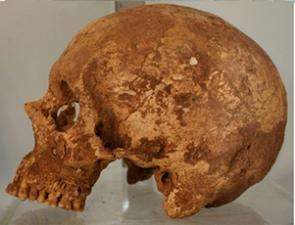
A team of archaeologists and Earthwatch volunteers led by Dr. Mary Glowacki and Louis Tesar uncovered an elite Wari cemetery at Cotocotuyoc this past summer in Peru’s Huaro Valley, near Cuzco. Among their finds was a “trophy skull,” which offers insight into warfare in the Wari Empire based here from 1,500 to 1,000 years ago.
The trophy skull was found in what the archaeologists consider the VIP area of the cemetery. Special placement of llama bones, a distinguishing feature of Wari remains, alerted the archaeologists and volunteers that something special might be underneath. The skull had a large circular hole cut in its base, suggesting that it may have been put or held on a pole. A large hole in the back of the skull indicates that it may have been worn during special ceremonies like a large pendant. The skull also features a line cut across the frontal bone, which indicates removal of the scalp possibly for the cleaning, perhaps for use as a ceremonial vessel, and was later reattached to the skull with gold alloy pins.
The skull was likely that of a warrior, as indicated by the many scars and abrasions on various parts of the skull that showed evidence of healing. Archaeologists estimate the man was around the age of 30 at his death, and that he must have been a warrior of repute for the Wari to remove his head and display the skull.
“The trophy skull adds a new dimension to our understanding of the role of warriors and warfare in Wari culture,” says Glowacki, principal investigator of Earthwatch’s Archaeology of Peru’s Wari Empire expedition. Volunteers may join Glowacki to help unearth more of cemetery this summer on the expedition. “I hope to be able to find the edges of the cemetery. We think we know where the center is, but don’t know how far it goes,” says Glowacki.
In addition to the trophy skull, the excavation teams also found whole ceramic pots accompanying the tombs of women in other parts of the cemetery. The teams have only uncovered one definitive male in the cemetery, and Glowacki suspects that he was probably a guardian since his remains show many injuries and his stone-lined burial tomb was built into the cemetery wall. Some of the ceramic vessels were elaborately decorated with owls, which early historic records indicate were the alter ego of female shamans elsewhere in Peru.
While another Wari cemetery was discovered some years ago nearby in Huaro, the burials at Cotocotuyoc are unique. The Cotocotuyoc cemetery demonstrates a very early Wari presence in the valley. Cotocotuyoc, which sits high above the Huaro Valley floor, is believed to have later served as a stronghold for the Wari as their political control weakened and the empire eventually collapsed.
Earthwatch Institute is a global volunteer organization that supports scientific research by offering members of the public unique opportunities to work alongside leading field scientists and researchers. Founded in 1971, Earthwatch’s mission is to engage people worldwide in scientific field research and education to promote the understanding and action necessary for a sustainable environment.
These findings and others will be presented at a symposium entitled “The Wari and Their Descendants: Imperial Transformation in Cuzco, Peru,” at the 72nd Annual Meeting of the Society for American Archaeology (SAA) in Austin, Texas, in April 2007.
For more information on how to volunteer on Archaeology of Peru’s Wari Empire, go to www.earthwatch.org/expeditions/glowacki.html
Source: Earthwatch Institute


