Investigators take a fresh look at crime
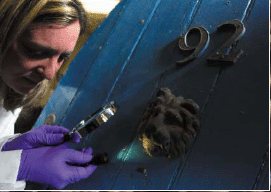
Space scientists built advanced imaging tools to investigate the origins of the planets. Now they're working with forensic scientists to see if their tools can help investigate crime.
There was something very different about Clark Kent, the reporter at the Daily Planet. He looked ordinary just like anyone else. But when trouble threatened the difference was clear.
Super vision
Clark Kent was Superman, and Superman had superhuman powers. Among them was 'super vision' the ability to see x-rays and infrared light as well as the colours of the rainbow. And because Superman could see things that humans couldn't, he was much better at fighting crime.
Scientists aren't supermen of course. But modern technology can give them superhuman powers.
Take multispectral imaging, for example. Cameras sensitive to different colours and types of light take pictures of the same scene. Software then puts everything together, revealing details the naked eye can't see.
Environmental scientists use the technique to study the Earth from space. Multispectral images from the European Space Agency's satellites allow them to track the spread of invasive plant species. Similar images are used to assess the damage caused by forest fires.
Multispectral images also help space scientists. They use them to study the planets and learn more about the rocks and soil on their surface.
But to make this possible, space scientists had to develop the technology further. Cameras had to be made smaller, lighter and more robust. And new software was needed to extract the data that interested them.
Revealing clues
Such advances are creating new uses for multispectral imaging here on Earth. One is in the fight against crime.
Today the business of gathering and processing evidence can be painstaking and time consuming. Work often has to be done in specially equipped laboratories.
Forensic scientists already use different types of light in their search for evidence at the scenes of crimes. Ultraviolet crime lights make fingerprints easier to see. Infrared light helps in the analysis of fibres and chemicals.
But is it possible to go further? Space scientists at the University of Leicester aim to find out.
The work is supported by PPARC and the Forensic Science Service. It's at an early stage so results have yet to be delivered. But major breakthroughs are expected.
The scientists hope to make it easier and faster to gather evidence. They also expect more will be able to be done at the scene of the crime.
Whats more, new evidence could come to light. Faint footprints and marks on paper can be hard or impossible to see. But it's thought a combination of multispectral imaging, advanced software and special illumination will make them stand out.
Other techniques may help in the collection of minute traces of evidence such as blood, fibres and paint fragments.
Like Clark Kent, forensic scientists may soon have super vision to call on in their fight against crime. And that's good news for us all. The faster and more thoroughly crimes can be investigated, the higher the chance that those responsible will be apprehended.
Source: PPARC


