Scientists discover new species of distinctive cloud-forest rodent
January 24th, 2007 Scientists discover new species of distinctive cloud-forest rodent

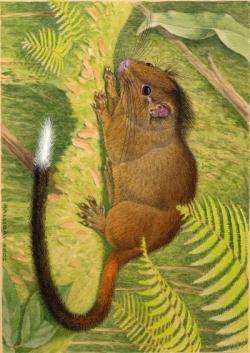
This illustration depicts Isothrix barbarabrownae, a newly discovered species of Neotropical rodent, in its arboreal habitat. The strikingly unusual animal has long dense fur, a broad blocky head, thickly furred tail and a blackish crest of fur on the crown, nape and shoulders. It is about the size of a squirrel. Credit: Illustration by Nancy Halliday, Courtesy of The Field Museum

A strikingly unusual animal was recently discovered in the cloud-forests of Peru. The large rodent is about the size of a squirrel and looks a bit like one, except its closest relatives are spiny rats.

The nocturnal, climbing rodent is beautiful yet strange looking, with long dense fur, a broad blocky head, and thickly furred tail. A blackish crest of fur on the crown, nape and shoulders add to its distinctive appearance.

Isothrix barbarabrownae, as the new species has been named, is described in the current issue of Mastozoología Neotropical (Neotropical mammalogy), the principal mammalogy journal of South America. A color illustration of the bushy rodent graces the cover of the journal.

The authors of the study found the rodent in 1999 while conducting field research in Peru's Manu National Park and Biosphere Reserve Mountains in Southern Peru along the eastern slope of the Andes. Extending from lowland tropical forests in the Amazon Basin to open grasslands above the Andean tree line, Manu is home to more species of mammals and birds than any equivalently sized area in the world.

"Like other tropical mountain ranges, such as the Himalayas, Ruwenzoris, Virungas and Kinabalu, the Andes support a fantastic variety of habitats," said Bruce Patterson, MacArthur Curator of Mammals at The Field Museum. "These in turn support some of the richest faunas on the planet."

The new rodent was discovered at an altitude of 6,200 feet. Little is known about its lifestyle because subsequent efforts to locate and observe the animal were fruitless.

I. barbarabrownae belongs to a family of rodents known as "spiny rats" because most of the species in that family bristle with spines. Its discovery has necessitated a re-examination of this tropical American family, especially its closest relatives, the bush-tailed tree rats found in South America's lowlands. As a result of the recent discovery, the authors have used The Field Museum's Pritzker Lab for Molecular Systematics and Evolution to resolve the evolutionary relationships among all of these rodents.

"The new species is not only a handsome novelty," Patterson said. "Preliminary DNA analyses suggest that its nearest relatives, all restricted to the lowlands, may have arisen from Andean ancestors. The newly discovered species casts a striking new light on the evolution of an entire group of arboreal rodents."

Source: Field Museum


print this article email this article download pdf blog this article bookmark this article     Digg this Stumble it share on Facebook share on Reddit add to delicious save to Yahoo! bookmarks
4.5/5 after 4 votes


January 24th, 2007 all stories
Biology /

Comments: 0
Rank: 4.5/5 after 4 votes

  • Stumble this up

  • Digg this

  • Share it:
  • share on Facebook
  • share on MySpace
  • share on Slashdot
  • rss-newsfeed
  • share on Google
  • share on Reddit
  • add to delicious
  • save to Yahoo! bookmarks
  • share on Windows Live
  • Add to Mixx!
Rating: 4.5/5 after 4 votes


Tags


  • Physicists Demonstrate Quantum Memory with Matter Qubits
    Physicists Demonstrate Quantum Memory with Matter Qubits
    Physics / General Physics
    created Jul 03, 2009 | popularity 4.4 / 5 (17) | comments 1
  • 'Holey' Nanosheets for Wastewater Dye Removal
    Nanotechnology / Nanomaterials
    created Jul 01, 2009 | popularity 5 / 5 (5) | comments 1
  • Jellyfish Robot Swims Like its Biological Counterpart
    Jellyfish Robot Swims Like its Biological Counterpart
    Electronics / Robotics
    created Jun 26, 2009 | popularity 4.4 / 5 (8) | comments 1
  • Could Maxwell's Demon Exist in Nanoscale Systems?
    Could Maxwell's Demon Exist in Nanoscale Systems?
    Physics / General Physics
    created Jun 24, 2009 | popularity 4.4 / 5 (18) | comments 29
  • Living Safely with Robots, Beyond Asimov's Laws
    Living Safely with Robots, Beyond Asimov's Laws
    Electronics / Robotics
    created Jun 22, 2009 | popularity 4.6 / 5 (52) | comments 40
  • Other News

    Researchers uncover the potential for super-sized abalone

    Biology / Microbiology

    created 3 hours ago | popularity not rated yet | comments 0

    (PhysOrg.com) -- Designer abalone could be an option in the foreseeable future, thanks to a project conducted at UQ's Heron Island Research Station and the St Lucia campus.


    Scientists 'rebuild' giant moa using ancient DNA

    Biology / Plants & Animals

    created Jul 01, 2009 | popularity 5 / 5 (10) | comments 12

    (PhysOrg.com) -- Scientists have performed the first DNA-based reconstruction of the giant extinct moa bird, using prehistoric feathers recovered from caves and rock shelters in New Zealand.


    Pacific Giant Salamander (Dicamptodon tenebrosus)

    Salamanders, regenerative wonders, heal like mammals, people

    Biology / Microbiology

    created Jul 01, 2009 | popularity 5 / 5 (20) | comments 11

    The salamander is a superhero of regeneration, able to replace lost limbs, damaged lungs, sliced spinal cord -- even bits of lopped-off brain. But it turns out that remarkable ability isn't so mysterious after ...


    California water plan aims to save Puget Sound orcas

    Biology / Ecology

    created 19 hours ago | popularity 4 / 5 (1) | comments 0

    A plan to restore salmon runs on California's Sacramento River also could help revive killer whale populations 700 miles to the north in Puget Sound, as federal scientists struggle to protect endangered species in a complex ...


    Genetically modified trees

    Anti-biotech groups obstruct forest biotechnology

    Biology / Biotechnology

    created Jun 30, 2009 | popularity 3.7 / 5 (7) | comments 5

    The potential of forest biotechnology to help address significant social and environmental issues is being "strangled at birth" by the rigid opposition of some groups and regulations that effectively preclude ...