HiRISE Camera Shows Mojave Crater Peak is High and Dry
January 24, 2007 HiRISE Camera Shows Mojave Crater Peak is High and Dry

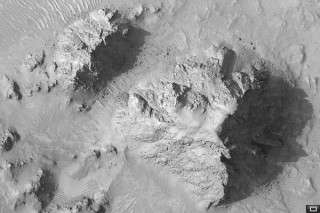
This is a portion of the HiRISE image that shows the central uplift structure in Mojave Crater. Central uplifts are a typical feature of large impact craters on the Earth, the moon and Mars; craters larger than 6 or 7 kilometers in diameter on Mars typically form this mountain-like peak in the central portion of the crater interior. (Photo credit: NASA/JPL/University of Arizona)

The HiRISE camera on NASA's Mars Reconnaissance Orbiter took a huge, detailed image of Mars' Mojave crater on Jan. 7, 2007.

This is only part of that photograph. It shows the central uplift structure in the crater. Rocks that form this peak were several kilometers beneath the surface until an impact formed the 37 mile-diameter (60 kilometer) crater just north of Mars' equator. The HiRISE image shows that boulders as large as 50 feet across (15 meters) have eroded from the massive uplifted rock and rolled downslope.

The HiRISE image also confirms earlier evidence that this part of Mojave crater appears untouched by liquid water. Previous photographs taken by the HiRISE camera, and even earlier by the Mars Orbital Camera that flew on NASA'S Mars Global Surveyor, show that Mojave crater rim walls feature striking drainage channels and alluvial fans that likely were formed by surface water runoff. How runoff formed these channels and alluvial fans is one of the questions that HiRISE team members and their collaborators are looking into.

The High Resolution Science Imaging Experiment (HiRISE) team, led by University of Arizona Professor Alfred S. McEwen, is based at UA's Lunar and Planetary Laboratory in Tucson. HiRISE began the science phase of the mission in November, 2006, and posts new images and captions on the Internet at http://hirise.lpl.arizona.edu every Wednesday.

Source: University of Arizona


print this article email this article download pdf blog this article bookmark this article     Stumble it Digg this share on Facebook retweet share on Reddit add to delicious
Rate this story - 3.7 /5 (7 votes)


January 24, 2007 all stories

Comments: 0

3.7 /5 (7 votes)
  • Stumble this up

  • Digg this

  • share this

  • hide
  • Related Stories

  • Gullies and Flow Features on Crater Wall
    created Nov 26, 2009 | popularity not rated yet | comments 0
  • Distal Rampart of Crater in Chryse Planitia
    created Nov 13, 2009 | popularity not rated yet | comments 0
  • Channels from Mars Hale Crater
    created Oct 28, 2009 | popularity not rated yet | comments 0
  • Scientists see water ice in fresh meteorite craters on Mars
    created Sep 24, 2009 | popularity not rated yet | comments 0
  • Patterns in Mars crater floors give picture of drying lakes
    created Sep 16, 2009 | popularity not rated yet | comments 0


  • hide
  • Relevant PhysicsForums posts

  • Some help with a X-Ray astronomy question please!
    created Nov 27, 2009
  • Help with Images and Optical Instrument Question..
    created Nov 26, 2009
  • Redshift as a distance indicator
    created Nov 26, 2009
  • Question about 2-body gravity
    created Nov 24, 2009
  • More from Physics Forums - General Astronomy

Other News

Japan launches 5th spy satellite (AP)

Japan launches 5th spy satellite

Space & Earth / Space Exploration

created 5 minutes ago | popularity not rated yet | comments 0

(AP) -- Japan launched its fifth spy satellite into orbit Saturday in a bid to boost its ability to independently gather intelligence, the government said.


Fermi Telescope Peers Deep into Microquasar

Fermi Telescope Peers Deep into Microquasar (w/ Video)

Space & Earth / Astronomy

created 18 hours ago | popularity 4.7 / 5 (10) | comments 0

(PhysOrg.com) -- NASA's Fermi Gamma-ray Space Telescope has made the first unambiguous detection of high-energy gamma-rays from an enigmatic binary system known as Cygnus X-3. The system pairs a hot, massive ...


The Energy Sources of Ultraluminous Galaxies

The Energy Sources of Ultraluminous Galaxies

Space & Earth / Astronomy

created 19 hours ago | popularity 4.5 / 5 (13) | comments 1

(PhysOrg.com) -- Ultraluminous infrared galaxies ((ULIRGs) are galaxies whose luminosity exceeds that of a trillion suns; for comparison, the Milky Way galaxy has a typical (and much more modest) luminosity ...


New climate targets may not change daily life much (AP)

New climate targets may not change daily life much

Space & Earth / Environment

created 23 hours ago | popularity 3.8 / 5 (13) | comments 9

(AP) -- Americans' day-to-day lives won't change noticeably if President Barack Obama achieves his newly announced goal of slashing carbon dioxide pollution by one-sixth in the next decade, experts say.


Space shuttle Atlantis, 7 astronauts back on Earth (AP)

Space shuttle Atlantis, 7 astronauts back on Earth

Space & Earth / Space Exploration

created 20 hours ago | popularity not rated yet | comments 0

(AP) -- Space shuttle Atlantis and its seven astronauts returned to Earth with a smooth touchdown Friday to end an 11-day flight that resupplied the International Space Station.