NASA creates microscopic technology for Webb Space Telescope
January 24, 2007
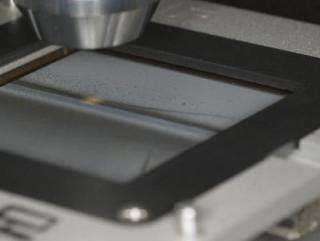
Using a microscope to look at a collection of Microshutters, called an "array" you can see a hair in the picture for a size comparison. Credit: NASA/Chris Gunn
NASA engineers and scientists have created something that will give better information about far away galaxies. This new creation, which will be in a future space telescope, is so tiny that it's the width of a few hairs.
"Microshutters" are tiny doorways that bring stars and galaxies very far away into better focus. This new technology will go aboard the James Webb Space Telescope, to be launched into space in a decade.
The microshutters will enable scientists to block unwanted light from objects closer to the camera in space, letting the light from faraway objects shine through. To get an idea of how these tiny little "hairlike" shutters work, think about how you try to make something look clearer – you squint. By squinting, your eyelashes block out light closer to you. That's similar to how the microshutters work.
These microshutters will allow the telescope to focus on the faint light of stars and galaxies so far away, they formed early in the history of the universe. That's because light travels at 186,000 miles per second, and light is still traveling through space from the time the universe started. No other telescope has this microshutter technology.
The Webb Telescope will take over for the Hubble Space Telescope. It is planned for launch in the next decade.
New technology always gets tested and re-tested to make sure it's ready to go on a spacecraft. In December 2006, the microshutters passed important tests that showed they can handle the stresses of being launched and placed in deep space.
The microshutters were designed, built and tested at NASA's Goddard Space Flight Center in Greenbelt, Md. They will work with a camera scheduled to be onboard the telescope called the "Near Infrared Spectrograph," which will be built by the European Space Agency. The spectrograph will break up the light from the galaxies into a rainbow of different colors, allowing scientists to determine the kinds of stars and gasses that make up the galaxies and measure their distances and motions.
"To build a telescope that can peer farther than Hubble can, we needed brand new technology," said Murzy Jhabvala, chief engineer of Goddard's Instrument Technology and Systems Division. "We've worked on this design for over six years, opening and closing the tiny shutters tens of thousands of times in order to perfect the technology."
Each shutter measures 100 by 200 microns, or about the width of three to six human hairs. These tiny shutters are arranged in a waffle-like grid containing over 62,000 shutters. The telescope will contain four of these waffle-looking grids all put together. They also have to work at the incredibly cold temperature of minus 388 degrees Fahrenheit (-233 degrees Celsius).
The big benefit of the microshutters is that they will allow scientists to look at 100 things in space at the same time and see deeper into space in less time.
"The microshutters are a remarkable engineering feat that will have applications both in space and on the ground, even outside of astronomy in biotechnology, medicine and communications," said Harvey Moseley, the Microshutter Principal Investigator.
Source: NASA/Goddard Space Flight Center
-
Astronomy team discovers nearby dwarf galaxy
22 hours ago |
4.3 / 5 (4) |
5
-
When worlds collide: Researchers harness supercomputers to understand solar storm, magnetosphere
Feb 07, 2012 |
3 / 5 (1) |
6
-
ESO team succeeds in linking telescopes at Paranal Observatory into giant VLT
Feb 06, 2012 |
4.9 / 5 (16) |
2
-
Classic portrait of a barred spiral galaxy
Feb 03, 2012 |
4.7 / 5 (7) |
3
-
Radio stars: Caltech's astronomy professor searches for cosmic radio waves
Feb 03, 2012 |
not rated yet |
0
-
Engineers build first sub-10-nm carbon nanotube transistor
Feb 01, 2012 |
4.9 / 5 (31) |
30
-
Something old, something new: Evolution and the structural divergence of duplicate genes
Jan 31, 2012 |
4.6 / 5 (7) |
1
-
The hidden nanoworld of ice crystals: Revealing the dynamic behavior of quasi-liquid layers
Jan 30, 2012 |
5 / 5 (3) |
1
-
Stock market network reveals investor clustering
Jan 27, 2012 |
3.9 / 5 (23) |
8
-
Of microchemistry and molecules: Electronic microfluidic device synthesizes biocompatible probes
Jan 26, 2012 |
5 / 5 (1) |
0
-
Calling function with no input argument
12 hours ago
-
Force free body diagram problem on gym equipment
13 hours ago
-
Empirical data regarding shower heads and water
21 hours ago
-
feed hold button on CNC lathe
Feb 09, 2012
-
RFAC in Fortran
Feb 09, 2012
-
dynamics 2/32
Feb 08, 2012
- More from Physics Forums - General Engineering
More news stories
Anonymous knocks CIA website offline (Update)
The website of the Central Intelligence Agency was inaccessible on Friday after the hacker group Anonymous claimed to have knocked it offline.
7 hours ago |
5 / 5 (7) |
12
Google users warned of threat to smartphone wallets
Users of Google smartphone wallets were being warned on Friday that there is a way to crack pass codes intended to thwart thieves from going on illicit shopping sprees.
5 hours ago |
5 / 5 (2) |
0
New error-correcting codes guarantee the fastest possible rate of data transmission
Error-correcting codes are one of the triumphs of the digital age. Theyre a way of encoding information so that it can be transmitted across a communication channel such as an optical fiber o ...
Technology / Computer Sciences
15 hours ago |
4.8 / 5 (6) |
6
|
New power source discovered
(PhysOrg.com) -- Researchers at the Massachusetts Institute of Technology (MIT) and RMIT University have made a breakthrough in energy storage and power generation.
Technology / Energy & Green Tech
14 hours ago |
4.8 / 5 (24) |
8
|
Small modular reactor design could be a 'SUPERSTAR'
(PhysOrg.com) -- Though most of today's nuclear reactors are cooled by water, we've long known that there are alternatives; in fact, the world's first nuclear-powered electricity in 1951 came from a reactor ...
Technology / Energy & Green Tech
15 hours ago |
4.3 / 5 (11) |
22
|
Complex wiring of the nervous system may rely on a just a handful of genes and proteins
Researchers at the Salk Institute have discovered a startling feature of early brain development that helps to explain how complex neuron wiring patterns are programmed using just a handful of critical genes. ...
Humans may have helped the decline of African rainforests 3000 years ago
(PhysOrg.com) -- Large areas of rainforests in Central Africa mysteriously disappeared over three thousand years ago, to be replaced by savannas. The prevailing theory has been that the cause was a change ...
The power of estrogen -- male snakes attract other males
A new study has shown that boosting the estrogen levels of male garter snakes causes them to secrete the same pheromones that females use to attract suitors, and turned the males into just about the sexiest ...
Putting the squeeze on planets outside our solar system
(PhysOrg.com) -- Using high-powered lasers, scientists at Lawrence Livermore National Laboratory and collaborators discovered that molten magnesium silicate undergoes a phase change in the liquid state, abruptly ...
Could Venus be shifting gear?
(PhysOrg.com) -- ESAs Venus Express spacecraft has discovered that our cloud-covered neighbour spins a little slower than previously measured. Peering through the dense atmosphere in the infrared, the ...
Advanced power-grid model finds low-cost, low-carbon future in West
(PhysOrg.com) -- The least expensive way for the Western U.S. to reduce greenhouse gas emissions enough to help prevent the worst consequences of global warming is to replace coal with renewable and other ...