Researchers 'wire' DNA to identify mutations
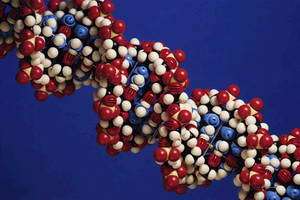
A team of ASU researchers led by Nongjian Tao and Peiming Zhang has developed a new, breakthrough technique for the detection of DNA mutations.
Their results, published in the journal Proceedings of the National Academy of Sciences, demonstrate for the first time, the possibility of directly identifying these mutations, or single nucleotide polymorphisms (SNPs), by means of measuring the electrical conductance of a single DNA molecule.
SNPs are buried in the 3 billion DNA bases of the human genome. On average, SNPs occur about once in every 1,000 DNA bases, though not every SNP found will necessarily cause a disease mutation. Cataloging these subtle DNA differences among the populace will aid the ongoing quest to understand and prevent disease.
"There is a high demand to track mutations for cancer research or future applications in personalized medicine," said Zhang, an associate research professor of the Center for Single Molecule Biophysics in the Biodesign Institute at ASU. "Currently, the main issue in doing this type of detection is that it is still costly and time consuming."
The team's breakthrough relies on an intrinsic physical property of DNA, conductivity, or how well the molecule can carry an electrical current. Depending on the experimental conditions, DNA has been previously shown to act as both a conductor and insulator.
"We have developed a technology that allows us to wire single molecules into an electrical circuit," said Tao, professor of electrical engineering in the Ira A. Fulton School of Engineering and also a researcher in the Center for Solid State Electronics Research. "We can now directly read the biological information in a single DNA molecule."
Measurement of DNA conductivity first requires wiring the molecule into an electrical circuit. "There are two things required to make a reliable measurement," said Tao. "One is that the DNA has to be tethered between two electrodes and the other is that it should be done in a slightly salty, water environment to minimize any perturbations to the structure of the molecule." Electrical engineering graduate students Joshua Hihath and Bingqian Xu carried out the measurement.
"We measure a small current through the molecules using a setup developed in our lab." said Tao. "It's a conceptually simple setup. You just bring two electrodes together, separate them apart, make the measurement and repeat."
In the technique, chemical linker groups that form a tight bond with gold electrodes are attached to the ends of DNA. A drop of a DNA solution is then placed between the two electrodes. The DNA sticks to the surface of the electrodes spontaneously.
As the tip is pulled away and the two electrodes teased apart, the molecules of DNA are eventually dispersed to the point of measuring the current of a single DNA molecule.
For a proof of concept of the potential for measuring SNPs, the group used DNA of 11 or 12 bases in length dissolved in a physiologically relevant saline solution. From one electrode tip, a small current, or bias is used to probe the internal electronic states of DNA. By measuring the conductance, the team was able to understand the sequence information in the DNA and whether there was a mismatch in comparison to a normal DNA sequence.
What they found was that just a single base pair mutation in a DNA molecule, such as substituting an A for a G, can cause a significant change in the conductance of the molecule. The measurement is extremely sensitive, as the alteration of a single base in the DNA stack can either increase or decrease the conductivity of a DNA helix, depending on the type of mismatched base.
Not only was the group the first measure SNPs in this manner, but they were also the first to make the measurement in a water environment relevant to that found in biological systems.
How the current flows through the DNA molecule is still a subject of speculation. "One idea is that there is a tunneling process," said Tao.
The DNA has properties which make the electrons easier to tunnel through, just like lowering a hill for a marathon runner.
"The other may be a charge-hopping phenomenon, where the electrons get trapped in the DNA and then hop from the electrode to the DNA to the second electrode."
The next goal of the research is to make the measurement steps easier and faster through automation, which will allow many different DNA sequences to be analyzed at once.
Source: Arizona State University


