Alaska's Columbia Glacier continues on disintegration course
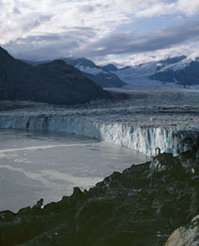
Alaska's rapidly disintegrating Columbia Glacier, which has shrunk in length by 9 miles since 1980, has reached the mid-point of its projected retreat, according to a new University of Colorado at Boulder study.
Tad Pfeffer, associate director of CU-Boulder's Institute of Arctic and Alpine Research, said the glacier is now discharging nearly 2 cubic miles of ice annually into the Prince William Sound, the equivalent of 100,000 ships packed with ice, each 500 feet long. The tidewater glacier -- which has its terminus, or end, in the waters of the Prince William Sound -- is expected to retreat an additional 9 miles in the next 15 years to 20 years before reaching an equilibrium point in shallow water near sea level, he said.
Pfeffer presented his latest findings at a news briefing at the fall meeting of the American Geophysical Union Dec. 5 to Dec. 9 in San Francisco. Pfeffer, CU-Boulder doctoral student Shad O'Neel and other researchers from CU-Boulder and around North America have been monitoring the glacier with time-lapse photography, aerial photography, satellites, seismometers, lasers and other instruments.
The Columbia Glacier is now the single largest glacial contributor to sea level in North America, producing about 10 percent of the water volume entering the sea from all Alaskan glaciers each year, said Pfeffer. Sliding roughly 80 feet a day, the Columbia Glacier is among the world's fastest-moving glaciers and the last of Alaska's 51 tidewater glaciers to exhibit a drastic retreat.
The glacier's retreat appears to be due to a combination of complex physical processes, he said. "The start of the retreat in 1980 is not the direct result of global warming, but was triggered by longer-term warming," said Pfeffer. "The Columbia Glacier, like all Alaska glaciers, is melting at an increased rate, but the enormous volume of loss accompanying the retreat is much greater than melt alone."
The retreat of the Columbia Glacier and Alaska's other tidewater glaciers are believed to be influenced by a slow warming trend that began in the Northern Hemisphere about 500 years ago, he said. The Muir Glacier in Alaska's Glacier Bay, for example, began its retreat in the late 1800s, according to researchers.
But the Columbia Glacier, which is about three miles wide in places and up to 3,000 feet thick, has thinned up to 1,300 feet in places during the past 25 years. The thinning is believed to be caused, in part, by seawater pressure floating the submerged glacier terminus slightly and "stretching it like taffy" as the glacier speed has increased, he said.
"When tidewater glaciers thin to a critical level, they seem to reach a point where they speed up discharging ice into the ocean and can't slow down," said Pfeffer, who is also an associate professor in CU-Boulder's engineering college. Pfeffer said he believes the ongoing retreat of the Columbia Glacier will eventually create a vast fjord rivaling the spectacular Glacier Bay.
The ongoing research on the Columbia Glacier retreat can be used as a model for the current behavior of glaciers in Greenland and Antarctica, where more than 90 percent of the Earth's ice is locked up, he said. Greenland and Antarctica are believed by scientists to be major contributors to global sea rise.
"Up until about 50 years ago, the perception was that Greenland and Antarctica were essentially monolithic pancakes of ice," he said. "We now understand that these large ice masses are made up of very different sub-regions that respond uniquely to climate forcing."
The Columbia Glacier has been under intense scrutiny since the late 1970s, when the U.S. Geological Survey determined that a marked increase in its calving rate might pose a threat to shipping lanes in Prince Williams Sound, site of the devastating 1989 Exxon Valdez oil spill. The initial USGS studies were begun by glaciologist Mark Meier, who came to CU-Boulder in 1986 as INSTAAR's first director and who remains on the faculty as an emeritus professor.
While climate-forcing events like the warming underway at high latitudes of Earth may appear to be occurring in small steps, the ultimate response of glaciers and other parts of the environment may be significantly larger and faster, Pfeffer said. "High latitudes respond to climate change in tricky and very unpredictable ways."
Source: University of Colorado at Boulder


