Unexpected cooling effect in Saturn's upper atmosphere
January 25th, 2007 Saturn

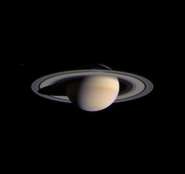
Saturn. Photo by NASA.

UK researchers from University College London, along with colleagues from Boston University, have found that the hotter than expected temperature of Saturn's upper atmosphere – and that of the other giant planets – is not due to the same mechanism that heats the atmosphere around the Earth's Northern Lights. Reporting in Nature (25th January) the researchers findings thus rule out a long held theory.

A simple calculation to give the expected temperature of a planet's upper atmosphere balances the amount of sunlight absorbed by the energy lost to the lower atmosphere. But the calculated values don't tally with the actual observations of the Gas Giants: they are consistently much hotter.

It has long been thought that the culprit behind the heating process was the ionosphere, being driven by the planet's magnetic field, or magnetosphere. By using numerical models of Saturn's atmosphere the researchers found that the net effects of the winds driven by polar energy inputs is not to heat the atmosphere but to actually cool it.

Professor Alan Aylward, of the UCL Department of Physics & Astronomy, and an author of the study, explains: "The aurora has been studied for over a hundred years, yet our discovery takes us back to first principles. We need to re-examine our basic assumptions about planetary atmospheres and what causes the observed heating."

"Studying what happens on planets such as Saturn gives us an insight into what happens closer to home. Planets can lose their atmospheres as we see with Mars. Do we completely understand how this happens? Are there mechanisms heating the gas and causing it to escape that we do not yet fully understand? By studying what happens in other atmospheres we may find clues to Earth's future."

Source: Particle Physics & Astronomy Research Council


print this article email this article download pdf blog this article bookmark this article     Digg this Stumble it share on Facebook share on Reddit add to delicious save to Yahoo! bookmarks
4.2/5 after 15 votes


January 25th, 2007 all stories
Space & Earth / Astronomy

Comments: 0
Rank: 4.2/5 after 15 votes

  • Stumble this up

  • Digg this

  • Share it:
  • share on Facebook
  • share on MySpace
  • share on Slashdot
  • rss-newsfeed
  • share on Google
  • share on Reddit
  • add to delicious
  • save to Yahoo! bookmarks
  • share on Windows Live
  • Add to Mixx!
Rating: 4.2/5 after 15 votes

  • Related Stories

  • Shaken and Stirred: Lab Studies Ice From Frigid Worlds
    created Jun 17, 2009 | popularity not rated yet | comments 0
  • Chemists see first building blocks to life on Earth
    created May 13, 2009 | popularity not rated yet | comments 0
  • Mass Loss Leaves Close-In Exoplanets Exposed to the Core
    created Apr 21, 2009 | popularity not rated yet | comments 0
  • Subterranean oceans on Saturn's moon Titan
    created Apr 06, 2009 | popularity not rated yet | comments 0
  • Cassini Provides Virtual Flyover of Saturn's Moon Titan
    created Mar 24, 2009 | popularity not rated yet | comments 0

Tags


  • Physicists Demonstrate Quantum Memory with Matter Qubits
    Physicists Demonstrate Quantum Memory with Matter Qubits
    Physics / General Physics
    created Jul 03, 2009 | popularity 4.4 / 5 (17) | comments 1
  • 'Holey' Nanosheets for Wastewater Dye Removal
    Nanotechnology / Nanomaterials
    created Jul 01, 2009 | popularity 5 / 5 (5) | comments 1
  • Jellyfish Robot Swims Like its Biological Counterpart
    Jellyfish Robot Swims Like its Biological Counterpart
    Electronics / Robotics
    created Jun 26, 2009 | popularity 4.4 / 5 (8) | comments 1
  • Could Maxwell's Demon Exist in Nanoscale Systems?
    Could Maxwell's Demon Exist in Nanoscale Systems?
    Physics / General Physics
    created Jun 24, 2009 | popularity 4.4 / 5 (18) | comments 29
  • Living Safely with Robots, Beyond Asimov's Laws
    Living Safely with Robots, Beyond Asimov's Laws
    Electronics / Robotics
    created Jun 22, 2009 | popularity 4.6 / 5 (52) | comments 40
  • Other News

    Forty years ago man first walked on the moon

    Space & Earth / Space Exploration

    created 8 hours ago | popularity 5 / 5 (2) | comments 0

    Forty years ago on July 20, 1969, American astronaut Neil Armstrong realized the oldest dream of human civilizations when he became the first man to walk on the moon.


    The least sea ice in 800 years

    The least sea ice in 800 years

    Space & Earth / Earth Sciences

    created Jul 01, 2009 | popularity 4.3 / 5 (59) | comments 52

    New research, which reconstructs the extent of ice in the sea between Greenland and Svalbard from the 13th century to the present indicates that there has never been so little sea ice as there is now. The ...


    Gas around young galaxy

    Intense heat killed the Universe's would-be galaxies, researchers say

    Space & Earth / Astronomy

    created Jul 01, 2009 | popularity 3.2 / 5 (19) | comments 25

    (PhysOrg.com) -- Our Milky Way galaxy only survived because it was already immersed in a large clump of dark matter which trapped gases inside it, scientists led by Durham University's Institute for Computational ...


    Scientists' Drill Hits Magma: Only Third Time on Record

    Scientists' Drill Hits Magma: Only Third Time on Record

    Space & Earth / Earth Sciences

    created Jun 29, 2009 | popularity 4.7 / 5 (20) | comments 19

    (PhysOrg.com) -- Scientists drilling a borehole deep into Iceland’s rocky crust to explore new methods of using geothermal energy hit a major roadblock on Thursday: Their drill ran into molten rock at a depth ...


    NASA manager pitches a cheaper return-to-moon plan

    Space & Earth / Space Exploration

    created Jun 30, 2009 | popularity 4 / 5 (7) | comments 18

    (AP) -- Like a car salesman pushing a luxury vehicle that the customer no longer can afford, NASA has pulled out of its back pocket a deal for a cheaper ride to the moon.