Multimedia car radio of the future
January 25, 2007 Multimedia car radio of the future

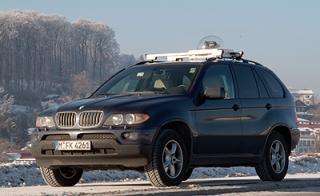
Together with a number of partners, ESA has developed a multimedia car radio of the future. A flat antenna in the roof of the car receives data from the Ku-band of communications satellites. A computer converts the data into sound, images and even complete software packages. Credits: BMW

Crackling radio stations, signal loss in tunnels and difficulties tuning to the correct frequency – the conventional car radio has had its day. ESA and its partners are developing the multimedia car radio of the future. The prototype is being demonstrated today at the Noordwijk Space Expo, in the Netherlands.

The car radio of the future works in a similar manner to a satellite receiver for television channels. However, the car has no large dish antenna on the roof, but a specially designed mobile antenna, flattened so that it can be built almost invisibly into the bodywork. The antenna receives signals in the Ku frequency band used by communications satellites.

The idea of an in-car satellite receiver is not new. In America, more than 13 million people use the services of XM-radio and Sirius radio, two broadcasters that transmit to mobile satellite receivers. They do that via communication satellites, but also with the help of a rural network of transmitter masts.

In two important areas, the new European multimedia system advances beyond existing solutions. Instead of new satellites and a network of ground-based transmitters – which might easily requites an investment of more than a billion Euro – the ESA system uses only existing communication satellites.

Additionally, the mobile multimedia system employs a cache memory – a hard disk or its solid-state equivalent. Received signals can be stored – in a similar way to personal video recorders – and played back after a short time shift or much later. This clever intermediate step prevents loss of signal in tunnels or behind obstructions from disturbing the programme. The listener can also select a part of the broadcast to listen to, or pause the show as they stop to buy fuel.

ESA developed the system with nine partners in the industry and service sectors. The main challenge was that the satellites used by the system were designed to broadcast television signals to large, fixed dish antennas. For use in cars, an entirely new approach was needed to achieve an antenna that can be easily built in by the car manufacturers.

ESA and its partners have worked on the mobile multimedia system for over three years. The technology has been demonstrated and has great potential for the car industry and information providers.

Source: European Space Agency


print this article email this article download pdf blog this article bookmark this article     Stumble it Digg this share on Facebook retweet share on Reddit add to delicious
Rate this story - 4.7 /5 (3 votes)


January 25, 2007 all stories

Comments: 0

4.7 /5 (3 votes)
  • Stumble this up

  • Digg this

  • share this

  • hide
  • Related Stories

  • Monarch butterflies with a heavy load
    created Jul 24, 2009 | popularity not rated yet | comments 0
  • Wireless at WARP speed
    created Jan 29, 2009 | popularity not rated yet | comments 0
  • Surround sound on the move
    created Feb 23, 2007 | popularity not rated yet | comments 0
  • Ask your car radio!
    created Mar 03, 2006 | popularity not rated yet | comments 0
  • Skiing toward the future of mobile services
    created Feb 10, 2006 | popularity not rated yet | comments 0


  • hide
  • Relevant PhysicsForums posts

Other News

Oracle logo

EU objects to Oracle's takeover of Sun

Technology / Business

created 1hour ago | popularity 5 / 5 (1) | comments 0

(AP) -- European antitrust regulators have formally objected to Sun Microsystems Inc.'s planned $7.4 billion sale to Oracle Corp., escalating a battle over a deal that has already been cleared in the U.S.


Video fingerprinting offers search solution

Video fingerprinting offers search solution

Technology / Computer Sciences

created 6 hours ago | popularity not rated yet | comments 0

(PhysOrg.com) -- The explosive growth of video on the internet calls for new ways of sorting and searching audiovisual content. A team of European researchers has developed a groundbreaking solution that is ...


Commercialization of new solar technology to boost solar efficiency

Technology / Energy

created 7 hours ago | popularity 5 / 5 (3) | comments 0

A pioneer in solar power in the 1990s before it became "sexy," University of Houston Professor Alex Freundlich recently entered into a collaborative research agreement with U.K.-based start-up QuantaSol for the development ...


Solar LED lamps

Solar Cells with LEDs Provide Inexpensive Lighting

Technology / Energy

created 9 hours ago | popularity 4.8 / 5 (11) | comments 1

(PhysOrg.com) -- Of the 1.5 billion people in developing countries who do not have electricity, many rely on kerosene lamps for light after the sun goes down. But now, researchers from Denmark have designed ...


Rubens Barrichello

Google ordered to pay 500,000 dlrs to F1 racer Barrichello

Technology / Business

created 4 hours ago | popularity 1 / 5 (1) | comments 0

Internet giant Google has been ordered to pay 500,000 dollars in damages to Formula 1 racer Rubens Barrichello for hosting fake online profiles of him on its social network Orkut.