Molecular link between inflammation and cancer discovered
A team led by biochemists at the University of California, San Diego has found what could be a long-elusive mechanism through which inflammation can promote cancer. The findings may provide a new approach for developing cancer therapies.
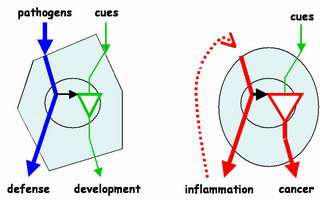
The study, published in the January 26 issue of the journal Cell, shows that what scientists thought were two distinct processes in cells--the cells' normal development and the cells' response to dangers such as invading organisms--are actually linked. The researchers, who were also from the Salk Institute for Biological Studies and the La Jolla Institute for Allergy and Immunology, say that the linkage of these two processes may explain why cancer, which is normal growth and development gone awry, can result from chronic inflammation, which is an out-of-control response to danger.
"Although there is plenty of evidence that chronic inflammation can promote cancer, the cause of this relationship is not understood," said Alexander Hoffmann, an assistant professor of chemistry and biochemistry at U.C. San Diego, who led the study. "We have identified a basic cellular mechanism that we think may be linking chronic inflammation and cancer."
Cellular defense is a rapid process compared to cellular development, just as a state's response to terrorist threats is swifter than the construction of new infrastructure. However, in both settings, safeguarding against threats and building structures have certain steps in common and require similar types of workers, or molecules.
Hoffmann referred to the parallel sets of steps in cellular defense and development as "mirror image pathways." His team showed that these pathways are not distinct from one another because they are linked by a protein called p100. They found that inflammation leads to an increase in p100, but that p100 is also used in certain steps in development. Therefore p100 allows communication between inflammation and development.
A small amount of dialogue between inflammation and development is beneficial, say the researchers, akin to how information from anti-terrorism efforts could be useful to crews building the state's infrastructure. On the other hand, the constant influence of defense processes on development is detrimental.
"Studies with animals have shown that a little inflammation is necessary for the normal development of the immune system and other organ systems," explained Hoffmann. "We discovered that the protein p100 provides the cell with a way in which inflammation can influence development. But there can be too much of a good thing. In the case of chronic inflammation, the presence of too much p100 may overactivate the developmental pathway, resulting in cancer."
In the paper, the researchers propose that thinking of the processes of defense and development as part of a single large system "represents an opportunity for therapeutic intervention." For example, it might be easier to break the link between inflammation and cancer by targeting the developmental pathway, rather than the inflammation pathway.
"Many of the developmental signals that cells use are sent outside the cell, so they should be easier to block with drugs than inflammation signals, which tend to be confined within cells," said Hoffmann. "It's more challenging to design drugs that will enter cells."
Because the molecules that play a role in the inflammation and development pathways have been extensively studied for many years, the researchers say that it is surprising to find a new molecule that significantly revises scientists' understanding about the interactions between inflammation and development. They credit their discovery to an approach that combines biochemical techniques and computation.
"Our mathematical model of inflammation and development includes 98 biochemical reactions," said Soumen Basak, a postdoctoral fellow working with Hoffmann. "When we ran the model, it predicted that p100 levels would be elevated for a significant period of time when the inflammation pathway was stimulated. We confirmed the prediction using biochemical techniques with cells in the laboratory."
"The finding is exciting because it means that p100 provides cells with a memory to inflammatory exposure," added Basak, who was the first author on the paper.
Source: University of California - San Diego


