Strong Magnetism Creates Two-Dimensional Superconductivity, Says Physicist
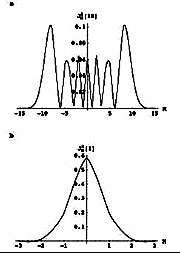
A University of Arizona physicist has shown that it should be possible to restrict electrons to two dimensions in space by placing conducting materials within strong magnetic fields. The fundamental discovery is important because it says that superconductivity is stable in this strongly magnetic environment. Stable superconductors are sought by energy, transportation, medical and computing industries.
Image: An electron standing wave at low magnetic fields (top) occupies about 20 atomic layers, but at high enough magnetic fields (below) can be localized to within one atomic layer. (Figure: Courtesy of Andrei Lebed)
"It sounds strange, but basically we can change the dimensionality of this world to a two-dimensional, pre-Aristotle world," said Andrei Lebed. (The ancient Greek philosopher Artistotle first reasoned that the Earth was not flat, but curved.) "We can confine electrons to just one plane, two dimensions in space, by applying the magnetic field."
Lebed, who joined the UA as an associate professor of physics in 2004, earned his doctorate in 1986 and his doctor of sciences degree (full professor accreditation) from the Landau Institute for Theoretical Physics and Moscow Institute for Physics and Technology in 2000. His research has influenced experiments conducted at Princeton University, Boston College, Harvard University, the National High Magnetic Field Laboratory, the Los Alamos National Laboratory and elsewhere.
Conventional wisdom says that superconductivity is destroyed at high currents, which are produced in strong magnetic fields, because as current increases, superconductors work only at progressively lower temperatures. Lebed has discovered this isn't the case in the two-dimensional world.
"My work may definitely lead to superconductivity that survives at ultra-strong magnetic fields because superconductivity is not destroyed by currents in the two-dimensional world. Two-dimensional superconductivity will be stable at extremely high currents and magnetic fields. This work explores new nano-scale properties of solids in a magnetic field," he said.
Lebed and experimental physicists Michael Naughton of Boston College and Heon-Ick Ha of Harvard University published two Physical Review Letters articles in 2003 and 2004 that showed that it is theoretically and experimentally possible to use magnetism to create "standing waves" of electrons within organic (carbon-containing) crystals. The phenomenon has to do with quantum mechanical wave properties of electrons that interfere with, or cancel, waves that would otherwise propagate in three dimensions in Earth's normal, much weaker, magnetic field.
In research published in the Dec. 9 Physical Review Letters, Lebed describes that it also is theoretically possible to restrict standing electron waves to a single molecule. Electron standing waves that occupy about 20 atomic layers within a weak magnetic field can be localized to a single atomic layer in strong -- but experimentally attainable -- magnetic fields.
Electrons will become completely two-dimensional within laboratory-produced magnetic fields that are between 200,000 times and a million times stronger than the magnetic field at the surface of the Earth, Lebed said. "These strong fields are still a hundred to a thousand times weaker that the magnetic fields in the atoms, and that's a key point," he added.
"I am delighted because I found that you will not destroy the atoms and molecules in the conducting material, but just qualitatively change the properties of the valence conduction electrons," Lebed said. (A valence electron is an electron in an outer shell of an atom that can form chemical bonds with other atoms.) "Basically, we can change the chemistry of the solids by how we rotate the sample in the magnetic field," he added.
"The results are not restricted to organic materials, but should be applicable to the important class of high-temperature superconductors."
Superconductors are materials that conduct electricity with near-zero resistance. Researchers seek to develop more practical superconducting materials, that is, those that conduct at temperatures higher than 300 Kelvin (80 degrees Fahrenheit) and preserve superconducting properties at high currents.
The highest - temperature superconducting materials developed so far are superconductors that work at around 138 degrees Kelvin (minus 211 degrees Fahrenheit). Commercial applications still require expensive cooling systems.
More practical, affordable superconductors would be a boon to power utilities that would realize enormous savings in more efficient systems for generating and storing electricity, to the transportation industry which is experimenting with trains that float above their tracks using superconducting magnets, to medical technologists who are developing improved magnetic resonance imaging, and to the supercomputing industry that seeks very fast electronic switches needed to build "petaflop" computers capable of performing a thousand-trillion floating point operations per second.
Source: University of Arizona (By Lori Stiles)


