Lutetia asteroid in Rosetta's spotlight
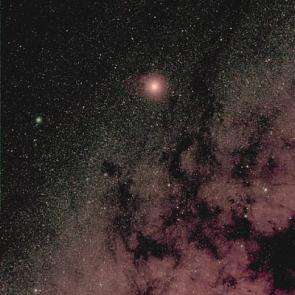
January 26, 2007 Rosetta’s view of Mars and the Milky Way

This view of Mars (visible towards the top of the image) and of the Milky Way was taken by the OSRIS camera on board the Rosetta orbiter on 3 December 2006, during the last series of instrument check-outs. In this image Mars is heavily overexposed and therefore surrounded by a halo of scattered light. Credit: ESA/MPS/UPD/LAM/IAA/RSSD/INTA/UPM/DASP/IDA

Earlier this month ESA's Rosetta had a first look at asteroid 21-Lutetia, one of the targets of its long mission. The onboard camera OSIRIS imaged the asteroid passing through its field of view during the spacecraft's gradual approach to Mars. The planet will be reached on 25 February 2007 for the mission's next gravity assist.

During its long trek to final destination (comet 67P Churyumov-Gerasimenko), Rosetta is planned to study two asteroids – 2867-Steins and 21-Lutetia, both lying in the asteroid belt between the orbits of Mars and Jupiter. Asteroids, as well as comets, carry important information about the origin of the Solar System – a better understanding of which is one of the primary goals of Rosetta.

The two asteroids will be visited at close range in September 2008 and July 2010, respectively, but the Rosetta scientists have already taken the opportunity to collect preliminary data about them. This opportunity will help scientists to better prepare for the broader observation campaigns of the two asteroids to come at later stage.

Steins was imaged by Rosetta on March 11, while Lutetia was first imaged by Rosetta during a 36-hour observation campaign on 2 and 3 January 2007, when the spacecraft was flying at about 245 million kilometres from the asteroid. OSIRIS, the Optical, Spectroscopic, and Infrared Remote Imaging System mounted onboard the Rosetta orbiter, was switched on for this remote sensing observation.

Lutetia can be seen as the near-stationary spot visible at the centre of the animated sequence presented in this article. The scattered light spots seen in the movie are cosmic rays events, that is high-energy cosmic radiation hitting the detectors of the OSIRIS camera.

Little is known about Lutetia and Steins. Actually, very little is known about asteroids in general. Out of the many millions of asteroids that populate the Solar System, only a few have been observed so far from near-by.

According to what we know so far, Steins and Lutetia have rather different properties. Steins is relatively small, with a diameter of a few kilometres. Lutetia is a much bigger object, about 100 kilometres in diameter.

The Lutetia observation this month were aimed at pre-characterizing the rotation direction of the asteroid. This can be done by the study of the so-called 'light curve' of the asteroid – by analysing how the light emitted by the observed object changes intensity for the observer, one can deduce in what direction the object rotates. Scientists are now busy in analysing the OSIRIS data to build the light curve of Lutetia.

Having concluded the Lutetia observations, Rosetta is now getting ready for the next mission milestone: the swing-by of planet Mars. At the end of February, the gravitational energy of the Red Planet will be used by the spacecraft to get accelerated and then pushed, like a stone in a sling-shot, on a trajectory towards Earth for the following gravity assist manoeuvre in November 2007.

In the meantime Rosetta continues to provide new emotions as this incredible spacecraft, travelling through the Solar System as a cosmic 'billiard ball', collects data and images of the objects on its way.

Source: European Space Agency


print this article email this article download pdf blog this article bookmark this article     Stumble it Digg this share on Facebook retweet share on Reddit add to delicious
Rate this story - 4.4 /5 (5 votes)


January 26, 2007 all stories

Comments: 0

4.4 /5 (5 votes)
  • Stumble this up

  • Digg this

  • share this

  • hide
  • Related Stories

  • Rosetta's final Earth boost
    created Nov 04, 2009 | popularity not rated yet | comments 0
  • Last visit home for ESA's comet chaser Rosetta
    created Oct 20, 2009 | popularity not rated yet | comments 0
  • Steins: A diamond in the sky
    created Sep 08, 2008 | popularity not rated yet | comments 0
  • Rosetta closes in on Earth -- a second time
    created Nov 08, 2007 | popularity not rated yet | comments 0
  • Rosetta obtains 'light curve' of asteroid Steins
    created Mar 20, 2007 | popularity not rated yet | comments 0


  • hide
  • Relevant PhysicsForums posts

  • Consistency of Meteor Shower Dates (i.e. the peak of Perseids always on Aug 13th)
    created 19 hours ago
  • Favourite Astronomy Book?
    created Nov 10, 2009
  • dark energy
    created Nov 10, 2009
  • The shape of our solar system's orbits.
    created Nov 07, 2009
  • More from Physics Forums - General Astronomy

Other News

Earth

Early life on Earth may have developed more quickly than thought

Space & Earth / Earth Sciences

created 39 minutes ago | popularity not rated yet | comments 0

The Earth's climate was far cooler -- perhaps more than 50 degrees -- billions of years ago, which could mean conditions for life all over the planet were more conducive than previously believed, according ...


sky, sun

A lightning strike in Africa helps take the pulse of the sun

Space & Earth / Space Exploration

created 49 minutes ago | popularity not rated yet | comments 0

Sunspots, which rotate around the sun's surface, tell us a great deal about our own planet. Scientists rely on them, for instance, to measure the sun's rotation or to prepare long-range forecasts of the Earth's ...


Earth's early ocean cooled more than a billion years earlier than thought: Stanford study

Earth's early ocean cooled more than a billion years earlier than thought (w/ Video)

Space & Earth / Earth Sciences

created 1hour ago | popularity 5 / 5 (1) | comments 0

(PhysOrg.com) -- The scalding-hot sea that supposedly covered the early Earth may in fact never have existed, according to a new study by Stanford University researchers who analyzed isotope ratios in 3.4 ...


Exoplanets Clue to Sun's Curious Chemistry

Exoplanets Clue to Sun's Curious Chemistry

Space & Earth / Astronomy

created 2 hours ago | popularity 4.7 / 5 (3) | comments 3

(PhysOrg.com) -- A ground-breaking census of 500 stars, 70 of which are known to host planets, has successfully linked the long-standing "lithium mystery" observed in the Sun to the presence of planetary systems. ...


A bubbling ball of gas

A bubbling ball of gas (w/ Video)

Space & Earth / Space Exploration

created 3 hours ago | popularity 5 / 5 (4) | comments 2

The Sun is a bubbling mass. Packages of gas rise and sink, lending the sun its grainy surface structure, its granulation. Dark spots appear and disappear, clouds of matter dart up - and behind the whole thing ...