Personal digital assistants in space
January 26, 2007 Personal digital assistants in space

Inventory Management System application used on the ISS to track the location of all items stored on board.

Can tiny and ubiquitous devices like Personal Digital Assistants (PDAs) be of use for space applications? The answer is a definite yes. Recent tests have demonstrated current and future uses for PDAs on board the International Space Station.

Current applications

Up until late 2006, PDAs had been used on board the International Space Station (ISS) mainly as personal computing or entertainment platforms.
In the near future, PDAs will start being used as integrated components of real applications.

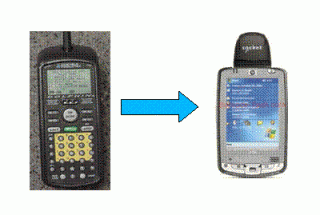
For example, on the space station there is an application called the Inventory Management System (IMS) that is responsible for keeping track of the location of all items stored on board. This application is based on the use of barcode labels. Starting in March 2007, the old barcode reader terminals will be replaced by PDAs. These PDAs will be equipped with a barcode reader and will be connected to the IMS via a wireless network.

A special application, known as the PDA Depressurisation Program (PDP) and conceived by the astronaut Thomas Reiter, has been developed by ESA to compute the 'egress time', – the time that is left before having to abandon the ISS in the event of depressurisation.

This application, tested for usability by Reiter during his long duration mission – from July to December 2006 – is currently undergoing qualification by NASA and will become part of the standard set of software packages loaded on each astronaut PDA.

Prototype applications and research areas

PDAs have been investigated as alternative or complementary platforms for some of the applications currently running on the ISS laptops. The idea is to use a PDA in those situations where a laptop might be inconvenient because it is too big or cumbersome.

An example of laptop to PDA conversion, developed by industry using ESA research and development funding, is the porting of the ESA/NASA International Procedure Viewer (IPV) application. In this type of conversion, the critical factor is adapting the laptop based user interface to a new platform where the available screen area is significantly smaller.

Another area of research is the use of the PDA as a voice or speech processing platform. Combined with wireless communication, PDAs could become suitable devices for crew-to-crew communication (VOIP applications) and crew-to-system communication (speech synthesis and speech recognition – an example is shown in the illustration – click the figure to enlarge).

One limitation for applications employing voice sounds for either input or output is the noise that is always present on board the ISS, most of which is generated by the ventilation system. The PDA Depressurisation Program uses speech synthesis to notify the crew members about the time remaining before egress. However, ambient sound is not an issue for this application because, if depressurisation occurs, the ventilation system is automatically switched off as safety measure.

Source: European Space Agency


print this article email this article download pdf blog this article bookmark this article     Stumble it Digg this share on Facebook retweet share on Reddit add to delicious
Rate this story - 5 /5 (2 votes)


January 26, 2007 all stories

Comments: 0

5 /5 (2 votes)
  • Stumble this up

  • Digg this

  • share this

  • hide
  • Related Stories

  • Palm Pre to go on sale June 6
    created May 19, 2009 | popularity not rated yet | comments 0
  • Emotional machines
    created Apr 03, 2008 | popularity not rated yet | comments 0
  • Lunar Dust Buster
    created Apr 20, 2006 | popularity not rated yet | comments 0
  • Novel anti-virus for handhelds from India
    created Dec 27, 2005 | popularity not rated yet | comments 0
  • Spansion Introduces Innovative Package-On-Package Solution To Reduce Wireless Device Size
    created Sep 12, 2005 | popularity not rated yet | comments 0


  • hide
  • Relevant PhysicsForums posts

  • Question about 2-body gravity
    created 17 hours ago
  • life on Mars
    created 19 hours ago
  • Semi-major axis from cartesian co-ordinates
    created Nov 23, 2009
  • Primary Mirror grinding
    created Nov 23, 2009
  • More from Physics Forums - General Astronomy

Other News

Cassini Captures Ghostly Dance of Saturn's Northern Lights

Cassini Captures Ghostly Dance of Saturn's Northern Lights (w/ Video)

Space & Earth / Space Exploration

created 9 hours ago | popularity 5 / 5 (3) | comments 0

(PhysOrg.com) -- In the first video showing the auroras above the northern latitudes of Saturn, Cassini has spotted the tallest known "northern lights" in the solar system, flickering in shape and brightness ...


First black holes may have incubated in giant, starlike cocoons, says CU-Boulder study

First black holes may have incubated in giant, starlike cocoons

Space & Earth / Astronomy

created 12 hours ago | popularity 4.4 / 5 (10) | comments 7

(PhysOrg.com) -- The first large black holes in the universe likely formed and grew deep inside gigantic, starlike cocoons that smothered their powerful x-ray radiation and prevented surrounding gases from ...


ET: Check your voicemail

ET: Check your voicemail

Space & Earth / Space Exploration

created 9 hours ago | popularity 3.4 / 5 (5) | comments 5

(PhysOrg.com) -- Alien beings on faraway planets may not have noticed, but it’s been 35 years since human beings made the first deliberate effort to send them a message.


Infrared Image of Circumstellar Disk Illuminates Massive Star Formation Process

Infrared Image of Circumstellar Disk Illuminates Massive Star Formation Process

Space & Earth / Astronomy

created 8 hours ago | popularity 4.5 / 5 (2) | comments 0

(PhysOrg.com) -- A team of astronomers from Ibaraki University, Japan Aerospace Exploration Agency, Kanagawa University, University of Tokyo, Academica Sinica, and National Astronomical Observatory of Japan ...


Humanity would need five Earths to create the resources needed if everyone lived as like Americans, a report has stated

Mankind using Earth's resources at alarming rate

Space & Earth / Environment

created 18 hours ago | popularity 3.3 / 5 (12) | comments 19

Humanity would need five Earths to produce the resources needed if everyone lived as profligately as Americans, according to a report issued Tuesday.