Engineers Investigate Issue on One of Hubble's Science Instruments
January 29, 2007 Hubble Space Telescope

Hubble Space Telescope

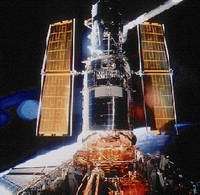
NASA engineers are examining a problem related to the Advanced Camera for Surveys (ACS) aboard the agency's Hubble Space Telescope.

On Jan. 27, the observatory entered a protective "safemode" condition at 7:34 a.m. EST. An initial investigation indicates the camera has stopped functioning, and the input power feed to its Side B electronics package has failed.

The instrument had been operating on its redundant electronics since June 30, 2006, when NASA engineers transitioned from the primary, Side A, electronics package due to a malfunction. Engineers currently are assessing the option to return ACS science operations to the primary electronics so that observations could resume in a reduced mode.

Hubble was recovered from safemode around 2 a.m. EST on Jan. 28, and science observations will resume this week using the remaining Hubble instruments: Wide Field Planetary Camera 2, Near Infrared Camera Multi-Object Spectrograph, and the Fine Guidance Sensors.

In November 2006, the Space Telescope Science Institute in Baltimore selected a set of backup non-ACS science programs for use in case of a future ACS anomaly. These programs now will be inserted into the science schedule to maintain a highly productive observing program.

An Anomaly Review Board was appointed on Jan. 29, to investigate the ACS anomaly. The board will perform a thorough investigation and assessment to decide the best course of action. The board is scheduled to present their findings and recommendations by March 2.

"It is too early to know what influences the ACS anomaly may have on Hubble Space Telescope Servicing Mission-4 planning" said Preston Burch, associate director/program manager for the Hubble Space Telescope. "It is important that the review board conduct a thorough investigation that will allow us to determine if there are any changes needed in the new instruments that will be installed on the upcoming servicing mission so that we can be sure of maximizing the telescope's scientific output. We are continuing to make excellent progress in our preparations for the servicing mission, which is presently targeted to fly in September 2008."

The Advanced Camera for Surveys is a third-generation instrument consisting of three electronic cameras, filters and dispersers that detect light from the ultraviolet to the near infrared. The instrument was installed during a March 2002, servicing mission. It was developed jointly by NASA's Goddard Space Flight Center, Greenbelt, Md., Johns Hopkins University, Baltimore; Ball Aerospace, Boulder, Colo.; and the Space Telescope Science Institute.

Source: NASA


print this article email this article download pdf blog this article bookmark this article     Stumble it Digg this share on Facebook retweet share on Reddit add to delicious
Rate this story - 5 /5 (3 votes)


January 29, 2007 all stories

Comments: 0

5 /5 (3 votes)
  • Stumble this up

  • Digg this

  • share this

  • hide
  • Related Stories

  • 'Dropouts' pinpoint earliest galaxies
    created Nov 06, 2009 | popularity not rated yet | comments 0
  • Hubble Image Showcases Star Birth in M83, the Southern Pinwheel
    created Nov 05, 2009 | popularity not rated yet | comments 0
  • Opening up a colorful cosmic jewel box
    created Oct 29, 2009 | popularity not rated yet | comments 0
  • Astronomers do it Again: Find Organic Molecules Around Gas Planet (w/ Video)
    created Oct 20, 2009 | popularity not rated yet | comments 0
  • Sky merger yields sparkling dividends
    created Oct 13, 2009 | popularity not rated yet | comments 0


  • hide
  • Relevant PhysicsForums posts

  • Consistency of Meteor Shower Dates (i.e. the peak of Perseids always on Aug 13th)
    created 4 hours ago
  • Favourite Astronomy Book?
    created 19 hours ago
  • dark energy
    created 19 hours ago
  • The shape of our solar system's orbits.
    created Nov 07, 2009
  • More from Physics Forums - General Astronomy

Other News

Controversial new climate change results

Controversial new climate change results

Space & Earth / Environment

created 17 hours ago | popularity 4.5 / 5 (15) | comments 19

(PhysOrg.com) -- New data show that the balance between the airborne and the absorbed fraction of CO2 has stayed approximately constant since 1850, despite emissions of CO2 having risen from about 2 billion ...


Earth

Atomic Particles Help Solve Planetary Puzzle

Space & Earth / Earth Sciences

created 7 hours ago | popularity 4.6 / 5 (5) | comments 0

(PhysOrg.com) -- A University of Arkansas professor and his colleagues have shown that the Earth's mantle contains the same isotopic signatures from magnesium as meteorites do, suggesting that the planet formed ...


The Stars My Destination

The Stars My Destination

Space & Earth / Space Exploration

created 8 hours ago | popularity 5 / 5 (10) | comments 0

The Voyager spacecraft are now in the outermost layer of the heliosphere, traveling toward interstellar space - the first man-made spacecraft to travel such a vast distance from Earth.


Cave study links climate change to California droughts

Space & Earth / Earth Sciences

created 9 hours ago | popularity 3 / 5 (2) | comments 0

California experienced centuries-long droughts in the past 20,000 years that coincided with the thawing of ice caps in the Arctic, according to a new study by UC Davis doctoral student Jessica Oster and geology professor ...


Scientists prepare the Mini-Research Module 2 (MRM 2) "Poisk"

Rocket with new module for space station blasts off

Space & Earth / Space Exploration

created 11 hours ago | popularity 5 / 5 (1) | comments 0

A Soyuz rocket carrying a new Russian-made module for the International Space Station blasted off on Tuesday from the Baikonur space base in Kazakhstan, television pictures showed.