New Sensor Detects Direction of Sound Under Water
January 29, 2007
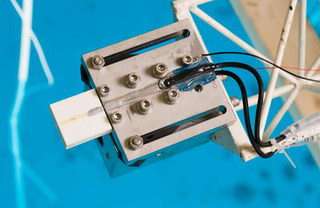
Using optical fibers, researchers at the Georgia Institute of Technology have created a sensor that detects the direction from which a sound is coming under water—an important improvement over current technology. Credit: Georgia Institute of Technology
A new sensor that measures the motion created by sound waves under water could allow the U.S. Navy to develop compact arrays to detect the presence of enemy submarines. These new arrays would detect quiet underwater targets, while also providing unambiguous directional information.
Using optical fibers, researchers at the Georgia Institute of Technology have found a way to create a sensor that detects the direction from which a sound is coming under water. This directional component is an important improvement over the current technology, researchers said.
“Detecting quiet sounds under water can be very difficult,” said Francois Guillot, a research engineer in Georgia Tech’s George W. Woodruff School of Mechanical Engineering. “But our sensor detects small sounds over the noise of the ocean and also provides directional information.”
The sensor uses a mechanism inspired by how fish hear under water. Inside a fish’s ear, there are thousands of tiny hairs that move when a sound wave passes through the fish. These hairs then communicate with nerves allowing fish to hear under water. Because fish excel at detecting sound so they don’t get eaten, the Georgia Tech researchers chose the fish hearing system as their model, they said.
Guillot described the novel underwater sensor late last fall at the 4th joint meeting of the Acoustical Society of America and the Acoustical Society of Japan in Honolulu, Hawaii. His presentation was part of a session titled “Underwater Acoustics: Array Processing, Sensors, and Technology.”
In the field of underwater acoustics, there is always a need to develop more sophisticated sensors, researchers said. The Navy currently tows long lines of hydrophones to listen to sound under water—much like a microphone listens to sound in the air. A hydrophone measures the pressure change associated with the propagation of a sound wave. It converts acoustic energy into electrical energy and is used in passive underwater systems to listen only. One hydrophone identifies a sound nearby, and multiple hydrophones can help tell the direction from which it’s coming. But directional ambiguity exists. A line array of hydrophones cannot tell if the sound is coming from the left or right.
Guillot and collaborators David Trivett, a principal research scientist, and Peter Rogers, a professor—both in the School of Mechanical Engineering—have developed a more compact, more sensitive sound detector that can provide unambiguous directional information. In addition, the sensor can be modified to measure the water deformation, known as shear, associated with a sound wave— a quantity typically difficult to measure because it requires very sensitive instruments. This new sensor shows promise that it can be successfully modified to detect this acoustic shear, which will enhance the directional information, the researchers said.
The sensor is designed with two small plates attached by a hinge. One plate is held rigidly, and the other plate—made of a composite material with the same density as water—is free to move. The freely moving plate shifts in the sound field and follows the motion of water. A light signal sent through an optical fiber glued to both plates is modified by the motion of the freely moving plate. Analyzing the light signal with a photodetector provides information relative to the sound waves.
The sensor developed at Georgia Tech offers advantages over existing systems, researchers said. Guillot hopes the new sensor changes the way the Navy detects sound under water.
“If the Navy tows an array of hydrophones thousands of feet long, it makes it difficult to maneuver the ship,” Rogers said. “Since we can cut that length by a factor of more than five, it will cost less money to operate and be easier to handle.”
The current prototype sensor has been tested in the School of Mechanical Engineering’s large underwater acoustic tank facility to observe the behavior of the sensor under water. The facility includes a rectangular concrete water tank 25 feet deep, 25 feet wide and 34 feet long; it contains about 160,000 gallons of water. The researchers hope to field test the prototype system soon to see if it outperforms current technology.
Source: Georgia Institute of Technology
-
Rap music powers rhythmic action of medical sensor
Jan 26, 2012 |
4.2 / 5 (5) |
1
-
Advanced mathematical techniques enable AUVs to survey large, complex and cluttered seascapes
Nov 08, 2011 |
not rated yet |
0
-
Redefining the SI base units
Nov 03, 2011 |
5 / 5 (6) |
3
-
'Orca ears' inspire researchers to develop ultrasensitive undersea microphone
Jun 23, 2011 |
5 / 5 (4) |
2
-
New class of implantable monitoring devices for heart patients
Feb 04, 2011 |
not rated yet |
0
-
Engineers build first sub-10-nm carbon nanotube transistor
Feb 01, 2012 |
4.9 / 5 (31) |
30
-
Something old, something new: Evolution and the structural divergence of duplicate genes
Jan 31, 2012 |
4.6 / 5 (7) |
1
-
The hidden nanoworld of ice crystals: Revealing the dynamic behavior of quasi-liquid layers
Jan 30, 2012 |
5 / 5 (3) |
1
-
Stock market network reveals investor clustering
Jan 27, 2012 |
3.9 / 5 (23) |
8
-
Of microchemistry and molecules: Electronic microfluidic device synthesizes biocompatible probes
Jan 26, 2012 |
5 / 5 (1) |
0
-
Need help reading 3-D
2 hours ago
-
A way to send and receive wireless data
8 hours ago
-
Tabletop Cold Fusion Reactor
10 hours ago
-
Calling function with no input argument
Feb 10, 2012
-
Force free body diagram problem on gym equipment
Feb 10, 2012
-
Empirical data regarding shower heads and water
Feb 10, 2012
- More from Physics Forums - General Engineering
More news stories
Walney offshore wind farm is world's biggest (for now)
(PhysOrg.com) -- The Walney wind farm on the Irish Sea--characterized by high tides, waves and windy weather--officially opened this week. The farm is treated in the press as a very big deal as the Walney ...
GPS court ruling leaves US phone tracking unclear
A US Supreme Court decision requiring a warrant to place a GPS device on the car of a criminal suspect leaves unresolved the bigger issue of police tracking using mobile phones, legal experts say.
11 hours ago |
4 / 5 (2) |
0
Europeans protest controversial Internet pact
Tens of thousands of people marched in protests in more than a dozen European cities Saturday against a controversial anti-online piracy pact that critics say could curtail Internet freedom.
7 hours ago |
5 / 5 (5) |
0
Netflix settlement trims 14 pct off 4Q earnings
(AP) -- Netflix pressed the rewind button on its fourth-quarter earnings after settling allegations that the video subscription service violated a consumer-privacy law.
11 hours ago |
not rated yet |
0
Navy to begin tests on electromagnetic railgun prototype launcher
The Office of Naval Research (ONR)'s Electromagnetic (EM) Railgun program will take an important step forward in the coming weeks when the first industry railgun prototype launcher is tested at a facility ...
Feb 06, 2012 |
4.6 / 5 (14) |
89
|
Europe stakes billion-dollar bet on new rocket
A pencil-slim rocket is scheduled to lift into space from South America on Monday, carrying a billion-dollar bet that Europe can grab a juicy slice of the market to place satellites in low orbit.
Study finds that anti-diabetic medication can prevent the long-term effects of maternal obesity
In a study to be presented today at the Society for Maternal-Fetal Medicine's annual meeting, The Pregnancy Meeting, in Dallas, Texas, researchers will report findings that show that short therapy with the anti-diabetic medication ...
Steroid injections prove effective in treatment of lumbar disc herniations
The use of epidural steroid injections may be a more efficient treatment option for lumbar disc herniations, according to research presented today at the American Orthopaedic Society for Sports Medicine's Specialty Day in ...
Amateur football players not always keen on returning to play after ACL injuries
Despite the known success rates of reconstructive Anterior Cruciate Ligament (ACL) surgery, the number of high school and collegiate football players returning to play may not be as high as anticipated, say researchers presenting ...
Study finds elevated levels of cell-free DNA in first trimester do not predict preeclampsia
In a study to be presented today at the Society for Maternal-Fetal Medicine's annual meeting, The Pregnancy Meeting, in Dallas, Texas, researchers will report findings that indicate that elevated levels of cell-free DNA in ...
PRP treatment aids healing of elbow injuries say researchers
As elbow injuries continue to rise, especially in pitchers, procedures to help treat and get players back in the game quickly have been difficult to come by. However, a newer treatment called platelet rich plasma (PRP) may ...