Hatching a New Model for Biomineralization

January 29, 2007

The idea started with an eggshell and ended with a new understanding of how minerals form to build exceptionally strong structures in the bodies of humans and other organisms. Biomineralization, the process by which organisms form materials such as bones, mollusk shells, and other structures, has captured the attention of scientists for years.

Finding a way to mimic the properties of these sturdy and naturally made materials could lead to the medical engineering of replacement bone, teeth, and cartilage, as well as the development of new electronic and industrial materials. Most of the research surrounding biomineralization has looked at the multiple processes it involves and the diversity of its products. But at the NSLS, using inspiration from an egg, a team of researchers studied the earliest stages of biomineralization to find out what sets the process in motion.
Hatching a New Model for Biomineralization
Enlarge

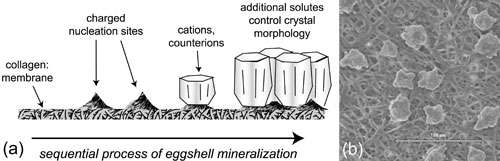
Figure 1. A) The sequential mineralization stages of an eggshell. Upon the rough collagen membrane, charged sites of nucleating protein are deposited first, then exposed to calcium and carbonate to nucleate crystals. Subsequent chemical species in the fluid control the crystal growth and orientation. B) Scanning electron micrograph of an eggshell membrane at the early stage, showing the fibers of collagen and the first nucleated crystals. (Courtesy of J. L. Arias, Universidad de Chile, Santiago Chile). Scale bar: 100 microns.

A bird’s eggshell is about a half-millimeter of layered calcium carbonate crystals, stabilized by a protein matrix. The shell forms during just about 12 hours of travel time through the bird’s oviduct, an amazing natural feat, said NSLS physicist Elaine DiMasi, one of the authors of the biomineralization study that was published in the October 3, 2006 edition of the Proceedings of the National Academy of Sciences.

“It starts as a collagen membrane and goes through a series of different fluids with different species in them, and in the end, you have this hard mineral,” she said. “We were looking for a system that would mimic some features of that eggshell.”
Hatching a New Model for Biomineralization
Enlarge

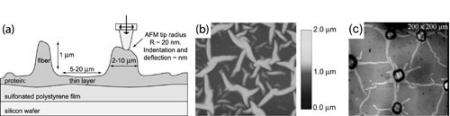
Figure 2. A) Schematic of the model system showing how thin layer protein and micron fibers are layered upon the silicon wafer/sulfonated polystyrene substrate. B) AFM image of the network of elastin fibers. Panel 50 microns wide. C) The eggshell-mimicking result of our experiments: optical micrograph of the elastin network with calcite crystals located at the fiber vertices. Panel 200 microns wide.

To model extracellular biomineralization, the formation of materials on the outside of the cell wall, such as in the case of egg shell formation, the research team used a self-assembled protein network with both fibronetin and elastin – major connective tissue components in multicellular organisms. These proteins were incubated on negatively charged surfaces in two forms: structurally organized fibers and regions with a thin unorganized layer of protein wedged in between them.

After exposing the system to calcium carbonate for a varying set of times, the researchers used a relatively new technique called shear modulation force microscopy (SMFM) to compare the response of the two sets of protein fibers. SMFM is an atomic force microscopy-based technique in which a cantilever with a superfine tip just 40 nanometers wide is stuck into the soft material being studied. The tip is then vibrated to measure the stiffness of the material, and thus whether or not mineralization occurred on the protein fibers.

The group found that the calcium carbonate stiffened only the organized protein fibers, without affecting the unorganized regions between them. This demonstrates that mineralization requires structural organization of the protein in order to function, DiMasi said.

“It’s exciting that there’s a demonstration of disorganized and organized proteins side by side in the same exact environment,” DiMasi said. “Any other experiment would have just inferred that an organized protein structure was necessary to nucleate, but there’s never been a comparison like this between disorganized and organized protein.”

Besides the actual results, the setup of the experiment itself, including the model system and the SMFM technique, provides valuable information for the scientific community – and not just to study eggs.

“This looks like a really good model system,” DiMasi said. “Now one could take collagen and calcium phosphate and study bone nucleation or any other number of things. It just looks like a really good platform.”

Other scientists involved in the study are Seo-Young Kwak (NSLS); Karthikeyan Subburaman, Nadine Pernodet, Shouren Ge, Vladimir Zaitsev, Xiaolan Ba, and Miriam Rafailovich (Stony Brook University); and Nan-loh Yang (City University of New York).

Source: by Kendra Snyder, Brookhaven National Laboratory


print this article email this article download pdf blog this article bookmark this article     Stumble it Digg this share on Facebook retweet share on Reddit add to delicious
Rate this story - 4.1 /5 (11 votes)


January 29, 2007 all stories

Comments: 0

4.1 /5 (11 votes)
  • Stumble this up

  • Digg this

  • share this

  • hide
  • Related Stories

  • Discovered key gene for the formation of new neurons
    created Sep 14, 2009 | popularity not rated yet | comments 0
  • Protected fear memories
    created Sep 11, 2009 | popularity not rated yet | comments 0
  • Common variation in gene linked to structural changes in the brain
    created Aug 17, 2009 | popularity not rated yet | comments 0
  • How E. coli grows its 'nose'
    created Jul 07, 2009 | popularity not rated yet | comments 0
  • Salamanders, regenerative wonders, heal like mammals, people
    created Jul 01, 2009 | popularity not rated yet | comments 0


  • hide
  • Relevant PhysicsForums posts

  • antibonding MO do they exist in reality?
    created 10 hours ago
  • temperature dependence on intrinsic carrier concentration
    created 14 hours ago
  • fermi level simple explanation
    created 19 hours ago
  • Absorption spectrum of water ice, infrared
    created 21 hours ago
  • wonder about atom characteristic
    created Nov 06, 2009
  • Proton mobility vs. conductance in ice
    created Nov 04, 2009
  • More from Physics Forums - Atomic, Solid State, Comp. Physics

Other News

Stars Fueled by Dark Matter Could Hold Secrets to the Universe

Stars Fueled by Dark Matter Could Hold Secrets to the Universe

Physics / General Physics

created Nov 03, 2009 | popularity 4.5 / 5 (51) | comments 41

(PhysOrg.com) -- The first stars in the universe may have been very different from the stars we see today, yet they may hold clues to understanding some of the mysterious features of the universe. These "dark ...


Second Law of Thermodynamics May Explain Economic Evolution

Second Law of Thermodynamics May Explain Economic Evolution

Physics / General Physics

created Nov 02, 2009 | popularity 4.3 / 5 (30) | comments 28

(PhysOrg.com) -- Terms such as the "invisible hand," laissez-faire policy, and free-market principles suggest that economic growth and decline in capitalist societies seem to be somehow self-regulated. Now, ...


High-performance plasmas may make reliable, efficient fusion power a reality

High-performance plasmas may make reliable, efficient fusion power a reality

Physics / Plasma Physics

created Nov 02, 2009 | popularity 4.7 / 5 (39) | comments 32

In the quest to produce nuclear fusion energy, researchers from the DIII-D National Fusion Facility have recently confirmed long-standing theoretical predictions that performance, efficiency and reliability ...


'Teapot effect' solved

Solving Teapot Effect

Physics / General Physics

created Nov 02, 2009 | popularity 4.9 / 5 (11) | comments 10

(PhysOrg.com) -- A team of scientists from France have worked out why teapots dribble at low flow rates, and how to stop them. The effect is called the "teapot effect", and solving it could finally put an ...


Laser accelerated protons to the highest energies so far

Researchers use trident laser to accelerate protons to record energies

Physics / General Physics

created Nov 02, 2009 | popularity 4.7 / 5 (6) | comments 10

An international team of physicists at Los Alamos National Laboratory has succeeded in using intense laser light to accelerate protons to energies never before achieved. Using this technique, scientists can ...