When Flowing Grains Get Jam Packed
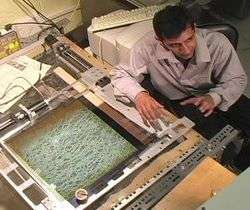
Using color-shifting cylinders as substitutes for sand grains or coal lumps, a Duke University-led team of physicists has pinpointed a critical density level where granular materials suddenly cease flowing like a liquid and instead congeal into a state of rigidity.
That magic moment -- described as a "jamming transition" -- is announced by a kind of phase change analogous to the freezing of water, the scientists showed in experiments.
"The transition does not occur at the point that the particles are as dense as they can possibly be," said Robert Behringer, the Duke physics professor who led the research team. "Actually, they are just beginning to get densely packed. So you don't need that much compaction to make them like solids. You just need this sort of magical amount.
"That's really very peculiar," he said. "Experience wouldn't suggest that there would be this magic point where there would suddenly be this leap."
The findings could help engineers resolve when grainlike coal pieces will clump together and when they will flow like a liquid. "If you open the door to a coal hopper, you don't want the coal to be like a solid," Behringer said. "You want it to flow."
The report was posted online on Monday, Jan. 29, in the journal Physical Review Letters.
Behringer has spent years overseeing experimental studies of granular materials, a group that includes sand, coal, cereal, sugar, pills, powders, gravel and ice cubes.
Such materials exhibit uncanny group behavior in which they sometimes flow but other times clump rigidly in a mass, he said. This behavior is unpredictable, with examples occurring in such diverse events as coal jams and avalanches.
A previous Behringer-led experiment demonstrated that small plastic beads exhibiting grainlike behavior can be made to "freeze" into crystallike solids or "melt" into loose and fluidlike irregularity, depending on how they are stirred or shaken.
In the new study, the researchers provided an unprecedented analysis detailing what happens as free-flowing grains begin to get jammed by each other.
The experiment relied on plastic cylinders as grain substitutes. The cylinders changed color where squeezed, giving researchers a glimpse of jagged "force chains" that transmit the group effects of grain-on-grain influences within a closed system. (Watch the video with RealPlayer)
The researchers compressed the cylinders within an adjustable frame and analyzed what happened using special computational mathematics developed by Trushant Majmudar, the first author of the journal report, who is a former Duke graduate student and now a postdoctoral researcher at the Massachusetts Institute of Technology.
"When a container is really large, there's lots of space between the particles so they don't touch very much and the system acts like a fluid," Behringer said. "But as you shrink the container, the number of contacts grows. And the prediction was that when there are enough contacts per particle, the system will make this transition from fluid to solid."
Confirming the almost-decade-old predictions of theoreticians from the University of Pennsylvania and the University of Chicago as well as Princeton, Yale and Brandeis universities, the Duke team documented that at a critical confluence, pressure and particle-density readings suddenly increase and then diverge -- a change mathematically known as a "power law."
Such power laws are also expressed in phase transitions, such as the point at which water and steam become indistinguishable, Behringer said.
Comparative digital images of the system in "almost jammed" versus "highly jammed" states graphically documented the difference, with a network of glowing force chains clearly visible in the highly jammed image, he said.
Source: Duke University


