Researchers achieve major breakthrough in laser diode development
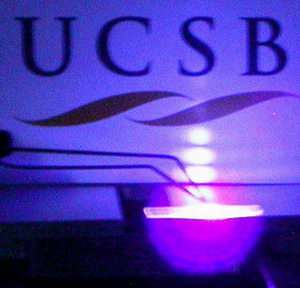
A team of researchers at the University of California, Santa Barbara led by Shuji Nakamura, winner of the 2006 Millennium Technology Prize, has reported a major breakthrough in laser diode development.
The researchers, from the Solid State Lighting and Display Center in UCSB's College of Engineering, have achieved lasing operation in nonpolar gallium nitride (GaN) semiconductors and demonstrated the world's first nonpolar blue-violet laser diodes.
The nonpolar blue-violet laser diodes have numerous commercial applications, including high-density optical data storage for high definition displays and video, optical sensing, and medical applications. Because of the shorter wavelength of emission in these devices, they can accommodate higher densities of optical storage than conventional red-laser based systems.
Nakamura, a professor in the Department of Materials at UC Santa Barbara's College of Engineering, is internationally known for his invention of revolutionary new light sources: blue, green, and white light-emitting diodes and the blue laser diode. He and two of his UCSB faculty colleagues, professors Steven DenBaars and James Speck, directed the work of two graduate students, Mathew Schmidt and Kwang Choong Kim, who fabricated the new nonpolar blue-violet laser diodes.
The findings have now been submitted for publication. A public demonstration of the nonpolar blue-violet laser is being planned for early February at UC Santa Barbara.
Said Nakamura: "Our initial results of the first violet nonpolar laser diodes with a low threshold current density demonstrate a high possibility that current c-plane violet laser diodes used for HD-DVD and Blue Ray DVD could soon be replaced with nonpolar violet laser diodes, which require lower operating power and have longer lifetimes.
"UCSB's Solid State Lighting and Display Center," added Nakamura, "has done pioneering work on nonpolar and semipolar devices in the past and continues to be a top research center in this field."
The new blue-violet laser diodes displayed threshold current densities as low as 7.5kA/cm2, clear far-field pattern and a lasing wavelength of 405 nanometers under pulsed operation. This new class of gallium nitride-based laser diode is based on novel nonpolar orientations of GaN that were pioneered at UC Santa Barbara. Devices based on nonpolar GaN semiconductors are expected to yield lower threshold current than the commercially available c-plane devices. These new orientations of GaN will result in laser diodes with lower operating power and longer lifetimes, which are necessary for high-performance operation.
Campus officials applauded the latest discovery. "This is a groundbreaking advancement in laser diodes and a major step in solid-state lighting technology," said UCSB Chancellor Henry T. Yang, who visited the researchers' laboratory minutes after hearing news of the exciting discovery. "The blue-violet laser will improve high density optical data storage for high definition TV, video discs, and optical sensors, and will also have applications in and long-term benefits for the communication, entertainment, medical, and environmental areas."
Matthew Tirrell, dean of UCSB's College of Engineering, said he was proud that his colleagues are achieving breakthroughs "not only in solid state light sources for data storage and display systems, but also in energy efficient technologies that will have impact on people's lives for decades to come."
Source: University of California - Santa Barbara


