Physicists create first robust DNA building blocks
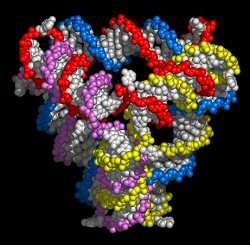
Physicists from the University of Oxford have designed the first structurally robust, self-assembling DNA building blocks. The DNA tetrahedra, 10,000,000,000 (ten thousand million) of which could fit on the head of a pin, could lead to the manufacture of complex nanostructures such as powerful electrical circuits.
Picture: Computer generated representation of a DNA tetrahedron.
DNA holds the genetic code in all living organisms, and it is this ability to store information which is the key to DNA’s usefulness as an engineering material. The DNA building blocks, designed by a team from Oxford’s Department of Physics and reported in the 9 December edition of Science, are made from four short strands of synthetic DNA. Each strand has three segments, and the structure of each segment carries a code which allows it to bind to one of the other strands. When the strands are heated in a salt solution to just below boiling point then rapidly cooled they bond together to form a tetrahedron. The researchers were then able to connect the tetrahedra using programmable “linkers” made of single strands of DNA.
‘Tetrahedra are used extensively in architecture and engineering because their structure is light, simple, but very strong, making them ideal for use in DNA nanostructures,’ said Professor Andrew Turberfield, who led the research team at Oxford. ‘Previous attempts at DNA nanostructures – in the shape of a cube and an octahedron – were very laborious and gave limited quantities. By contrast, our DNA tetrahedra can self-assemble in a single step in a matter of seconds, with a yield of up to 95 per cent.’
Colleagues at the Vrije Universiteit in Amsterdam were able to prove that the assembly of the DNA tetrahedra had worked by using an atomic force microscope (AFM). The AFM uses a very fine needle to probe the object, and then translates this information into a 3D image. As well as confirming that the DNA strands had indeed self-assembled to form tetrahedra with a height of seven nanometres, the researchers were able to test the strength of the structure. By applying pressure using the microscope’s needle they observed the tetrahedron flexing, demonstrating that the structures can withstand a relatively large force.
Professor Turberfield commented: ‘DNA is a wonderful material with which to build, with the potential to create complex self-assembling nanostructures with great precision. At its simplest, building with DNA is like building a Lego model by designing the bricks such that they can only fit together in one way – and then putting them in a bag and shaking it.
‘We have designed a family of DNA tetrahedra which are structurally stable and can be manufactured in a quick and simple step. Ultimately we hope to use them as a building material for nanofabrication, to act as templates for much more complex DNA nanostructures.’
As well as potential applications in the manufacture of nanostructures such as molecular electrical circuits, Professor Turberfield’s team are investigating using the DNA tetrahedra as containers for individual protein molecules: a technique which if successful could one day lead to new methods of drug delivery.
The research is part of the programme of the Bionanotechnology Interdisciplinary Research Collaboration (IRC), a collaboration that brings together scientists working at the interface between the physical and life sciences.
Source: University of Oxford


