Non-venomous Asian snakes 'borrow' defensive poison from toxic toads
January 30, 2007

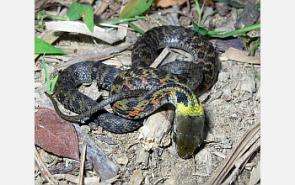
A Juvenile Rhabdophis tigrinus snake from Ishima, a Japanese island, curls in a defense posture. Credit: Old Dominion University, Alan Savitsky

Most snakes are born with poisonous bites they use for defense. But what can non-poisonous snakes do to ward off predators?

What if they could borrow a dose of poison by eating toxic toads, then recycling the toxins?

That's exactly what happens in the relationship between an Asian snake and a species of toad, according to a team of researchers funded by the National Science Foundation (NSF) Division of Integrative Organismal Systems (IOS).

Herpetologists Deborah Hutchinson, Alan Savitzky of Old Dominion University in Norfolk, Va., and colleagues published results of research on the snake's dependence on certain toads in this week's online issue of the journal Proceedings of the National Academy of Sciences.

Hutchinson studied the Asian snake Rhabdophis tigrinus and its relationship to a species of toxic toad it eats. In the PNAS paper, she and co-authors describe dietary sequestration of toxins by the snakes. The process allows the snakes to store toxins from the toads in their neck glands. When under attack, the snakes re-release the poisons from these neck glands.

Many invertebrates sequester dietary toxins for use in defense, including milkweed insects and sea slugs. But vertebrate examples of toxin sequestration, especially from vertebrate prey, are rare. "A snake that's dependent on a diet of toads for chemical defense is highly unusual," said Hutchinson.

Hutchinson said the research had identified six compounds in the snakes that may hold promise in medical treatments for people suffering from hypertension and related blood pressure disorders.

The researchers made their case by testing Rhabdophis tigrinus on several Japanese islands, one with a large population of the toxic toads and another with none, and compared them with snakes from the Japanese island of Honshu, where toads are few. The presence of toxins in the snakes' neck glands depended upon their access to the toads.

Snakes without the borrowed toxins were more likely to turn and flee from danger than to hold their ground and perform a toxin-releasing defensive maneuver.

"Sequestration of toxins in a specialized [neck gland] structure in a vertebrate is a remarkable finding," said William Zamer, IOS deputy director at NSF. "This finding offers new insights into the complex mechanisms underlying ecological relationships and will lead to important insights about fundamental biological questions."

Source: National Science Foundation


print this article email this article download pdf blog this article bookmark this article     Stumble it Digg this share on Facebook retweet share on Reddit add to delicious
Rate this story - 4.6 /5 (7 votes)


January 30, 2007 all stories

Comments: 0

4.6 /5 (7 votes)
  • Stumble this up

  • Digg this

  • share this

  • hide
  • Related Stories

  • The first gene-encoded amphibian toxin isolated
    created Aug 17, 2009 | popularity not rated yet | comments 0
  • Road losses add up, taxing amphibians and other animals
    created Apr 16, 2008 | popularity not rated yet | comments 0
  • Peptide discovered in scorpion venom may hold key to secretory diseases
    created Feb 14, 2008 | popularity not rated yet | comments 0
  • Snake venoms share similar ingredients
    created Dec 20, 2007 | popularity not rated yet | comments 0
  • Researchers Sometimes Encounter What They're Not Looking For
    created May 30, 2007 | popularity not rated yet | comments 0


Other News

Antarctic lake

Antarctic lake home to diverse community of viruses

Biology / Cell & Microbiology

created 8 hours ago | popularity 5 / 5 (6) | comments 0

(PhysOrg.com) -- A study of the genetic structure of viruses in an Antarctic lake has revealed an astonishing genetic richness in the large number of viral families discovered.


Can a plant be altruistic?

Biology / Plants & Animals

created 8 hours ago | popularity 5 / 5 (1) | comments 0

The concept of altruism has long been debated in philosophical circles, and more recently, evolutionary biologists have joined the debate. From the perspective of natural selection, altruism may have evolved because any ...


Gov't says brown pelicans are endangered no longer (AP)

Gov't says brown pelicans are endangered no longer

Biology / Ecology

created 2 hours ago | popularity not rated yet | comments 0

(AP) -- Much like its death-defying dives for fish, the brown pelican has resurfaced after plummeting to the brink of extinction.


Cornell releases predator beetle to battle hemlock pest

Cornell releases predator beetle to battle hemlock pest

Biology / Ecology

created 8 hours ago | popularity 5 / 5 (1) | comments 0

(PhysOrg.com) -- Cornell researchers released a well-studied beetle predator to test its ability to ward off a hemlock-killing aphid-like insect.


Warm-blooded dinosaurs worked up a sweat

Warm-blooded dinosaurs worked up a sweat

Biology / Plants & Animals

created 12 hours ago | popularity 5 / 5 (2) | comments 0

(PhysOrg.com) -- Were dinosaurs endothermic (warm-blooded) like present-day mammals and birds or ectothermic (cold-blooded) like present-day lizards? The implications of this simple-sounding question go beyond ...