January 31, 2007 feature
'Misdirected and unreasonable' acts of kindness can have significant consequences
There is a story about a guy who makes a point to be kind to his taxi driver, giving him a sincere thanks and a generous tip. The guy reasons that, if the taxi driver is then inspired to be kind to each of his passengers, which can be as many as 100 per day, and every passenger goes on to be nice to the next person they meet, who is then kind to another person, and so on, then the guy’s initial kindness could theoretically brighten the day of thousands of people in a big city.
It’s a nice scenario, but does it work? According to a recent study, no. It turns out that, by itself, this so-called “upstream reciprocity”—or helping someone other than the person who just helped you—is a weak chain where natural selection prefers to reduce cooperativity, and is therefore not a mechanism that facilitates a large-scale increase of cooperation.
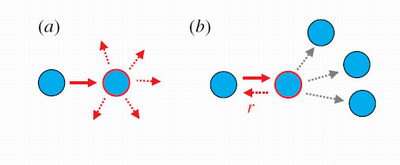
However, there’s another part to upstream reciprocity, say scientists Martin Nowak from Harvard and Sebastien Roch from Berkeley. Say that some people in the city know that when they do a favor for certain other people, they can expect a favor in return—this is what’s called “direct reciprocity.”
The receiver feels gratitude toward the giver, and gives back—and sometimes, he may give back in a second way—a “misdirected” and “unreasonable” urge may cause him to be kind to a third person, completely unrelated to the initial giver. Thus, upstream reciprocity appears as a “by-product” of direct reciprocity.
“Direct reciprocity allows the evolution of cooperation, and upstream reciprocity can hitch-hike on direct reciprocity,” Nowak and Roch found, explained in their paper from Proceedings of the Royal Society B. “The interpretation of this finding is: if there is direct reciprocity in a population, then upstream reciprocity will evolve too.”
Besides direct reciprocity, there is a second model that Nowak and Roch investigated where cooperators may benefit more from upstream reciprocity by forming clusters than in a random spatial orientation. When surrounded by others with an ability to reciprocate upstream, people who cooperate can pass on their altruism at a high enough rate to allow cooperation to evolve overall. Nowak and Roch call this interaction between upstream and spatial reciprocity “synergistic,” where each mechanism needs the other to succeed.
While in one sense giving back to someone other than the person who gave to you may appear misdirected and unreasonable, Nowak and Roch explain that there is a mechanism that prompts such behavior—something called “gratitude.” Defined as “the positive emotion one feels after receiving something of value,” gratitude likely makes an individual interested in the well-being of society as a whole. So it makes no difference which part of society (e.g. which person) receives his kindness.
Nowak and Roch speculate that still different situations and models will reveal enormous consequences of upstream reciprocity for human and animal behavior.
“[These extensions] can lead to an ‘epidemiology of altruism’ resulting in an explosive increase in altruistic acts,” they conclude. “For a change, this is a pandemic which would be welcomed by all of us.”
For more information, visit Nowak’s Web page, the Program for Evolutionary Dynamics at Harvard University: www.ped.fas.harvard.edu/ .
Citation: Nowak, Martin A., and Roch, Sebastien. “Upstream reciprocity and the evolution of gratitude.” Proc. R. Soc. B. doi:10.1098/rspb.2006.0125.
By Lisa Zyga, Copyright 2007 PhysOrg.com.
All rights reserved. This material may not be published, broadcast, rewritten or redistributed in whole or part without the express written permission of PhysOrg.com.


